Loading...
Andres de Santa Cruz vs Prayut Chan-o-cha
Andres de Santa Cruz leads by 12.4 pts · 2 figures compared
…
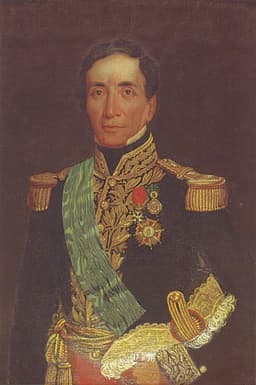
Andres de Santa Cruz
General · Modern
60.5Total
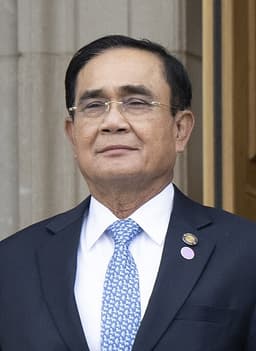
Prayut Chan-o-cha
General · Modern
48.1Total
Basic Information
Born
1792
1954
Died
1865
—
Era
Modern
Modern
Nationality
Bolivia
Thailand
Occupation
General
General
Civilization
Western
Eastern
Score Comparison
Military (10%)
67.5
10.2
Political (20%)
59.3
68.0
Influence (20%)
62.0
51.8
Legacy (20%)
50.0
40.8
Leadership (15%)
68.0
68.0
Strategy (15%)
66.3
35.7
TOTAL
60.5
48.1
Andres de Santa Cruz — Complete Timeline
1823 AD
Battle of ZepitaWar
Santa Cruz commanded Peruvian forces in a victory over Spanish royalists at Zepita during the Peruvian War of Independence. This battle enhanced his military reputation and contributed to the eventual liberation of Peru from Spanish rule.
Peruvian War of IndependenceBattleLiberation
Impact: regional
1826 AD
Presidency of PeruPolitical Action
Santa Cruz served as President of the Council of Government of Peru from 1826 to 1827, effectively ruling the country. His administration focused on centralizing power and organizing the state, but he was overthrown by a rebellion led by Agust
PresidencyPeruCentralization
Impact: national
1829 AD
Presidency of BoliviaPolitical Action◆ Major
Santa Cruz became President of Bolivia in 1829, serving until 1839. He implemented administrative reforms, stabilized the economy, and modernized the military, establishing Bolivia as a more coherent state after the chaos following independence.
PresidencyBoliviaReforms
Impact: nationalconstructive
1836 AD
War of the ConfederationWar◆ Major
Chile and Argentina declared war on the Peru-Bolivia Confederation, viewing it as a threat to the balance of power. Santa Cruz led the confederation's forces in a conflict that lasted until 1839, ultimately resulting in the confederation's defeat.
WarChileArgentinaConfederation
Impact: regional
Creation of the Peru-Bolivia ConfederationPolitical Action
Santa Cruz established the Peru-Bolivia Confederation, uniting Bolivia and Peru into a single state with himself as Supreme Protector. This confederation aimed to create a powerful Andean nation and challenged the regional influence of Chile and Argentina.
ConfederationUnificationAndean Power
Impact: regional
1839 AD
Battle of YungayWar
Santa Cruz's confederation forces were decisively defeated by the Chilean army at the Battle of Yungay. This defeat led to the dissolution of the Peru-Bolivia Confederation and forced Santa Cruz into exile, ending his political project.
BattleDefeatEnd of Confederation
Impact: regionaltragic
Exile and DeathPolitical Action
After the defeat at Yungay, Santa Cruz fled to Ecuador and later to France. He spent the rest of his life in exile, making unsuccessful attempts to return to power. He died in France in 1865, never regaining his former influence.
ExileDeathFailure
Impact: nationaltragic
Prayut Chan-o-cha — Complete Timeline
2014 AD
Led the 2014 military coupPolitical Action
General Prayut Chan-o-cha, as Army Commander-in-Chief, led a coup d'
CoupMilitaryThailand
Impact: nationaldestructive
Appointed Prime Minister by military legislaturePolitical Action◆ Major
Following the coup, Prayut was appointed Prime Minister by the military-controlled National Legislative Assembly. He assumed executive power, leading a government that promised reforms and national reconciliation.
AppointmentMilitary RuleThailand
Impact: national
2017 AD
Promulgation of the 2017 ConstitutionReform◆ Major
Prayut's government oversaw the drafting and approval of a new constitution that strengthened the military's political role and created a fully appointed Senate. The charter was criticized for entrenching military influence.
ConstitutionMilitaryThailand
Impact: national
2019 AD
Re-elected Prime Minister after 2019 electionPolitical Action◆ Major
Prayut was re-elected Prime Minister following a general election that was criticized for being manipulated to favor pro-military parties. He formed a coalition government, continuing his rule under a civilian facade.
ElectionContinuityThailand
Impact: national
Expert Analysis
Andres de Santa Cruz vs Prayut Chan-o-cha
# The General as Statesman: Andres de Santa Cruz and Prayut Chan-o-cha
On a dusty plain in northern Peru, in August 1823, a young Bolivian general named Andres de Santa Cruz watched his cavalry charge into Spanish lines at the Battle of Zepita. The victory was decisive, a moment of brilliance in the long struggle for independence. Nearly two centuries later, on a sweltering May night in Bangkok in 2014, another general, Prayut Chan-o-cha, sat in a military command center as his troops rolled tanks into the streets, seizing control of a nation in a bloodless coup. Both men were soldiers who became rulers. But their paths—and their legacies—could not have diverged more sharply. What drove one to build a nation and the other to fortify a system?
Origins
Andres de Santa Cruz was born in 1792 in La Paz, then part of the Spanish Viceroyalty of Peru. His father was a Spanish colonial official, his mother a Quechua noblewoman from the Inca aristocracy. This mixed heritage—European and indigenous—gave him a unique perspective. He grew up fluent in Spanish and Quechua, moving between two worlds. The era was one of revolution: across the Americas, Bolívar and San Martín were shattering Spanish rule. Santa Cruz joined the independence cause, and his military talent quickly emerged. He was shaped by the chaos of war and the dream of a unified Andean state.
Prayut Chan-o-cha was born in 1954 in Nakhon Ratchasima, Thailand, a country that had never been colonized. His father was a military officer, his mother a homemaker. He grew up in a kingdom where the military had long been the guardian of the throne and the constitution. The Cold War loomed large: Thailand was a frontline state against communism, and the army was the ultimate arbiter of stability. Prayut entered the Chulachomklao Royal Military Academy, rising through a system that rewarded loyalty and order. His era was one of coups and counter-coups—Thailand had seen a dozen since 1932.
Rise to Power
Santa Cruz rose through the crucible of war. After Zepita, he became a trusted commander under Simón Bolívar, serving as chief of staff at the Battle of Ayacucho in 1824, which sealed Peruvian independence. In 1826, he was appointed President of the Council of Government of Peru, effectively ruling the country. But his power was fragile; he was a foreigner in Peruvian politics. In 1829, he returned home to Bolivia and was elected president. There, he found his footing: a small, landlocked nation desperate for stability. Santa Cruz had the vision to see beyond borders.
Prayut’s rise was slower, more institutional. He became Army Commander-in-Chief in 2010, a position of immense influence. He had overseen the bloody crackdown on Red Shirt protesters that year, earning him the trust of the royalist establishment. When political paralysis gripped Thailand in 2013-2014—with mass protests against the elected government of Yingluck Shinawatra—Prayut stepped in. On May 22, 2014, he declared martial law, then a full coup. He presented himself not as an ambitious general, but as a reluctant savior. “I have to take power,” he said in a televised address. “To restore peace and order.”
Leadership & Governance
Santa Cruz’s tenure as President of Bolivia from 1829 to 1839 was a whirlwind of reform. He stabilized the economy by imposing tariffs and encouraging trade, reorganized the tax system, and codified laws. He promoted education, building schools and inviting European intellectuals. But his grandest ambition was the Peru-Bolivia Confederation, created in 1836. He united the two countries under a single government, with himself as Supreme Protector. It was a bold experiment in Andean unity—part Inca revival, part Napoleonic state-building. He believed that only a large, strong nation could resist the pressures of Argentina, Chile, and Peru’s own internal divisions.
Prayut governed differently. His 2017 Constitution was a masterpiece of military control: it gave the army sweeping powers over politics, created an unelected Senate, and weakened political parties. He ruled by decree and used lèse-majesté laws to silence dissent. His economic policies were cautious, favoring infrastructure and foreign investment, but growth remained modest. Unlike Santa Cruz, Prayut had no grand vision—only maintenance. He saw his role as a caretaker, a guardian against chaos. “We need to be strong,” he often said, “to protect the nation, the religion, and the monarchy.”
Triumph & Tragedy
Santa Cruz’s greatest moment was the creation of the Confederation. For three years, it flourished: trade boomed, stability reigned, and the Andean region seemed to have found its balance. But it was also his tragedy. Chile and Argentina viewed the Confederation as a threat to their own power. In 1836, Chile declared war. Santa Cruz was a skilled diplomat but a mediocre strategist. At the Battle of Yungay in 1839, his forces were crushed by the Chilean army. The Confederation dissolved. Santa Cruz fled to Ecuador, then to France, where he died in exile in 1865, still dreaming of his lost union.
Prayut’s triumph was survival. He stayed in power for nine years—longer than any Thai prime minister since the 1970s. He weathered elections, protests, and a pandemic. But his tragedy was the erosion of democracy. The 2019 election, which returned him to office, was widely criticized as rigged. Young Thais took to the streets, demanding reform. By 2023, his coalition began to fracture. He stepped down as prime minister, but the military’s grip on Thailand remained.
Character & Destiny
Santa Cruz was a dreamer and a builder. His mixed heritage gave him a sense of mission: to unite the Andes, to heal the wounds of conquest. But he was also arrogant, believing his vision could overcome geography and nationalism. He underestimated the resentment of Peruvians who saw him as a Bolivian interloper.
Prayut was a pragmatist and a survivor. He had no ideology beyond order. His personality—blunt, gruff, dismissive—reflected a soldier’s contempt for messy politics. He believed that democracy was a luxury Thailand could not afford. His destiny was to entrench a system, not to transform a nation.
Legacy
Santa Cruz is remembered as a visionary, a pioneer of Andean integration. Bolivia and Peru honor him with statues and streets. But his Confederation is a cautionary tale: a grand idea crushed by reality. His legacy is one of what might have been.
Prayut’s legacy is more ambiguous. He is praised by conservatives for restoring stability, but reviled by democrats for destroying freedoms. In Thailand, his name is tied to a constitution that still shackles democracy. He left no great reforms, only a fortified status quo.
Conclusion
Two generals, two centuries apart, both seized power in times of crisis. Santa Cruz tried to build a new world and failed; Prayut tried to preserve an old one and succeeded—at least for a time. The difference lies not in their uniforms, but in their dreams. Santa Cruz looked outward, to a continent waiting to be united. Prayut looked inward, to a country he feared would collapse without his grip. In the end, one left a legend; the other, a system. History judges both, but it remembers the dreamer longer.
Rankings
🥇
Andres de Santa CruzLeader
Mil: 67.5Pol: 59.3Inf: 62.0
60.5
🥈
Prayut Chan-o-cha
Mil: 10.2Pol: 68.0Inf: 51.8
48.1
+12.4 behind
How This Comparison Works
Algorithm
Each figure is scored on 6 dimensions (0—100 scale) based on structured historical data: Military (10%), Political (20%), Influence (20%), Legacy (20%), Leadership (15%), Strategy (15%). The weighted total produces the final ranking.
Data Sources
Scores are computed from structured sub-indicators in the database. Scale factors adjust for era (Ancient ×0.85, Modern ×1.0) and civilization size (Eastern ×1.05, Other ×0.80) to account for differences in population and military scale.
Maximum 3 Figures
Comparisons are limited to 2—3 figures to ensure readability and statistical meaningfulness.
Error Margins
±5 points per dimension — Sub-scores are derived from historical records with inherent uncertainty. Two figures within 5 points on a dimension should be considered roughly equivalent in that area.
Total Score Accuracy
±3 points overall — The weighted combination of 6 dimensions produces a total score with approximately ±3 points of uncertainty. Differences of less than 3 points are not statistically significant— the figures are effectively tied.
Known Limitations
- Historical records are incomplete and uneven across civilizations
- Figures from oral-tradition societies may be underrepresented
- Occupation labels can misclassify multi-role figures
- Scores measure capability and impact, not moral character
- Quantitative scoring is a comparison tool, not absolute truth
Capability Radar
Military (10%) — Battles & Warfare
Battles
60
5
Win Rate
55
5
Expansion
55
5
Political (20%) — Governance & Reform
Reform
65
30
Diplomacy
60
40
Economy
55
35
Influence (20%) — Cultural & Global Reach
Cultural
45
20
Global
35
20
Legacy (20%) — Historical Impact
Historical
50
20
Longevity
40
15
Leadership (15%) — Power & Stability
Tenure
60
60
Stability
40
25
Strategy (15%) — Tactics & Innovation
Strategy
65
15
Tactics
60
10
Reform
50
20
Similar Comparisons
Comments & Discussion
MACHETE MANDELA6/16/2026
Santa Cruz actually tried to forge a multinational federation—the Peru-Bolivia Confederation—that recognized indigenous rights and economic integration. Prayut’s entire legacy is preserving a Bangkok-centric military monarchy that’s crushed every reform movement since 2014. One man built a nation from chaos; the other just built a bigger bunker for the elites. There’s no comparison, only contrast.|
数据屠夫6/16/2026
把Santa Cruz和Prayut放一起比,根本是拿拿破仑比保安队长。Santa Cruz打赢Zepita时才31岁,还搞了跨国联邦,Prayut呢?最高战绩是2014年不流血政变,然后统治七年经济零增长。一个用马刀雕刻历史,一个用坦克挡住时间,别侮辱安第斯的鹰了。|
GLADIATOR OF GRAMMAR6/16/2026
The title “General as Statesman” is generous to Prayut. Santa Cruz authored constitutions, liberated slaves in fits and starts, and tried to unite Peru and Bolivia. Prayut authored a junta charter that gave the army a permanent senate veto. One man had a vision of a continental nation; the other has a vision of his own chair. History won’t blur that line.|
冷战遗老6/16/2026
两位都是将军治国,但Santa Cruz至少踩着西班牙帝国的废墟建了个跨安第斯联邦,虽然没撑过三年,但那是19世纪的大胆尝试。Prayut生在21世纪,政权靠政变驱动,宪法改了十几次,到头来就是军方养老金计划。说他们是同一类人?Santa Cruz会从坟墓里笑出声。|
AMPHIBIOUS HISTORIAN6/16/2026
Santa Cruz’s mother was a cacica—an Inca noble—and he used that legitimately to bridge indigenous and creole worlds. Prayut is a pure product of Thailand’s feudal military caste, with zero interest in bridging anything. One built a confederation that scared Chile and Argentina into war; the other scared nobody except unarmed protesters. Scale matters. Respect requires it.