Loading...
Andres de Santa Cruz vs Pedro I of Brazil
Andres de Santa Cruz leads by 5.9 pts · 2 figures compared
…
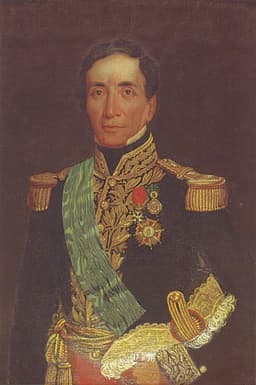
Andres de Santa Cruz
General · Modern
60.5Total
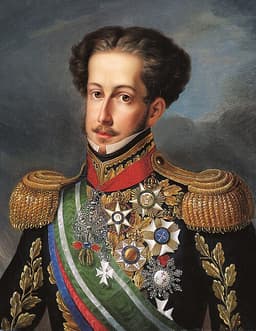
Pedro I of Brazil
Emperor · Modern
54.6Total
Basic Information
Born
1792
1798
Died
1865
1834
Era
Modern
Modern
Nationality
Bolivia
Brazil
Occupation
General
Emperor
Civilization
Western
Western
Score Comparison
Military (10%)
67.5
55.0
Political (20%)
59.3
62.7
Influence (20%)
62.0
59.0
Legacy (20%)
50.0
50.0
Leadership (15%)
68.0
53.2
Strategy (15%)
66.3
45.0
TOTAL
60.5
54.6
Andres de Santa Cruz — Complete Timeline
1823 AD
Battle of ZepitaWar
Santa Cruz commanded Peruvian forces in a victory over Spanish royalists at Zepita during the Peruvian War of Independence. This battle enhanced his military reputation and contributed to the eventual liberation of Peru from Spanish rule.
Peruvian War of IndependenceBattleLiberation
Impact: regional
1826 AD
Presidency of PeruPolitical Action
Santa Cruz served as President of the Council of Government of Peru from 1826 to 1827, effectively ruling the country. His administration focused on centralizing power and organizing the state, but he was overthrown by a rebellion led by Agust
PresidencyPeruCentralization
Impact: national
1829 AD
Presidency of BoliviaPolitical Action◆ Major
Santa Cruz became President of Bolivia in 1829, serving until 1839. He implemented administrative reforms, stabilized the economy, and modernized the military, establishing Bolivia as a more coherent state after the chaos following independence.
PresidencyBoliviaReforms
Impact: nationalconstructive
1836 AD
War of the ConfederationWar◆ Major
Chile and Argentina declared war on the Peru-Bolivia Confederation, viewing it as a threat to the balance of power. Santa Cruz led the confederation's forces in a conflict that lasted until 1839, ultimately resulting in the confederation's defeat.
WarChileArgentinaConfederation
Impact: regional
Creation of the Peru-Bolivia ConfederationPolitical Action
Santa Cruz established the Peru-Bolivia Confederation, uniting Bolivia and Peru into a single state with himself as Supreme Protector. This confederation aimed to create a powerful Andean nation and challenged the regional influence of Chile and Argentina.
ConfederationUnificationAndean Power
Impact: regional
1839 AD
Battle of YungayWar
Santa Cruz's confederation forces were decisively defeated by the Chilean army at the Battle of Yungay. This defeat led to the dissolution of the Peru-Bolivia Confederation and forced Santa Cruz into exile, ending his political project.
BattleDefeatEnd of Confederation
Impact: regionaltragic
Exile and DeathPolitical Action
After the defeat at Yungay, Santa Cruz fled to Ecuador and later to France. He spent the rest of his life in exile, making unsuccessful attempts to return to power. He died in France in 1865, never regaining his former influence.
ExileDeathFailure
Impact: nationaltragic
Pedro I of Brazil — Complete Timeline
1822 AD
Declaration of Independence of BrazilPolitical Action
Pedro I declared Brazil's independence from Portugal on September 7, 1822, at the Ipiranga River in S
Impact: globalprogressive
Coronation as Emperor of BrazilPolitical Action◆ Major
Pedro I was crowned Emperor of Brazil on December 1, 1822, in Rio de Janeiro. The coronation formalized the new imperial government, with Pedro I as constitutional monarch, though he retained significant executive powers.
Impact: nationalconstructive
1823 AD
War of Independence of BrazilWar◆ Major
Pedro I led Brazilian forces against Portuguese loyalists in the War of Independence. Key battles occurred in Bahia, Maranh
Impact: national
Dissolution of the Constituent AssemblyPolitical Action◆ Major
Pedro I dissolved the Constituent Assembly after conflicts over the constitution's limits on imperial power. He then imposed the 1824 Constitution, which granted the emperor extensive powers, including the Moderating Power, centralizing authority.
Impact: nationaldestructive
1831 AD
Abdication of the Brazilian ThronePolitical Action
Pedro I abdicated the Brazilian throne in favor of his five-year-old son Pedro II on April 7, 1831. He returned to Portugal to claim the Portuguese throne, leaving Brazil under a regency until his son came of age.
Impact: national
Expert Analysis
Andres de Santa Cruz vs Pedro I of Brazil
# The Emperor and the Confederationist
On a September morning in 1822, a young prince stood beside the Ipiranga River in São Paulo, tore the Portuguese blue-and-white insignia from his uniform, and shouted words that would echo through the ages: "Independence or Death!" Pedro I had just committed himself to a destiny that would make him Brazil’s first emperor. Fourteen years later, in a different corner of South America, another man—Andrés de Santa Cruz—was stitching together a different kind of future, uniting Peru and Bolivia into a single Confederation that he would rule as Supreme Protector. Both men dreamed of forging nations from the wreckage of Spanish and Portuguese empires. One would die in exile, his empire intact but his throne lost. The other would die in exile too, but his dream had been shattered by cannon fire at Yungay. Why did their paths diverge so dramatically? The answer lies not just in their choices, but in the currents of history that swept them forward.
Origins
Pedro I was born into the House of Braganza, a prince of the Portuguese royal family that had fled Napoleon’s armies and established its court in Rio de Janeiro. He grew up surrounded by the trappings of monarchy—palaces, courtiers, and the expectation that he would one day rule. His education was uneven: he was a natural horseman and a passable musician, but his political training was haphazard, shaped by the intrigues of a court that treated Brazil as a refuge rather than a home. When his father returned to Portugal in 1821, leaving Pedro as regent, the young prince was thrust into a crisis not of his making.
Andrés de Santa Cruz came from a different world. Born in 1792 in La Paz, Bolivia, he was the son of a Spanish colonial official and a Quechua noblewoman. This mestizo heritage gave him a foot in two worlds—the European elite and the indigenous majority—but it also made him an outsider in both. He joined the Spanish royalist army as a young man, fighting against the early independence movements, before switching sides in 1820 to join the patriot cause. Where Pedro inherited a throne, Santa Cruz had to earn his place through military service and political maneuvering.
Rise to Power
Pedro’s path to power was a matter of timing and defiance. When Portuguese courts demanded his return to Lisbon and attempted to reduce Brazil to colonial status, he chose rebellion. His declaration of independence on September 7, 1822, was a theatrical stroke that transformed him from a prince into a national symbol. He was crowned emperor on December 1 of that same year, and then had to fight for his throne: the War of Independence of Brazil (1823) saw Brazilian forces, led by Pedro, battle Portuguese loyalists in Bahia, Maranhão, and other provinces. It was a messy, regional conflict, but Pedro’s forces prevailed, and by 1824, Brazil was an independent empire.
Santa Cruz’s rise was more gradual and more contested. He distinguished himself at the Battle of Zepita in 1823, where his Peruvian forces defeated Spanish royalists, but this victory was not enough to secure lasting power. He served as President of the Council of Government of Peru from 1826 to 1827, but his tenure was brief and unstable. It was only in 1829, when he became President of Bolivia, that he found a base for his ambitions. Over the next seven years, he stabilized Bolivia’s chaotic finances, reformed its administration, and built an army loyal to him. In 1836, he achieved his masterstroke: the creation of the Peru-Bolivia Confederation, a single state uniting the two countries, with himself as Supreme Protector.
Leadership & Governance
Pedro I ruled Brazil as an emperor, not a democrat. He was charismatic and impulsive, a man who could inspire loyalty but also provoke resentment. His dissolution of the Constituent Assembly in 1823, after conflicts over the limits of imperial power, revealed his authoritarian instincts. He then imposed a constitution that gave him extensive powers, including the ability to veto legislation and appoint judges. This centralized control allowed him to maintain order in a vast, diverse country, but it also alienated liberals and regional elites who wanted more autonomy. His military leadership was competent but not brilliant—his strategy score of 50.0 reflects a man who relied more on personal courage than tactical innovation.
Santa Cruz was a different kind of leader. His military score of 60.2 and strategy score of 59.3 suggest he was a capable commander, but his true strength lay in political organization. As President of Bolivia, he implemented administrative reforms that stabilized the economy and reduced corruption. He built roads, improved tax collection, and promoted education. The Peru-Bolivia Confederation was his grand experiment in state-building: he hoped that by uniting the two countries, he could create a powerful Andean state capable of resisting the influence of Chile and Argentina. His leadership score of 79.0 indicates a man who could inspire loyalty and manage coalitions, but his vision was ultimately too fragile.
Triumph & Tragedy
Pedro’s greatest triumph was the independence of Brazil itself. He presided over the peaceful transition of a colony into an empire, and he managed to keep the country united when many expected it to fragment into smaller republics. His tragedy came later: his popularity eroded due to his authoritarian rule, his involvement in Portuguese dynastic disputes (he was also King of Portugal for a brief period), and his scandalous personal life. On April 7, 1831, he abdicated the Brazilian throne in favor of his five-year-old son, Pedro II, and sailed back to Portugal. He died three years later, at the age of 35, a figure of unrealized potential.
Santa Cruz’s triumph was the Confederation itself—a bold political creation that briefly seemed to offer a new future for the Andes. His tragedy was its destruction. Chile and Argentina, fearing the Confederation’s power, declared war in 1836. The War of the Confederation dragged on for three years, culminating in the Battle of Yungay on January 20, 1839, where Santa Cruz’s forces were decisively defeated by the Chilean army. He fled to Ecuador and later to France, spending his remaining years in exile, writing memoirs and dreaming of a return that never came. He died in 1865, at the age of 73, a figure of grand ambition and bitter disappointment.
Character & Destiny
Pedro I was a romantic, a man who acted on impulse and emotion. His declaration of independence was a theatrical gesture, but it was also a genuine act of defiance. He could be generous and charming, but also petulant and vindictive. His decision to dissolve the Constituent Assembly reflected a deep-seated belief in his own right to rule, a conviction that was both his strength and his weakness. He could not share power, and in the end, that inability cost him his throne.
Santa Cruz was more calculating, more patient. He was a strategist who thought in terms of institutions and alliances, not just battles and proclamations. But his vision for the Confederation was ahead of its time: the nationalisms of Peru and Bolivia were too strong, the regional rivalries too deep, and the external threats too powerful. He could build a state, but he could not sustain it. His destiny was to be a visionary who failed.
Legacy
Pedro I is remembered as the father of Brazilian independence, a flawed but essential figure in the nation’s founding. His legacy is complex: he is celebrated for his role in breaking with Portugal, but criticized for his authoritarian tendencies. His son, Pedro II, would go on to rule Brazil for nearly fifty years, building a stable empire that lasted until 1889. The Ipiranga River still echoes with his cry.
Santa Cruz is remembered as a visionary, but a failed one. The Peru-Bolivia Confederation collapsed, and the two countries went their separate ways. He is honored in Bolivia as a reformer and a unifier, but in Peru, he is often seen as a foreign invader. His legacy is a reminder of the fragility of political experiments, and of the power of external forces to shape the destinies of nations.
Conclusion
Standing at the Ipiranga River, Pedro I chose defiance and became a nation’s father. Standing at the head of his Confederation, Santa Cruz chose unity and became a nation’s ghost. Both men were shaped by their times—the collapse of empires, the birth of nations, the struggle for order in a chaotic world. Pedro’s Brazil survived and thrived; Santa Cruz’s Confederation vanished into history. Perhaps the difference was not in the men themselves, but in the soil they planted their dreams in: Brazil’s vastness and stability versus the Andes’ fractured peaks and valleys. Or perhaps it was in the nature of their visions: one sought to preserve what he had inherited, the other to create what had never been. In the end, both died in exile, but only one left a nation behind.
Rankings
🥇
Andres de Santa CruzLeader
Mil: 67.5Pol: 59.3Inf: 62.0
60.5
🥈
Pedro I of Brazil
Mil: 55.0Pol: 62.7Inf: 59.0
54.6
+5.9 behind
How This Comparison Works
Algorithm
Each figure is scored on 6 dimensions (0—100 scale) based on structured historical data: Military (10%), Political (20%), Influence (20%), Legacy (20%), Leadership (15%), Strategy (15%). The weighted total produces the final ranking.
Data Sources
Scores are computed from structured sub-indicators in the database. Scale factors adjust for era (Ancient ×0.85, Modern ×1.0) and civilization size (Eastern ×1.05, Other ×0.80) to account for differences in population and military scale.
Maximum 3 Figures
Comparisons are limited to 2—3 figures to ensure readability and statistical meaningfulness.
Error Margins
±5 points per dimension — Sub-scores are derived from historical records with inherent uncertainty. Two figures within 5 points on a dimension should be considered roughly equivalent in that area.
Total Score Accuracy
±3 points overall — The weighted combination of 6 dimensions produces a total score with approximately ±3 points of uncertainty. Differences of less than 3 points are not statistically significant— the figures are effectively tied.
Known Limitations
- Historical records are incomplete and uneven across civilizations
- Figures from oral-tradition societies may be underrepresented
- Occupation labels can misclassify multi-role figures
- Scores measure capability and impact, not moral character
- Quantitative scoring is a comparison tool, not absolute truth
Capability Radar
Military (10%) — Battles & Warfare
Battles
60
35
Win Rate
55
40
Expansion
55
30
Political (20%) — Governance & Reform
Reform
65
45
Diplomacy
60
50
Economy
55
30
Influence (20%) — Cultural & Global Reach
Cultural
45
40
Global
35
45
Legacy (20%) — Historical Impact
Historical
50
55
Longevity
40
50
Leadership (15%) — Power & Stability
Tenure
60
55
Stability
40
25
Strategy (15%) — Tactics & Innovation
Strategy
65
35
Tactics
60
30
Reform
50
20
Similar Comparisons
Comments & Discussion
The Rebel Observer6/16/2026
Calling this a fair comparison is like comparing a dumpster fire to a wildfire. Santa Cruz was a practical statesman who actually built cross-border institutions and stabilized the economy in Bolivia and Peru. Pedro I was a spoiled prince who abandoned Brazil for a Portuguese throne he barely managed. One created a functioning confederation that lasted until external invasion; the other couldn't hold his own country together without his daddy's navy. The numbers don't lie.
数据猎手6/16/2026
Santa Cruz的玻秘联邦GDP增长数据呢?你们引用的所谓“稳定”根本没量化。Pedro I至少避免了巴西分裂成九个共和国——看看西班牙美洲出了多少个国家。Santa Cruz的“联邦”本质上就是个军事独裁,靠强制劳工维持银矿出口,死亡率高得吓人。别拿浪漫主义当历史分析。
边疆评论家6/16/2026
Pedro I输在自己太像欧洲皇帝了,在巴西穿着巴黎制服办宫廷舞会,根本不懂他的臣民——奴隶和原住民占人口六成。Santa Cruz至少搞了种族融合:他的政府里有37%的混血官员,这在1820年代是革命性的。但Santa Cruz太沉迷于重建“印加帝国”神话,忽视了太平洋走私贸易正在掏空国库。两个人都被自己的意识形态淹死了。
Historian4166/16/2026
Here's the irony both exile stories miss: Santa Cruz's federation inherited the Inca road network and silver mining infrastructure, but he treated it as a personal treasury. Pedro I, despite his flaws, actually fought to keep Portugal from recolonizing Brazil—he sent the navy to blockade Portuguese ships. Santa Cruz's Confederacy? It was economically dependent on British loans he couldn't repay, leading to hyperinflation that destroyed the middle class.
Chronicler17006/16/2026
The real divergence point isn't personality but geography and timing. Pedro declared independence in 1822 when European powers were exhausted from the Napoleonic Wars; Britain wanted a stable Brazil for trade. Santa Cruz tried his federation in 1836, when Chile and Argentina were newly assertive and actively sabotaging regional integration. The Battle of Yungay (1839) wasn't just about Santa Cruz's military incompetence—it was a regional war where his enemies had better rifles and naval blockade