Loading...
Andres de Santa Cruz vs Nguyen Cao Ky
Andres de Santa Cruz leads by 11.5 pts · 2 figures compared
…
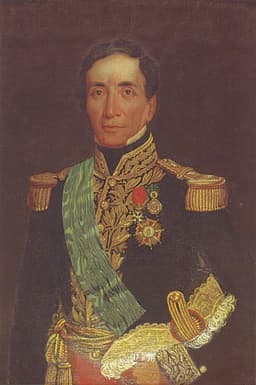
Andres de Santa Cruz
General · Modern
60.5Total
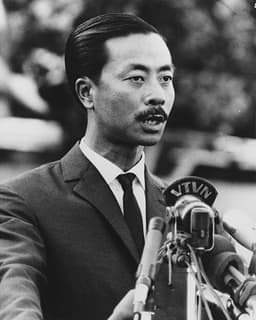
Nguyen Cao Ky
General · Modern
49.0Total
Basic Information
Born
1792
1930
Died
1865
—
Era
Modern
Modern
Nationality
Bolivia
Vietnam
Occupation
General
General
Civilization
Western
Eastern
Score Comparison
Military (10%)
67.5
45.0
Political (20%)
59.3
39.4
Influence (20%)
62.0
50.2
Legacy (20%)
50.0
40.0
Leadership (15%)
68.0
67.0
Strategy (15%)
66.3
60.0
TOTAL
60.5
49.0
Andres de Santa Cruz — Complete Timeline
1823 AD
Battle of ZepitaWar
Santa Cruz commanded Peruvian forces in a victory over Spanish royalists at Zepita during the Peruvian War of Independence. This battle enhanced his military reputation and contributed to the eventual liberation of Peru from Spanish rule.
Peruvian War of IndependenceBattleLiberation
Impact: regional
1826 AD
Presidency of PeruPolitical Action
Santa Cruz served as President of the Council of Government of Peru from 1826 to 1827, effectively ruling the country. His administration focused on centralizing power and organizing the state, but he was overthrown by a rebellion led by Agust
PresidencyPeruCentralization
Impact: national
1829 AD
Presidency of BoliviaPolitical Action◆ Major
Santa Cruz became President of Bolivia in 1829, serving until 1839. He implemented administrative reforms, stabilized the economy, and modernized the military, establishing Bolivia as a more coherent state after the chaos following independence.
PresidencyBoliviaReforms
Impact: nationalconstructive
1836 AD
War of the ConfederationWar◆ Major
Chile and Argentina declared war on the Peru-Bolivia Confederation, viewing it as a threat to the balance of power. Santa Cruz led the confederation's forces in a conflict that lasted until 1839, ultimately resulting in the confederation's defeat.
WarChileArgentinaConfederation
Impact: regional
Creation of the Peru-Bolivia ConfederationPolitical Action
Santa Cruz established the Peru-Bolivia Confederation, uniting Bolivia and Peru into a single state with himself as Supreme Protector. This confederation aimed to create a powerful Andean nation and challenged the regional influence of Chile and Argentina.
ConfederationUnificationAndean Power
Impact: regional
1839 AD
Battle of YungayWar
Santa Cruz's confederation forces were decisively defeated by the Chilean army at the Battle of Yungay. This defeat led to the dissolution of the Peru-Bolivia Confederation and forced Santa Cruz into exile, ending his political project.
BattleDefeatEnd of Confederation
Impact: regionaltragic
Exile and DeathPolitical Action
After the defeat at Yungay, Santa Cruz fled to Ecuador and later to France. He spent the rest of his life in exile, making unsuccessful attempts to return to power. He died in France in 1865, never regaining his former influence.
ExileDeathFailure
Impact: nationaltragic
Nguyen Cao Ky — Complete Timeline
1963 AD
Commander of South Vietnamese Air ForcePolitical Action◆ Major
Nguyen Cao Ky was appointed commander of the Republic of Vietnam Air Force. He led the air force during the Buddhist crisis and participated in the coup that overthrew President Ngo Dinh Diem.
Air ForceCoupDiem
Impact: national
1965 AD
Appointed Prime MinisterPolitical Action◆ Major
Nguyen Cao Ky became Prime Minister of South Vietnam, leading a military junta. His government intensified the war against the Viet Cong and North Vietnam, with strong US support.
Prime MinisterMilitary juntaVietnam War
Impact: national
1967 AD
Conflict with President ThieuPolitical Action
Nguyen Cao Ky ran for president but lost to Nguyen Van Thieu, becoming vice president. The two leaders had a tense relationship, with Ky later accusing Thieu of corruption and mismanagement of the war.
ElectionThieuRivalry
Impact: nationaldestructive
1975 AD
Exile after fall of SaigonPolitical Action◆ Major
Nguyen Cao Ky fled South Vietnam as Saigon fell to North Vietnamese forces. He settled in the United States, where he became a critic of the communist government and later returned to Vietnam for visits.
ExileFall of SaigonVietnam War
Impact: nationaltragic
Expert Analysis
Andres de Santa Cruz vs Nguyen Cao Ky
### The Dreamer and the Pilot
History is littered with men who tried to force a continent into a shape it would not hold. Andrés de Santa Cruz, the architect of a short-lived Andean superstate, and Nguyễn Cao Kỳ, the flamboyant air marshal who briefly ruled a collapsing South Vietnam, never met. Yet their stories echo each other across a century and a hemisphere. Both were generals who seized political power in fragile republics. Both saw their grand visions crushed by larger, more determined enemies. And both ended their days in exile, haunted by what might have been. What drove two men from such different worlds down such similar paths—and why did their dreams end in ashes?
### Origins
Santa Cruz was born in 1792 in La Paz, Bolivia, the son of a Spanish nobleman and an Indigenous mother. This mixed heritage would define his political imagination. He grew up in the twilight of the Spanish Empire, a world of rigid caste hierarchies and simmering colonial resentments. Educated in the classics and trained for the priesthood before choosing the sword, he absorbed the Enlightenment ideals of order and progress, yet never forgot the Indigenous roots of his mother’s people. His era was one of revolutionary upheaval, when South America was being carved into new nations by liberators like Simón Bolívar and José de San Martín. Santa Cruz watched, learned, and waited.
Nguyễn Cao Kỳ was born in 1930 in French Indochina, a world equally defined by empire, but one already in its death throes. His father was a minor civil servant; his family was staunchly anti-communist. Kỳ grew up under the shadow of the Japanese occupation and the First Indochina War. He chose the air force because it was modern, glamorous, and fast—a way to escape the grinding poverty of the countryside. While Santa Cruz’s world was carved by sabers and mules, Kỳ’s was shaped by jet fighters and American aid. Both men emerged from fractured societies, but Santa Cruz dreamed of uniting what had been broken; Kỳ dreamed of defending what remained.
### Rise to Power
Santa Cruz entered history on the battlefield. At the Battle of Zepita in 1823, he commanded Peruvian forces that defeated Spanish royalists, earning a reputation as a capable and cool-headed commander. But his true genius was political. In 1826, he became President of the Council of Government of Peru, effectively ruling the country. Three years later, he assumed the presidency of Bolivia. He did not simply hold power; he reformed it. He stabilized the currency, reorganized the treasury, and modernized the administration. By 1836, he felt ready for his masterstroke: the creation of the Peru-Bolivia Confederation, a single state uniting both nations under his protection as Supreme Protector.
Kỳ’s rise was faster, more chaotic, and more violent. In 1963, he was appointed commander of the South Vietnamese Air Force, a position that placed him at the heart of the Buddhist crisis and the coup that toppled President Diệm. Two years later, in 1965, he became Prime Minister of South Vietnam, the youngest man to hold that office. He flew his own fighter jet, wore a purple scarf, and carried a pearl-handled revolver. He was a symbol of the military junta’s determination to win the war, but also of its instability. Where Santa Cruz built his power through patient reform, Kỳ seized it with theatrical bravado.
### Leadership & Governance
Santa Cruz governed as a visionary technocrat. He believed that a strong, centralized state could overcome the fractious regionalism that plagued the Andes. He built roads, opened schools, and encouraged trade. His legal codes were models of clarity. He sought to balance the interests of the elite with the demands of the Indigenous majority, a delicate act that required constant negotiation. His military strategy was defensive and cautious; he understood that the Confederation’s greatest weakness was its geography—a long, vulnerable spine of mountains.
Kỳ governed as a wartime strongman. His priority was survival—his own, and his country’s. He intensified the war against the Viet Cong and North Vietnam, relying heavily on American airpower and advisors. He was ruthless with political opponents, but also pragmatic: he tried to reform the army and root out corruption, with limited success. His military strategy was aggressive, built on air mobility and quick strikes. But he lacked Santa Cruz’s patience. The Confederation had years to consolidate; Kỳ had months.
### Triumph & Tragedy
Santa Cruz’s greatest moment was the creation of the Confederation itself, a diplomatic and military achievement that stunned his contemporaries. For a few years, the Andes seemed to belong to him. But his tragedy came at the Battle of Yungay in 1839. There, the Chilean army, aided by Peruvian dissidents, shattered his forces. The Confederation dissolved overnight. Santa Cruz fled to Ecuador, then to France, where he spent the rest of his life writing memoirs and lobbying for a return that never came.
Kỳ’s triumph was more personal: he survived. He lost the 1967 presidential election to Nguyễn Văn Thiệu but became vice president, a tense partnership that lasted until the end. His tragedy was total: the fall of Saigon in 1975. He fled by helicopter, clutching his family, as the city he had tried to defend collapsed into chaos. In exile in the United States, he opened a liquor store and later wrote a memoir, trying to explain himself to a world that had moved on.
### Character & Destiny
Santa Cruz was a dreamer who believed in order. He was reserved, calculating, and stubborn. He never fully trusted his allies, and they never fully trusted him. His mixed heritage made him a symbol of unity, but also a target of suspicion. He was undone by the very forces he sought to overcome: the fierce nationalism of Chile, the regional rivalries of Peru, and the simple fact that the Andes are too vast for any one man to rule.
Kỳ was a gambler who believed in action. He was charismatic, impulsive, and vain. He loved the spotlight and the roar of jet engines. But he was also a realist who knew that South Vietnam was a creation of Cold War politics, not history. He fought not to build a new nation, but to prevent an old one from being erased. In the end, he was undone by the very forces that sustained him: American withdrawal, North Vietnamese determination, and the simple fact that a country cannot be saved by airpower alone.
### Legacy
Santa Cruz is remembered in Bolivia as a great reformer and a tragic figure. His portrait hangs in government buildings. Historians debate whether the Confederation could have survived if he had been more ruthless or more flexible. He is a cautionary tale about the limits of ambition.
Kỳ is remembered in Vietnam, if at all, as a relic of a failed era. In the West, he is a footnote in the larger story of the Vietnam War. His legacy is ambiguous: a patriot who fought for a lost cause, a strongman who could not hold power, a pilot who flew too close to the sun.
### Conclusion
Both men tried to defy the logic of their time. Santa Cruz dreamed of an Andean nation that history had already decided against; Kỳ fought for a South Vietnam that geography and ideology had already doomed. Their stories remind us that leadership is not just about vision or courage—it is about timing. The best general cannot win a war that the world has already decided to lose. The best reformer cannot build a state that the neighbors refuse to tolerate. In the end, Santa Cruz and Kỳ were not failures. They were men who saw a path that led nowhere, and walked it anyway.
Rankings
🥇
Andres de Santa CruzLeader
Mil: 67.5Pol: 59.3Inf: 62.0
60.5
🥈
Nguyen Cao Ky
Mil: 45.0Pol: 39.4Inf: 50.2
49.0
+11.5 behind
How This Comparison Works
Algorithm
Each figure is scored on 6 dimensions (0—100 scale) based on structured historical data: Military (10%), Political (20%), Influence (20%), Legacy (20%), Leadership (15%), Strategy (15%). The weighted total produces the final ranking.
Data Sources
Scores are computed from structured sub-indicators in the database. Scale factors adjust for era (Ancient ×0.85, Modern ×1.0) and civilization size (Eastern ×1.05, Other ×0.80) to account for differences in population and military scale.
Maximum 3 Figures
Comparisons are limited to 2—3 figures to ensure readability and statistical meaningfulness.
Error Margins
±5 points per dimension — Sub-scores are derived from historical records with inherent uncertainty. Two figures within 5 points on a dimension should be considered roughly equivalent in that area.
Total Score Accuracy
±3 points overall — The weighted combination of 6 dimensions produces a total score with approximately ±3 points of uncertainty. Differences of less than 3 points are not statistically significant— the figures are effectively tied.
Known Limitations
- Historical records are incomplete and uneven across civilizations
- Figures from oral-tradition societies may be underrepresented
- Occupation labels can misclassify multi-role figures
- Scores measure capability and impact, not moral character
- Quantitative scoring is a comparison tool, not absolute truth
Capability Radar
Military (10%) — Battles & Warfare
Battles
60
30
Win Rate
55
35
Expansion
55
10
Political (20%) — Governance & Reform
Reform
65
20
Diplomacy
60
25
Economy
55
15
Influence (20%) — Cultural & Global Reach
Cultural
45
15
Global
35
15
Legacy (20%) — Historical Impact
Historical
50
20
Longevity
40
10
Leadership (15%) — Power & Stability
Tenure
60
40
Stability
40
10
Strategy (15%) — Tactics & Innovation
Strategy
65
30
Tactics
60
40
Reform
50
25
Similar Comparisons
Comments & Discussion
EL CONDOR VOLADOR6/16/2026
The comparison misses the epic scale of Santa Cruz's vision versus Ky's desperation. Santa Cruz actually unified Peru and Bolivia for three years (1836-1839) with functioning infrastructure, while Ky was just a US puppet propped up for a decade. Call me when Ky tries to revive the Inca monetary system like Santa Cruz did with the peso feble. One built, one burned.
数据炼金术师6/16/2026
完全同意Ky只是个花哨的飞行员,但Santa Cruz的“伟大”只是殖民主义的变种。他的印欧混血身份被浪漫化了——实际上他镇压了原住民起义来维护精英利益。Ky至少是个诚实的战犯,不像Santa Cruz用启蒙话语粉饰剥削。别把合众国建造者和美国空军马戏团团长相提并论。
CENTURION OF THE PAST6/16/2026
You're ignoring the military asymmetry. Santa Cruz fought in the Battle of Yanacocha (1835) commanding indigenous troops who actually had skin in the game—they'd die for his Confederation. Ky's air force dropped napalm on his own people while drinking cognac in Saigon clubs. One was a revolutionary general, the other a gangster with a pilot's license. Facts don't care about your feelings.
折扇书生6/16/2026
从治国角度看,两人都是灾难。Santa Cruz的秘鲁-玻利维亚联帮只维持了三年就被智利打垮,Ky的南越政府更是被北越碾压。更讽刺的是,Santa Cruz死后被玻利维亚奉为国父,Ky却在加州开酒馆写回忆录。历史对失败者的审判标准如此不同:一个被当做失落的先知,另一个被当做过时的笑话。
REALIST REVISIONIST6/16/2026
Fine, but let's not pretend Santa Cruz was some tragic visionary. He personally ordered the execution of General Agustín Gamarra's supporters after the 1835 battle—that's not building, that's butchering. Ky at least admitted he was a dictator with swagger. Santa Cruz wrapped his tyranny in Inca revivalism while running a classic caudillo machine. Give me an honest pilot over a poetic butcher any day.