Loading...
Andres de Santa Cruz vs Julius Maada Bio
Andres de Santa Cruz leads by 9.3 pts · 2 figures compared
…
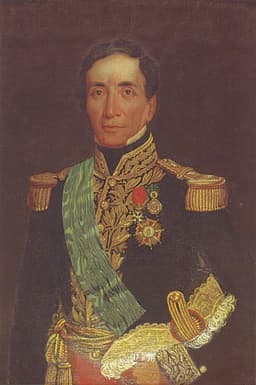
Andres de Santa Cruz
General · Modern
60.5Total
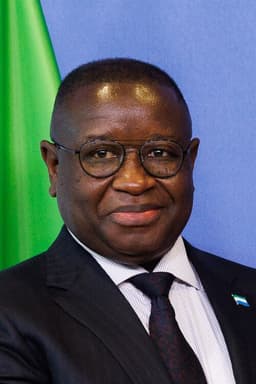
Julius Maada Bio
General · Modern
51.2Total
Basic Information
Born
1792
1964
Died
1865
—
Era
Modern
Modern
Nationality
Bolivia
Sierra Leone
Occupation
General
General
Civilization
Western
Other
Score Comparison
Military (10%)
67.5
50.0
Political (20%)
59.3
45.0
Influence (20%)
62.0
53.3
Legacy (20%)
50.0
45.0
Leadership (15%)
68.0
70.0
Strategy (15%)
66.3
43.7
TOTAL
60.5
51.2
Andres de Santa Cruz — Complete Timeline
1823 AD
Battle of ZepitaWar
Santa Cruz commanded Peruvian forces in a victory over Spanish royalists at Zepita during the Peruvian War of Independence. This battle enhanced his military reputation and contributed to the eventual liberation of Peru from Spanish rule.
Peruvian War of IndependenceBattleLiberation
Impact: regional
1826 AD
Presidency of PeruPolitical Action
Santa Cruz served as President of the Council of Government of Peru from 1826 to 1827, effectively ruling the country. His administration focused on centralizing power and organizing the state, but he was overthrown by a rebellion led by Agust
PresidencyPeruCentralization
Impact: national
1829 AD
Presidency of BoliviaPolitical Action◆ Major
Santa Cruz became President of Bolivia in 1829, serving until 1839. He implemented administrative reforms, stabilized the economy, and modernized the military, establishing Bolivia as a more coherent state after the chaos following independence.
PresidencyBoliviaReforms
Impact: nationalconstructive
1836 AD
War of the ConfederationWar◆ Major
Chile and Argentina declared war on the Peru-Bolivia Confederation, viewing it as a threat to the balance of power. Santa Cruz led the confederation's forces in a conflict that lasted until 1839, ultimately resulting in the confederation's defeat.
WarChileArgentinaConfederation
Impact: regional
Creation of the Peru-Bolivia ConfederationPolitical Action
Santa Cruz established the Peru-Bolivia Confederation, uniting Bolivia and Peru into a single state with himself as Supreme Protector. This confederation aimed to create a powerful Andean nation and challenged the regional influence of Chile and Argentina.
ConfederationUnificationAndean Power
Impact: regional
1839 AD
Battle of YungayWar
Santa Cruz's confederation forces were decisively defeated by the Chilean army at the Battle of Yungay. This defeat led to the dissolution of the Peru-Bolivia Confederation and forced Santa Cruz into exile, ending his political project.
BattleDefeatEnd of Confederation
Impact: regionaltragic
Exile and DeathPolitical Action
After the defeat at Yungay, Santa Cruz fled to Ecuador and later to France. He spent the rest of his life in exile, making unsuccessful attempts to return to power. He died in France in 1865, never regaining his former influence.
ExileDeathFailure
Impact: nationaltragic
Julius Maada Bio — Complete Timeline
1992 AD
1992 Sierra Leonean coup d'étatPolitical Action◆ Major
Julius Maada Bio was a member of the National Provisional Ruling Council (NPRC) that overthrew President Joseph Momoh in a military coup. Bio served as a key figure in the junta, which promised to end the civil war but faced criticism for human rights abuses.
CoupSierra LeoneCivil War
Impact: nationaldestructive
1996 AD
Brief tenure as head of statePolitical Action◆ Major
Bio led a palace coup within the NPRC in January 1996, becoming head of state. He oversaw the transition to civilian rule, handing over power to Ahmad Tejan Kabbah after elections in March 1996, a move that earned him praise for restoring democracy.
TransitionDemocracyCoup
Impact: nationalconstructive
2018 AD
Election as President of Sierra LeonePolitical Action◆ Major
Bio won the 2018 Sierra Leonean presidential election as the candidate of the Sierra Leone People's Party, defeating Samura Kamara in a runoff. His victory marked a return to power for the SLPP after a decade in opposition.
ElectionSierra LeonePresidency
Impact: nationalconstructive
2023 AD
Re-election amid economic challengesPolitical Action◆ Major
Bio was re-elected in 2023 with 56.6% of the vote, but the election was disputed by the opposition. His second term has been marked by economic difficulties, including high inflation and debt, as well as allegations of authoritarianism.
ElectionSierra LeoneEconomy
Impact: national
Expert Analysis
Andres de Santa Cruz vs Julius Maada Bio
### The Confederation Dreamer and the Democratic General
On a windswept battlefield in Peru in 1823, a young Andrés de Santa Cruz led his forces to victory against the last vestiges of Spanish rule, a triumph that seemed to herald a new era of unity for the fractured Andean republics. Exactly 173 years later, in a cramped office in Freetown, a young Julius Maada Bio, freshly seized power in a palace coup, made a decision that would define his legacy: he relinquished control, handing the government to civilians. One man dreamed of forging a mighty confederation; the other, of building a stable democracy. Their paths, separated by centuries and continents, ask a profound question: what makes a leader—the grand ambition of a visionary or the pragmatic humility of a democrat?
### Origins
Andrés de Santa Cruz was born in 1792 in La Paz, Bolivia, a child of the Spanish colonial elite. His father was a Spanish colonel, his mother a descendant of Inca nobility. This dual heritage shaped his worldview: he saw himself as a bridge between two worlds, capable of uniting the fractured nations of South America into a single, powerful state. The wars of independence had left the continent in chaos—new republics squabbling over borders, economies in shambles. Santa Cruz, educated in the military academies of the Spanish Empire, absorbed the Enlightenment ideals of order and progress, but also the harsh realities of power.
Julius Maada Bio, born in 1964 in a small village in Sierra Leone, inherited a different legacy. His country had been carved out by British colonialism, then abandoned to corruption and civil war. Bio grew up in a world of poverty and instability, where the state was a distant, often predatory force. He joined the military not out of ideological fervor, but as a path to survival and advancement. In the 1990s, Sierra Leone was a cauldron of violence—rebels with machetes, child soldiers, and a government that had all but collapsed. Bio’s origins were not of empire and ambition, but of survival and necessity.
### Rise to Power
Santa Cruz’s rise was meteoric. After the Battle of Zepita in 1823, he became a national hero in Peru, a symbol of the independence struggle. By 1826, he was effectively ruling Peru as President of the Council of Government, a position he used to consolidate power. But his ambition was larger than any single country. In 1829, he became President of Bolivia, and there he began to craft his masterpiece: the Peru-Bolivia Confederation. In 1836, he formally united the two nations under a single state, with himself as Supreme Protector. It was a bold, almost Napoleonic vision—a superstate that could rival Brazil and Argentina.
Bio’s rise was more chaotic. In 1992, he was a young officer in the National Provisional Ruling Council (NPRC), a group of soldiers who overthrew the corrupt President Joseph Momoh. The coup was welcomed by many Sierra Leoneans tired of dysfunction. But the NPRC soon fractured. In January 1996, Bio led a palace coup within the junta, becoming head of state. Unlike Santa Cruz, who seized power to build a union, Bio took power to dismantle military rule. He oversaw elections that year and handed over the presidency to Ahmad Tejan Kabbah, a civilian. It was an astonishing act for a man who had just become the most powerful person in the country.
### Leadership & Governance
Santa Cruz was a reformer in the mold of an enlightened despot. As President of Bolivia from 1829 to 1839, he stabilized the economy, reformed the tax system, and modernized the military. He built roads and schools, and his administration was known for its efficiency. But his crowning achievement—the Confederation—was his undoing. He ruled as Supreme Protector, a title that alarmed his neighbors. Chile and Argentina saw the Confederation as a threat to the balance of power, and in 1836 they declared war. Santa Cruz was a capable general, but his strategy was reactive. He fought a defensive war, never able to project power decisively.
Bio, by contrast, governed as a reluctant strongman. After his brief 1996 tenure, he spent two decades in the political wilderness, watching Sierra Leone descend into a brutal civil war. He returned as a civilian politician, winning the presidency in 2018 on a platform of education and anti-corruption. His style was cautious and consensus-driven, a stark contrast to the bold strokes of Santa Cruz. He focused on domestic stability, navigating a fragile economy and a deeply polarized society. His military background gave him authority, but his political wisdom lay in knowing when not to use it.
### Triumph & Tragedy
Santa Cruz’s greatest moment was the creation of the Confederation in 1836. For a brief, glorious moment, he had united two nations under one flag. But tragedy followed swiftly. At the Battle of Yungay in 1839, his forces were crushed by the Chilean army. The Confederation dissolved overnight. Santa Cruz fled to Ecuador, then to France, where he spent the rest of his life in exile, a broken visionary. He died in 1865, still dreaming of what might have been.
Bio’s triumph came in 2018, when he was elected president in a free and fair election—a remarkable comeback for a former coup leader. His re-election in 2023, though disputed by the opposition, was another milestone. But his tragedy is subtler: he governs a country still scarred by war, with endemic corruption and a youth population desperate for change. His democratic credentials are solid, but the challenges of governance are relentless.
### Character & Destiny
Santa Cruz was a man of grand visions, a strategic dreamer who believed he could reshape history. His personality was that of a builder, but also of a conqueror—he could not accept that others might fear his ambition. This hubris led to his downfall. He saw the Confederation as a gift to the continent, but his neighbors saw it as a threat. His destiny was shaped by the limits of his era: the post-independence chaos of South America was not ready for unity.
Bio’s character is that of a survivor and a pragmatist. He learned from the failure of military rule—his own and others’. He understood that power in a democracy is not about control, but about legitimacy. His destiny was shaped by the horrors of Sierra Leone’s civil war, which taught him that stability is more precious than glory. He chose to be a democrat because he had seen the alternative.
### Legacy
Santa Cruz is remembered as a visionary who failed. In Bolivia and Peru, he is a controversial figure—some see him as a unifier, others as a power-hungry autocrat. His legacy score of 68.9 reflects this ambiguity. He left behind no lasting state, only the memory of a dream.
Bio’s legacy is still being written. He is one of the few African coup leaders to voluntarily return power to civilians, and then win that power back through the ballot box. His score of 59.0 for legacy is modest, but it may grow if Sierra Leone continues its fragile democratic journey. He is a symbol of the possibility of redemption—a general who learned to serve, not rule.
### Conclusion
Santa Cruz and Bio stand at opposite ends of the spectrum of military leadership. One reached for the stars and fell; the other kept his feet on the ground and endured. Their stories remind us that history judges leaders not only by the size of their ambitions, but by the wisdom of their choices. Santa Cruz’s tragedy was that he could not see the limits of his power. Bio’s triumph is that he did. In the end, the greatest strength of a general may be the courage to lay down the sword.
Rankings
🥇
Andres de Santa CruzLeader
Mil: 67.5Pol: 59.3Inf: 62.0
60.5
🥈
Julius Maada Bio
Mil: 50.0Pol: 45.0Inf: 53.3
51.2
+9.3 behind
How This Comparison Works
Algorithm
Each figure is scored on 6 dimensions (0—100 scale) based on structured historical data: Military (10%), Political (20%), Influence (20%), Legacy (20%), Leadership (15%), Strategy (15%). The weighted total produces the final ranking.
Data Sources
Scores are computed from structured sub-indicators in the database. Scale factors adjust for era (Ancient ×0.85, Modern ×1.0) and civilization size (Eastern ×1.05, Other ×0.80) to account for differences in population and military scale.
Maximum 3 Figures
Comparisons are limited to 2—3 figures to ensure readability and statistical meaningfulness.
Error Margins
±5 points per dimension — Sub-scores are derived from historical records with inherent uncertainty. Two figures within 5 points on a dimension should be considered roughly equivalent in that area.
Total Score Accuracy
±3 points overall — The weighted combination of 6 dimensions produces a total score with approximately ±3 points of uncertainty. Differences of less than 3 points are not statistically significant— the figures are effectively tied.
Known Limitations
- Historical records are incomplete and uneven across civilizations
- Figures from oral-tradition societies may be underrepresented
- Occupation labels can misclassify multi-role figures
- Scores measure capability and impact, not moral character
- Quantitative scoring is a comparison tool, not absolute truth
Capability Radar
Military (10%) — Battles & Warfare
Battles
60
15
Win Rate
55
20
Expansion
55
5
Political (20%) — Governance & Reform
Reform
65
50
Diplomacy
60
55
Economy
55
45
Influence (20%) — Cultural & Global Reach
Cultural
45
30
Global
35
20
Legacy (20%) — Historical Impact
Historical
50
35
Longevity
40
25
Leadership (15%) — Power & Stability
Tenure
60
55
Stability
40
40
Strategy (15%) — Tactics & Innovation
Strategy
65
20
Tactics
60
25
Reform
50
10
Similar Comparisons
Comments & Discussion
战术舞者6/16/2026
历史总是偏爱"白纸上的英雄",但Santa Cruz不过是殖民末期的又一个"西班牙希望"——试图用旧帝国的框架解决新大陆的分裂。Maada Bio则更接近现代领袖:知道什么时候该交出权力。如果你认为统一比民主更重要,那你一定没在非洲看过军政府的模样。
千古一梦6/16/2026
Santa Cruz的意志与才能毫无疑问,但他的野心是典型的殖民精英思维——梦想用铁腕统一安第斯,却对印第安部落的自治诉求熟视无睹。Maada Bio至少明白,权力最终得还给人民。一个为帝国而战,一个为民主而退,高下立判。
迷路将军6/16/2026
别跟我说什么"辉煌梦想"——Santa Cruz的"统一"本质上就是军事强人的自我膨胀,他连智利都搞不定,更别提解决安第斯深层的民族矛盾。而Maada Bio,至少把枪放下来了。一个还在蹒跚学步的国家,最缺的不是拿破仑,而是愿意退位的人。
ScoreboardScholar6/16/2026
Let's talk numbers: The Peru-Bolivia Confederation under Santa Cruz lasted just three years, from 1836 to 1839. Maada Bio's civilian handover lasted? The 1996 elections he enabled led to a government that survived five years before another coup. Both projects failed, but one gave his people a genuine democratic test. That's worth more than any grand unification scheme.
RenaissanceReader6/16/2026
As a military historian, I see two men who understood the same lesson differently: position matters. Santa Cruz won battles but couldn't sustain a confederation because he ignored Chile's naval power—they literally blockaded his ports. Bio, however, read the room: after a brutal civil war, Sierra Leone needed healing, not another general in charge. The smartest strategic move isn't always conquest.
PharaohFile6/16/2026
Andres de Santa Cruz was the original "man who would be emperor" but lacked the pragmatism to make it stick. His Peru-Bolivia Confederation was a logistical nightmare, collapsing because he alienated local elites in both Lima and Buenos Aires. A confederation without buy-in is just a conquest waiting to be undone. Give me Maada Bio's humility any day.