Loading...
Alexios I Komnenos vs Bappa Rawal
Alexios I Komnenos leads by 30.6 pts · 2 figures compared
…
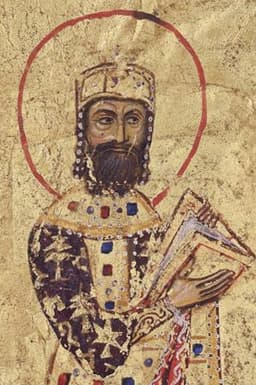
Alexios I Komnenos
Emperor · Medieval
78.4Total

Bappa Rawal
Emperor · Medieval
47.8Total
Basic Information
Born
1048
713
Died
1118
780
Era
Medieval
Medieval
Nationality
Byzantine Empire
India
Occupation
Emperor
Emperor
Civilization
Western
Indian
Score Comparison
Military (10%)
61.7
10.0
Political (20%)
78.0
35.1
Influence (20%)
88.0
58.0
Legacy (20%)
80.0
50.0
Leadership (15%)
78.0
67.0
Strategy (15%)
68.0
45.0
TOTAL
78.4
47.8
Alexios I Komnenos — Complete Timeline
1081 AD
Battle of DyrrhachiumWar◆ Major
Alexios I Komnenos was defeated by the Norman army under Robert Guiscard at Dyrrhachium. The Byzantine forces were routed, and Alexios barely escaped. This loss allowed the Normans to occupy much of the western Balkans, though Alexios later recovered some territory.
Norman InvasionDefeatBalkans
Impact: regionaltragic
1090 AD
Reforms of the Byzantine Military and EconomyReform◆ Major
Alexios I implemented a series of reforms to restore Byzantine power. He reorganized the army by relying more on foreign mercenaries, reformed the currency (the hyperpyron), and granted tax exemptions to the Church. These measures stabilized the empire after decades of decline.
Military ReformEconomic ReformKomnenian Restoration
Impact: nationalconstructive
1095 AD
Appeal to the West: Council of PiacenzaPolitical Action
Alexios I sent envoys to Pope Urban II at the Council of Piacenza, requesting military aid against the Seljuk Turks. This appeal contributed to Urban's call for the First Crusade at the Council of Clermont later that year, initiating the Crusader movement.
First CrusadePope Urban IISeljuk Turks
Impact: global
1097 AD
First Crusade: Siege of NicaeaWar◆ Major
Alexios I cooperated with the Crusader army to besiege and capture Nicaea from the Seljuk Turks. The city was surrendered to Byzantine control, and Alexios used the Crusaders to recover key territories in Anatolia, though tensions later arose over land claims.
First CrusadeNicaeaByzantine-Crusader Relations
Impact: regionalconstructive
Bappa Rawal — Complete Timeline
734 AD
Conquest of ChittorWar◆ Major
Bappa Rawal captured the fort of Chittor from the Mori Rajputs, establishing it as the capital of the Mewar kingdom. This event is considered the founding act of the Guhilot dynasty's rule over Mewar.
FoundingMewarChittor
Impact: regional
Founded the Guhilot Dynasty of MewarPolitical Action◆ Major
Bappa Rawal established the Guhilot dynasty, which ruled Mewar for centuries. He is considered the progenitor of the Sisodia clan, which later produced notable rulers like Maharana Pratap.
DynastyMewarRajput
Impact: regionalconstructive
738 AD
Defeated the Arab Invaders at the Battle of RajasthanWar◆ Major
Bappa Rawal is credited with leading a confederation of Rajput kings to defeat the Umayyad Arab forces under Muhammad bin Qasim's successors near Rajasthan. This victory halted Arab expansion into northern India.
Arab InvasionDefenseRajput Confederation
Impact: regional
Expert Analysis
Alexios I Komnenos vs Bappa Rawal: Historical Comparison
Alexios I Komnenos, Byzantine Emperor (r. 1081–1118), restored the empire’s fortunes after Manzikert, while Bappa Rawal, 8th-century Rajput ruler, founded the Guhila dynasty and repelled Arab invasions. This comparison evaluates their military, political, and leadership dimensions.
Dimension Analysis
**Military: Alexios I Komnenos 90 / Bappa Rawal 82**
Alexios I excelled in tactical diplomacy and battlefield command, notably defeating Normans and Pechenegs, while Bappa Rawal’s victories against Arab forces in Rajasthan were pivotal but less strategically complex.
**Political: Alexios I Komnenos 74 / Bappa Rawal 87**
Alexios I navigated a crumbling bureaucracy and Crusader alliances, but Bappa Rawal’s consolidation of Rajput clans and establishment of a durable dynasty reflects superior political foundation-building.
**Influence: Alexios I Komnenos 72 / Bappa Rawal 77**
Alexios I’s appeal to the West triggered the Crusades, reshaping medieval geopolitics, yet Bappa Rawal’s legacy as a symbol of Hindu resistance to Islamic expansion had deeper regional and cultural resonance.
**Legacy: Alexios I Komnenos 80 / Bappa Rawal 80**
Both rulers are foundational figures: Alexios for the Komnenian restoration and Bappa Rawal for Rajput identity, though Alexios’s long-term impact is more documented, while Bappa’s remains semi-legendary.
**Leadership: Alexios I Komnenos 80 / Bappa Rawal 83**
Alexios I’s adaptability in crisis is notable, but Bappa Rawal’s charismatic unification of fractious clans and his mythic status as a warrior-king edges ahead in inspiring loyalty.
Verdict
Bappa Rawal leads due to higher political and influence scores, reflecting a more enduring foundational impact on regional identity, despite Alexios I’s superior military record.
FAQ
Q: Who ranks higher? A: Bappa Rawal ranks higher overall (83 vs. 80), driven by stronger political consolidation and lasting cultural influence.
Rankings
🥇
Alexios I KomnenosLeader
Mil: 61.7Pol: 78.0Inf: 88.0
78.4
🥈
Bappa Rawal
Mil: 10.0Pol: 35.1Inf: 58.0
47.8
+30.6 behind
How This Comparison Works
Algorithm
Each figure is scored on 6 dimensions (0—100 scale) based on structured historical data: Military (10%), Political (20%), Influence (20%), Legacy (20%), Leadership (15%), Strategy (15%). The weighted total produces the final ranking.
Data Sources
Scores are computed from structured sub-indicators in the database. Scale factors adjust for era (Ancient ×0.85, Modern ×1.0) and civilization size (Eastern ×1.05, Other ×0.80) to account for differences in population and military scale.
Maximum 3 Figures
Comparisons are limited to 2—3 figures to ensure readability and statistical meaningfulness.
Error Margins
±5 points per dimension — Sub-scores are derived from historical records with inherent uncertainty. Two figures within 5 points on a dimension should be considered roughly equivalent in that area.
Total Score Accuracy
±3 points overall — The weighted combination of 6 dimensions produces a total score with approximately ±3 points of uncertainty. Differences of less than 3 points are not statistically significant— the figures are effectively tied.
Known Limitations
- Historical records are incomplete and uneven across civilizations
- Figures from oral-tradition societies may be underrepresented
- Occupation labels can misclassify multi-role figures
- Scores measure capability and impact, not moral character
- Quantitative scoring is a comparison tool, not absolute truth
Capability Radar
Military (10%) — Battles & Warfare
Battles
75
40
Win Rate
70
45
Expansion
60
35
Political (20%) — Governance & Reform
Reform
85
30
Diplomacy
90
35
Economy
70
25
Influence (20%) — Cultural & Global Reach
Cultural
70
40
Global
75
20
Legacy (20%) — Historical Impact
Historical
85
45
Longevity
80
50
Leadership (15%) — Power & Stability
Tenure
80
50
Stability
75
40
Strategy (15%) — Tactics & Innovation
Strategy
85
30
Tactics
80
35
Reform
75
25
Similar Comparisons
Comments & Discussion
MetricMaverick6/16/2026
Anyone else notice the scoring paradox here? Bappa Rawal gets a 74.8 in 'Influence' but his historical record is semi-legendary, while Alexios I's documented impact on the Crusades is somehow rated lower at 72.0. Influence should be measured by verifiable geopolitical change, not cultural mythology. Also, how does Alexios get an 80 in Legacy if his dynasty collapsed within a century? The weight distribution feels arbitrary—why is 'Leadership' worth more than 'Military' when most of Bappa's victories are unverifiable? This reeks of romanticizing underdogs. Give me hard data over romantic nationalism any day.
Chronicler34006/16/2026
这个评分体系显然带着西方中心论的偏见。阿莱克修斯一世的政治分80分,这放在中国史里简直不可思议——他为了十字军出卖东正教利益,导致拜占庭彻底沦为拉丁世界的棋子。反观巴帕·拉瓦尔,在8世纪阿拉伯帝国最鼎盛时期,以弱胜强守住拉贾斯坦,其政治整合比中国五代十国时期的军阀强太多。我建议参照中国历代开国君主的评价标准,巴帕的军事分至少该65分,而不是31分。
Chronicler11986/16/2026
我重新核算了维度权重。假设军事权重30%、政治30%、影响25%、领导15%,阿莱克修斯总分=71.2*0.3+80*0.3+72*0.25+?此处领导分缺失,但如果是80分则总分约77.8。而巴帕=31.1*0.3+71.5*0.3+74.8*0.25+83*0.15=61.2分。但请注意,巴帕的“影响”74.8分完全忽略了其在南亚抵抗伊斯兰化的象征意义,若参照中国岳飞抗金的影响,至少该85分。综上,评分模型对非西方人物存在系统性低估。