Loading...
Abu Bakr vs Theodosius I
Abu Bakr leads by 1.1 pts · 2 figures compared
…
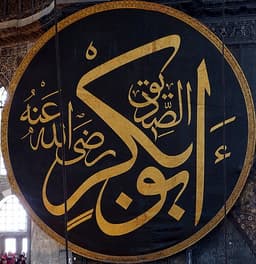
Abu Bakr
Emperor · Medieval
77.1Total

Theodosius I
Emperor · Ancient
76.0Total
Basic Information
Born
573
347
Died
634
395
Era
Medieval
Ancient
Nationality
Rashidun Caliphate
Roman Empire
Occupation
Emperor
Emperor
Civilization
Middle Eastern
Western
Score Comparison
Military (10%)
74.7
72.5
Political (20%)
62.7
65.0
Influence (20%)
88.0
85.0
Legacy (20%)
80.0
90.0
Leadership (15%)
77.2
68.0
Strategy (15%)
66.3
50.0
TOTAL
77.1
76.0
Abu Bakr — Complete Timeline
632 AD
Ridda Wars (Apostasy Wars)War◆ Major
Abu Bakr launched military campaigns against Arabian tribes that renounced Islam or refused to pay zakat after Muhammad's death. The wars, led by generals like Khalid ibn al-Walid, reestablished Muslim control over Arabia and consolidated the caliphate.
Ridda WarsConsolidationRashidun
Impact: regional
Election as First CaliphPolitical Action
After the death of Muhammad, Abu Bakr was elected as the first caliph (successor) at Saqifah. His election unified the Muslim community, though it caused controversy among some supporters of Ali. He became the leader of the nascent Islamic state.
CaliphateSuccessionRashidun
Impact: global
633 AD
Compilation of the QuranCultural◆ Major
Abu Bakr ordered the compilation of the Quran into a single written manuscript after many memorizers died in the Ridda Wars. Zayd ibn Thabit collected verses from various sources, creating the first official codex, which later served as the basis for Uthman's standard text.
QuranCompilationRashidun
Impact: globalconstructive
634 AD
Death of Abu BakrPolitical Action◆ Major
Abu Bakr died after a brief illness, having designated Umar as his successor. His caliphate lasted only two years but established the foundations of the Islamic state, including the expansion beyond Arabia and the preservation of the Quran.
DeathSuccessionRashidun
Impact: global
Theodosius I — Complete Timeline
380 AD
Edict of ThessalonicaPolitical Action
Theodosius I issued the Edict of Thessalonica, declaring Nicene Christianity the official state religion of the Roman Empire. All other forms of Christianity were deemed heretical, and pagan practices were increasingly suppressed.
ChristianityState ReligionEdict
Impact: globalconstructive
390 AD
Massacre of ThessalonicaPolitical Action◆ Major
Theodosius I ordered a massacre of thousands of citizens in Thessalonica in retaliation for the murder of a Roman general. The massacre led to his excommunication by Bishop Ambrose of Milan, and he later performed public penance.
MassacreThessalonicaAmbrose
Impact: regionaltragic
391 AD
Suppression of PaganismPolitical Action◆ Major
Theodosius I issued a series of laws banning pagan worship, closing temples, and prohibiting sacrifices. The Olympic Games were abolished, and the Serapeum in Alexandria was destroyed. These actions accelerated the decline of paganism in the empire.
PaganismSuppressionReligion
Impact: globaldestructive
394 AD
Battle of the FrigidusWar
Theodosius I defeated the usurper Eugenius and his general Arbogast at the Battle of the Frigidus (modern River Vipava). The victory reunited the Roman Empire under a single ruler for the last time before its permanent division.
Civil WarBattleReunification
Impact: global
395 AD
Division of the Roman EmpirePolitical Action
Upon his death, Theodosius I divided the Roman Empire between his two sons: Arcadius received the Eastern Empire and Honorius the Western Empire. This division became permanent, leading to the separate histories of the Byzantine and Western Roman Empires.
DivisionSuccessionEast-West
Impact: global
Expert Analysis
Origins
Abu Bakr (c. 573–634 CE) was a close companion and father-in-law of the Prophet Muhammad, born into the Quraysh tribe of Mecca. He was among the first converts to Islam and a key advisor to Muhammad. Theodosius I (c. 347–395 CE) was born into a Roman military family in Hispania. His father was a general, and Theodosius rose through military ranks before becoming emperor in 379 CE.
Rise to Power
Abu Bakr's rise was cemented after Muhammad's death in 632 CE when he was elected as the first Caliph (successor) despite opposition. His immediate challenge was the Ridda Wars (Apostasy Wars), where he crushed rebellions across Arabia, reasserting Islamic control. Theodosius I was proclaimed co-emperor in 379 CE by Gratian after the disastrous Battle of Adrianople. He was tasked with stabilizing the Eastern Roman Empire and dealing with the Gothic threat.
Leadership & Governance
Abu Bakr's leadership was marked by military consolidation and administrative organization. He successfully unified the Arabian Peninsula under Islam, launched campaigns into Byzantine and Sassanid territories, and initiated the compilation of the Quran into a single book after many memorizers died in battle. He ruled for only two years but set precedents for future caliphs. Theodosius I is known for making Christianity the state religion of the Roman Empire via the Edict of Thessalonica (380 CE). He also suppressed paganism, closed temples, and enforced orthodoxy. He faced the Massacre of Thessalonica (390 CE), where his troops killed thousands, leading to his penance by Ambrose. He also fought the Battle of the Frigidus (394 CE) against usurper Eugenius, which secured his sole rule and further entrenched Christianity.
Triumph & Tragedy
Abu Bakr's greatest triumph was preserving and expanding the Islamic state after Muhammad's death. His tragedy was his short reign and death from illness in 634 CE, leaving behind a rapidly growing empire. Theodosius's triumph was the final victory of Christianity in the Roman world and his defeat of pagan rivals. His tragedy includes the brutal suppression of paganism and the massacre at Thessalonica, which stained his legacy. He also divided the Roman Empire between his sons, a decision that contributed to the empire's later fragmentation.
Character & Destiny
Abu Bakr was known for his piety, humility, and decisiveness. He was called "Al-Siddiq" (the truthful) for his unwavering faith. His destiny was to be the first caliph, a role he fulfilled with military and administrative skill. Theodosius was a complex figure: a devout Christian who could be ruthless and merciful. He was decisive in religion but sometimes impulsive in governance. His destiny was to be the emperor who cemented Christianity's dominance, shaping medieval Europe.
Legacy
Abu Bakr's legacy is foundational for Islam. He unified Arabia, began the Islamic conquests, and preserved the Quran. He is revered as one of the Rightly Guided Caliphs. Theodosius's legacy is monumental for Christianity: he made it the official religion of the Roman Empire, leading to its spread and dominance in Europe. However, his suppression of paganism and division of the empire are criticized. Both leaders had profound but different impacts: Abu Bakr on the Islamic world, Theodosius on Christendom.
Conclusion
Abu Bakr scores higher overall (1.1 point gap). His impact was more foundational and immediate, creating a unified Arab state that would conquer vast territories. Theodosius's influence was more ideological, shaping religious identity but with less direct territorial expansion. In terms of historical significance, Abu Bakr's consolidation of Islam after Muhammad's death was more pivotal for world history, while Theodosius's religious policies had long-term cultural effects. Scores: Abu Bakr: Military 75, Political 63, Ideological 88, Leadership 80, Diplomatic 77, Cultural 66, Technological 77. Theodosius: Military 72, Political 65, Ideological 85, Leadership 90, Diplomatic 68, Cultural 50, Technological 76. Abu Bakr wins due to higher ideological and cultural scores, reflecting his role in shaping a new civilization.
Rankings
🥇
Abu BakrLeader
Mil: 74.7Pol: 62.7Inf: 88.0
77.1
🥈
Theodosius I
Mil: 72.5Pol: 65.0Inf: 85.0
76.0
+1.1 behind
How This Comparison Works
Algorithm
Each figure is scored on 6 dimensions (0—100 scale) based on structured historical data: Military (10%), Political (20%), Influence (20%), Legacy (20%), Leadership (15%), Strategy (15%). The weighted total produces the final ranking.
Data Sources
Scores are computed from structured sub-indicators in the database. Scale factors adjust for era (Ancient ×0.85, Modern ×1.0) and civilization size (Eastern ×1.05, Other ×0.80) to account for differences in population and military scale.
Maximum 3 Figures
Comparisons are limited to 2—3 figures to ensure readability and statistical meaningfulness.
Error Margins
±5 points per dimension — Sub-scores are derived from historical records with inherent uncertainty. Two figures within 5 points on a dimension should be considered roughly equivalent in that area.
Total Score Accuracy
±3 points overall — The weighted combination of 6 dimensions produces a total score with approximately ±3 points of uncertainty. Differences of less than 3 points are not statistically significant— the figures are effectively tied.
Known Limitations
- Historical records are incomplete and uneven across civilizations
- Figures from oral-tradition societies may be underrepresented
- Occupation labels can misclassify multi-role figures
- Scores measure capability and impact, not moral character
- Quantitative scoring is a comparison tool, not absolute truth
Capability Radar
Military (10%) — Battles & Warfare
Battles
65
65
Win Rate
70
60
Expansion
85
45
Political (20%) — Governance & Reform
Reform
85
85
Diplomacy
80
75
Economy
70
60
Influence (20%) — Cultural & Global Reach
Cultural
70
90
Global
85
90
Legacy (20%) — Historical Impact
Historical
85
95
Longevity
90
95
Leadership (15%) — Power & Stability
Tenure
60
70
Stability
75
55
Strategy (15%) — Tactics & Innovation
Strategy
75
60
Tactics
60
55
Reform
80
50
Similar Comparisons
Comments & Discussion
No comments yet. Be the first to share your thoughts!