Loading...
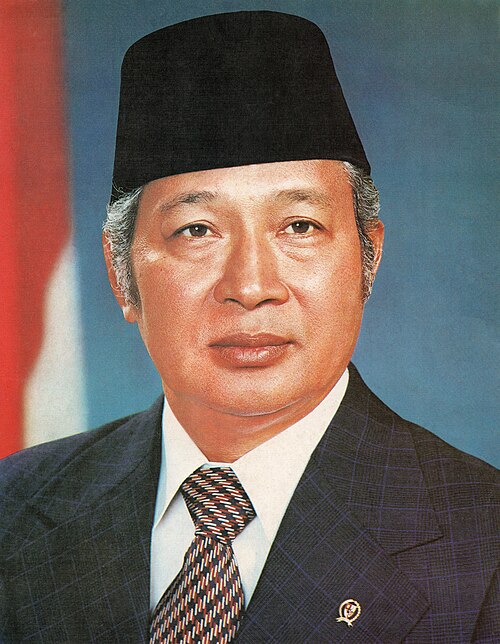
Suharto
ModernGeneralIndonesia1921 — ?
Second president of Indonesia who ruled for 31 years.
Compare Suharto with another historical figure:
Quick Facts
Born
1921
Country
Indonesia
Era
Modern
Occupation
General
Score Overview
Military (10%)20
Political (20%)59
Influence (20%)60
Legacy (20%)52
Leadership (15%)82
Strategy (15%)60
Total Score57.2
Suharto — Complete Timeline
1966 AD
Supersemar and Transfer of PowerPolitical Action
President Sukarno signed the Supersemar order, delegating authority to General Suharto to restore order after the 30 September Movement. Suharto used this to ban the Communist Party, purge leftists, and gradually assume executive power, effectively beginning his New Order regime.
SupersemarNew OrderIndonesia
Impact: nationaldestructive
1967 AD
New Order Economic DevelopmentReform◆ Major
Suharto implemented the New Order's economic policies, focusing on foreign investment, agricultural self-sufficiency, and industrialization. The government achieved high growth rates, reduced poverty, and stabilized the economy, but also fostered crony capitalism and corruption.
Economic GrowthDevelopmentIndonesia
Impact: nationalconstructive
1975 AD
Invasion of East TimorWar◆ Major
Suharto ordered the invasion of East Timor after Portugal withdrew. Indonesian forces occupied the territory, leading to a 24-year occupation marked by widespread human rights abuses, including massacres and forced displacement, resulting in an estimated 100,000-200,000 deaths.
East TimorOccupationHuman Rights
Impact: regionaldestructive
1998 AD
Asian Financial Crisis and Fall from PowerPolitical Action
The Asian Financial Crisis devastated Indonesia's economy, leading to massive unemployment and food shortages. Widespread protests and riots forced Suharto to resign in May 1998 after 31 years in power, ending his authoritarian rule and ushering in the Reformasi era.
Financial CrisisResignationReformasi
Impact: nationaltragic
Detailed Scores
▶View all detailed scores
Military
Strategy
7
Tactics
7
Battles
7
Army Scale
7
War Impact
7
Political
Governance
8
Reform
8
Stability
8
Policy
8
Power
9
Influence
History
9
Global
8
Culture
9
Ideology
9
Legacy
9
People often compare with
See how Suharto stacks up against other historical figures
Popular Comparisons
Suharto vs Tokugawa Ieyasu
vs Tokugawa Ieyasu82
Suharto vs Arthur Wellesley
vs Arthur Wellesley72
Suharto vs Oliver Cromwell
vs Oliver Cromwell72
Suharto vs Napoleon Bonaparte
vs Napoleon Bonaparte71
Suharto vs Shaka Zulu
vs Shaka Zulu70
Suharto vs Yitzhak Rabin
vs Yitzhak Rabin66