Loading...
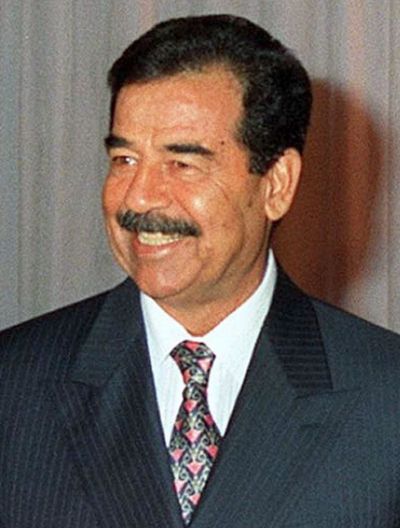
Saddam Hussein
ModernPoliticianIraq1937 — ?
President of Iraq known for the Iran-Iraq War and Gulf Wars.
Compare Saddam Hussein with another historical figure:
Quick Facts
Born
1937
Country
Iraq
Era
Modern
Occupation
Politician
Score Overview
Military (10%)53
Political (20%)44
Influence (20%)58
Legacy (20%)48
Leadership (15%)40
Strategy (15%)55
Total Score49.7
Saddam Hussein — Complete Timeline
1979 AD
Became President of IraqPolitical Action
Saddam Hussein forced President Ahmed Hassan al-Bakr to resign on July 16, 1979, and assumed the presidency. He immediately purged the Ba'ath Party, executing 68 senior members in a televised purge. This consolidated his absolute control over Iraq's government and security apparatus.
Power ConsolidationPurgeBa'ath Party
Impact: nationaldestructive
1980 AD
Invaded IranWar
Saddam launched a full-scale invasion of Iran on September 22, 1980, aiming to seize the oil-rich Khuzestan province and overthrow the new Islamic regime. The war lasted eight years, resulting in hundreds of thousands of casualties and massive economic destruction for both countries, ending in a stalemate.
Iran-Iraq WarInvasionStalemate
Impact: regionaldestructive
1988 AD
Used chemical weapons against Kurds at HalabjaWar◆ Major
During the Anfal campaign, Iraqi forces under Saddam's orders attacked the Kurdish town of Halabja with mustard gas and nerve agents on March 16, 1988. An estimated 5,000 civilians were killed instantly. The attack is considered one of the worst chemical weapons attacks against a civilian population.
Chemical WeaponsWar CrimeKurds
Impact: nationaldestructive
1990 AD
Invaded KuwaitWar
Saddam ordered the invasion and annexation of Kuwait on August 2, 1990, claiming it was historically part of Iraq. The invasion was condemned internationally and led to the Gulf War. A US-led coalition expelled Iraqi forces in February 1991, and Iraq faced severe UN sanctions.
Gulf WarInvasionSanctions
Impact: globaldestructive
2003 AD
Captured by US forces and executedPolitical Action
After the US-led invasion of Iraq in March 2003, Saddam went into hiding. He was captured by US forces on December 13, 2003, near Tikrit. Tried by the Iraqi Special Tribunal for crimes against humanity, he was sentenced to death and executed by hanging on December 30, 2006.
CaptureTrialExecution
Impact: globaltragic
Detailed Scores
▶View all detailed scores
Military
Strategy
7
Tactics
7
Battles
7
Army Scale
6
War Impact
7
Political
Governance
7
Reform
7
Stability
7
Policy
7
Power
8
Influence
History
9
Global
8
Culture
9
Ideology
9
Legacy
9
People often compare with
See how Saddam Hussein stacks up against other historical figures
Popular Comparisons
Saddam Hussein vs Mustafa Kemal Ataturk
vs Mustafa Kemal Ataturk80
Saddam Hussein vs Ito Hirobumi
vs Ito Hirobumi74
Saddam Hussein vs Midhat Pasha
vs Midhat Pasha64
Saddam Hussein vs Chiang Kai-shek
vs Chiang Kai-shek61
Saddam Hussein vs Yuan Shikai
vs Yuan Shikai60
Saddam Hussein vs Leopold Sedar Senghor
vs Leopold Sedar Senghor58