Loading...
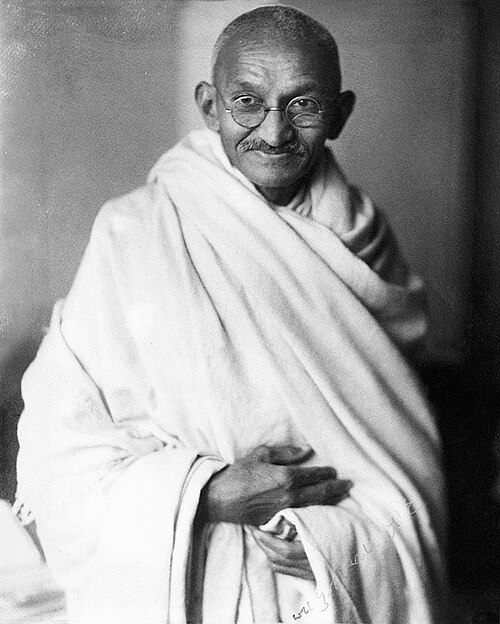
Mahatma Gandhi
ModernPoliticianIndia1869 — 1948
印度民族解放运动领袖。倡导非暴力不合作运动,领导印度走向独立。被称为圣雄。
Compare Mahatma Gandhi with another historical figure:
Quick Facts
Born
1869
Died
1948
Country
India
Era
Modern
Occupation
Politician
Score Overview
Military (10%)42
Political (20%)65
Influence (20%)80
Legacy (20%)75
Leadership (15%)70
Strategy (15%)55
Total Score68.7
Mahatma Gandhi — Complete Timeline
1917 AD
Champaran SatyagrahaPolitical Action
Gandhi led his first nonviolent protest in India, supporting indigo farmers in Champaran, Bihar, against exploitative British planters. He organized a campaign of civil disobedience and negotiations, resulting in the abolition of the oppressive tinkathia system.
Civil disobedienceFarmers' rightsBritish Raj
Impact: nationalprogressive
1919 AD
Jallianwala Bagh massacre aftermathPolitical Action◆ Major
After British troops killed hundreds of unarmed civilians in Amritsar, Gandhi organized a nationwide hartal (strike) and nonviolent protests. He returned his medals and launched the Rowlatt Satyagraha, marking a shift from cooperation to non-cooperation with British rule.
ProtestBritish RajMassacre
Impact: nationaltragic
1930 AD
Salt MarchPolitical Action
Gandhi led a 240-mile march from Sabarmati to Dandi, Gujarat, to defy the British salt monopoly. Thousands joined him, making salt from seawater. This act of civil disobedience sparked mass protests across India and drew global attention to the independence movement.
Civil disobedienceSalt taxIndependence movement
Impact: globalprogressive
1942 AD
Quit India Movement launchPolitical Action◆ Major
Gandhi launched the Quit India Movement, calling for an end to British rule with the slogan 'Do or Die'. The British arrested him and other leaders, but the movement led to widespread protests and repression, accelerating the end of colonial rule.
IndependenceCivil disobedienceBritish Raj
Impact: nationalprogressive
1948 AD
AssassinationPolitical Action
Gandhi was shot and killed by Nathuram Godse, a Hindu nationalist, during a prayer meeting in New Delhi. His assassination shocked the world and led to a wave of grief and violence, but also reinforced his legacy as a martyr for nonviolence.
AssassinationMartyrdomNonviolence
Impact: globaltragic
Detailed Scores
▶View all detailed scores
Military
Strategy
2
Tactics
2
Battles
2
Army Scale
2
War Impact
2
Political
Governance
7
Reform
7
Stability
7
Policy
7
Power
7
Influence
History
9
Global
9
Culture
9
Ideology
9
Legacy
9
People often compare with
See how Mahatma Gandhi stacks up against other historical figures
Popular Comparisons
Mahatma Gandhi vs Mao Zedong
vs Mao Zedong79
Mahatma Gandhi vs Abraham Lincoln
vs Abraham Lincoln78
Mahatma Gandhi vs George Washington
vs George Washington77
Mahatma Gandhi vs Winston Churchill
vs Winston Churchill72
Mahatma Gandhi vs Franklin D. Roosevelt
vs Franklin D. Roosevelt71
Mahatma Gandhi vs Joseph Stalin
vs Joseph Stalin69