Loading...
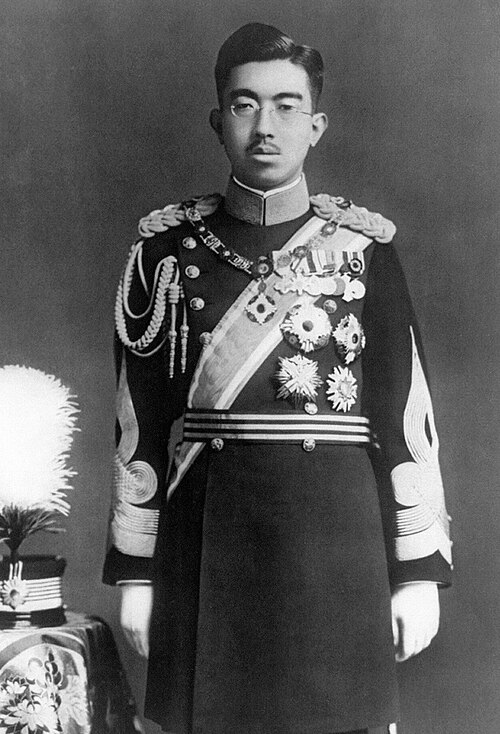
Hirohito
ModernEmperorJapan1901 — 1989
Emperor of Japan during WWII and its postwar transformation.
Compare Hirohito with another historical figure:
Quick Facts
Born
1901
Died
1989
Country
Japan
Era
Modern
Occupation
Emperor
Score Overview
Military (10%)51
Political (20%)60
Influence (20%)55
Legacy (20%)55
Leadership (15%)72
Strategy (15%)56
Total Score58.0
Hirohito — Complete Timeline
1926 AD
Accession to the ThronePolitical Action◆ Major
Hirohito became Emperor of Japan upon the death of his father, Emperor Taisho. His reign was designated the Showa era. As emperor, he held a symbolic and constitutional role, but his actual political power was limited by the Meiji Constitution.
Japanese MonarchyShowa EraSuccession
Impact: national
1931 AD
Japanese Invasion of ManchuriaWar◆ Major
The Japanese Kwantung Army invaded Manchuria without explicit approval from the civilian government. Hirohito's role in the invasion is debated, but he was informed and did not oppose it. The invasion led to the establishment of the puppet state of Manchukuo and increased militarism in Japan.
World War IIJapanese ExpansionManchuria
Impact: regionaldestructive
1945 AD
Decision to Surrender in World War IIPolitical Action
After the atomic bombings of Hiroshima and Nagasaki and the Soviet invasion of Manchuria, Hirohito intervened in a deadlocked cabinet to accept the Potsdam Declaration. He made a radio broadcast announcing Japan's surrender, the first time the Japanese people heard his voice. This ended World War II.
World War IISurrenderAtomic Bomb
Impact: global
1946 AD
Renunciation of DivinityCultural◆ Major
Under pressure from the Allied occupation, Hirohito issued the Humanity Declaration, in which he denied the traditional claim that the Japanese emperor was a living god. This was a key step in the transformation of Japan into a constitutional monarchy with a symbolic emperor.
Post-War JapanConstitutional MonarchyOccupation
Impact: nationalconstructive
1947 AD
Post-War Reign and Symbolic RolePolitical Action◆ Major
Under the new Japanese Constitution, Hirohito became a symbol of the state with no political power. He focused on ceremonial duties and public appearances, helping to stabilize Japan during its post-war reconstruction. He reigned until his death in 1989, overseeing Japan's economic recovery.
Post-War JapanConstitutional MonarchyReconstruction
Impact: nationalconstructive
Detailed Scores
▶View all detailed scores
Military
Strategy
7
Tactics
7
Battles
7
Army Scale
6
War Impact
7
Political
Governance
7
Reform
7
Stability
7
Policy
8
Power
8
Influence
History
9
Global
8
Culture
9
Ideology
9
Legacy
8
People often compare with
See how Hirohito stacks up against other historical figures
Popular Comparisons
Hirohito vs King Hussein of Jordan
vs King Hussein of Jordan61
Hirohito vs King Faisal of Saudi Arabia
vs King Faisal of Saudi Arabia59
Hirohito vs Mahendra
vs Mahendra58
Hirohito vs Osei Kwadwo
vs Osei Kwadwo56
Hirohito vs Charles Frederick of Baden
vs Charles Frederick of Baden53
Hirohito vs Kigeli III Ndabarasa
vs Kigeli III Ndabarasa48