Loading...
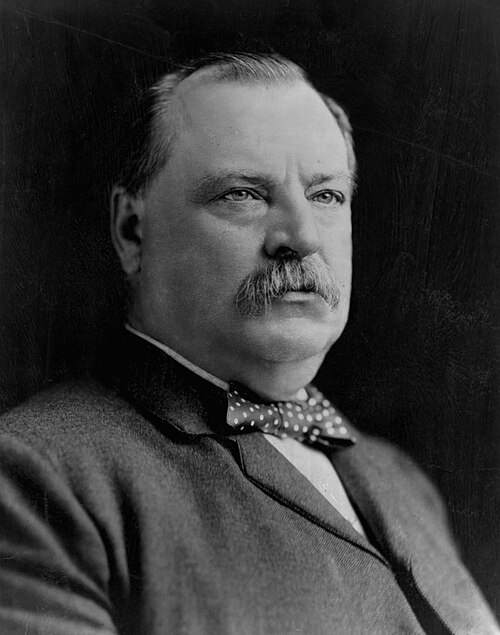
Grover Cleveland
ModernPoliticianUnited States1837 — 1908
Only president to serve two non-consecutive terms.
Compare Grover Cleveland with another historical figure:
Quick Facts
Born
1837
Died
1908
Country
United States
Era
Modern
Occupation
Politician
Score Overview
Military (10%)50
Political (20%)45
Influence (20%)55
Legacy (20%)48
Leadership (15%)80
Strategy (15%)42
Total Score53.7
Grover Cleveland — Complete Timeline
1884 AD
Election as President of the United States (First Term)Political Action◆ Major
Cleveland, a Democrat, won the 1884 presidential election against Republican James G. Blaine. The campaign was marked by personal attacks, but Cleveland's reputation as a reformer helped him win a narrow victory.
Presidential ElectionDemocratic Party
Impact: national
1887 AD
Signing of the Interstate Commerce ActReform◆ Major
Cleveland signed the Interstate Commerce Act, which created the Interstate Commerce Commission (ICC) to regulate railroad rates and practices. This was the first federal agency to regulate private industry, marking a significant expansion of federal power over commerce.
Railroad RegulationFederal Regulation
Impact: nationalconstructive
1892 AD
Election as President of the United States (Second Term)Political Action◆ Major
Cleveland won the 1892 presidential election against incumbent Benjamin Harrison, becoming the only president to serve two non-consecutive terms. His victory was a repudiation of the McKinley Tariff and Republican economic policies.
Presidential ElectionNon-Consecutive Terms
Impact: national
1894 AD
Intervention in the Pullman StrikePolitical Action◆ Major
Cleveland ordered federal troops to break the Pullman Strike, a nationwide railroad strike led by Eugene V. Debs. The intervention was controversial, as it used federal power to suppress labor unrest, and led to Debs' imprisonment.
Labor StrikeFederal Intervention
Impact: nationaldestructive
Detailed Scores
▶View all detailed scores
Military
Strategy
6
Tactics
5
Battles
6
Army Scale
5
War Impact
6
Political
Governance
7
Reform
7
Stability
7
Policy
7
Power
8
Influence
History
9
Global
8
Culture
8
Ideology
9
Legacy
8
People often compare with
See how Grover Cleveland stacks up against other historical figures
Popular Comparisons
Grover Cleveland vs Yuan Shikai
vs Yuan Shikai60
Grover Cleveland vs Peter Fraser
vs Peter Fraser58
Grover Cleveland vs Mulayam Singh Yadav
vs Mulayam Singh Yadav58
Grover Cleveland vs Le Duan
vs Le Duan55
Grover Cleveland vs Martin Van Buren
vs Martin Van Buren54
Grover Cleveland vs John Turner
vs John Turner53