Loading...
Grover Cleveland vs Mulayam Singh Yadav
Mulayam Singh Yadav leads by 4.2 pts · 2 figures compared
…
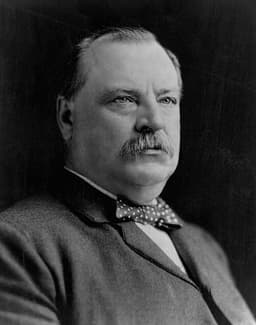
Grover Cleveland
Politician · Modern
53.7Total

Mulayam Singh Yadav
Politician · Modern
57.9Total
Basic Information
Born
1837
1939
Died
1908
—
Era
Modern
Modern
Nationality
United States
India
Occupation
Politician
Politician
Civilization
Western
Indian
Score Comparison
Military (10%)
50.0
40.0
Political (20%)
45.0
68.0
Influence (20%)
54.9
60.0
Legacy (20%)
48.3
50.0
Leadership (15%)
79.8
68.0
Strategy (15%)
41.8
60.0
TOTAL
53.7
57.9
Grover Cleveland — Complete Timeline
1884 AD
Election as President of the United States (First Term)Political Action◆ Major
Cleveland, a Democrat, won the 1884 presidential election against Republican James G. Blaine. The campaign was marked by personal attacks, but Cleveland's reputation as a reformer helped him win a narrow victory.
Presidential ElectionDemocratic Party
Impact: national
1887 AD
Signing of the Interstate Commerce ActReform◆ Major
Cleveland signed the Interstate Commerce Act, which created the Interstate Commerce Commission (ICC) to regulate railroad rates and practices. This was the first federal agency to regulate private industry, marking a significant expansion of federal power over commerce.
Railroad RegulationFederal Regulation
Impact: nationalconstructive
1892 AD
Election as President of the United States (Second Term)Political Action◆ Major
Cleveland won the 1892 presidential election against incumbent Benjamin Harrison, becoming the only president to serve two non-consecutive terms. His victory was a repudiation of the McKinley Tariff and Republican economic policies.
Presidential ElectionNon-Consecutive Terms
Impact: national
1894 AD
Intervention in the Pullman StrikePolitical Action◆ Major
Cleveland ordered federal troops to break the Pullman Strike, a nationwide railroad strike led by Eugene V. Debs. The intervention was controversial, as it used federal power to suppress labor unrest, and led to Debs' imprisonment.
Labor StrikeFederal Intervention
Impact: nationaldestructive
Mulayam Singh Yadav — Complete Timeline
1989 AD
First term as Chief Minister of Uttar PradeshPolitical Action◆ Major
Mulayam Singh Yadav became Chief Minister of Uttar Pradesh for the first time as a Janata Dal leader. His government faced the Babri Masjid crisis. He ordered police to fire on kar sevaks attempting to demolish the mosque in 1990, which defined his secular image.
Chief MinisterBabri MasjidSecularism
Impact: regional
1990 AD
Ordered firing on kar sevaks at Babri Masjid (1990)Political Action◆ Major
As UP chief minister, Mulayam Singh Yadav ordered police to open fire on Hindu activists (kar sevaks) attempting to attack the Babri Masjid in Ayodhya. Several activists were killed. This action earned him the label of a secular leader but also made him a target of Hindu nationalist anger.
Babri MasjidAyodhyaSecularism
Impact: nationaltragic
1992 AD
Founded Samajwadi Party (SP)Political Action◆ Major
Mulayam Singh Yadav founded the Samajwadi Party after splitting from the Janata Dal. The party aimed to represent socialists, backward castes, and Muslims in Uttar Pradesh. It became a major political force in the state and a key player in national coalition politics.
Party FormationSocialismUttar Pradesh
Impact: nationalconstructive
1996 AD
Served as Defence Minister of IndiaPolitical Action
Mulayam Singh Yadav served as India's Defence Minister in the United Front government under Prime Minister H.D. Deve Gowda. He held the portfolio for about a year. This was his highest national office, though his tenure was brief.
Defence MinisterUnited FrontNational Politics
Impact: nationalconstructive
2003 AD
Third term as Chief Minister (2003-2007)Political Action◆ Major
Mulayam Singh Yadav returned as UP chief minister after the 2002 election, leading a coalition government. His third term saw improved law and order but also allegations of corruption and criminalization of politics. He lost the 2007 election to Mayawati.
Chief MinisterUttar PradeshSP
Impact: regional
Expert Analysis
Origins
Grover Cleveland was born on March 18, 1837, in Caldwell, New Jersey, the son of a Presbyterian minister. He left school at 16 to support his family after his father's death, working as a clerk and later studying law. He was admitted to the bar in 1859 and became a lawyer in Buffalo, New York. Cleveland never served in the military, paying a substitute during the Civil War.
Mulayam Singh Yadav was born on November 22, 1939, in Saifai, Uttar Pradesh, into a farming family of the Yadav caste. He earned a B.A. and a teaching degree, becoming a schoolteacher. He entered politics through student activism, joining the Socialist Party. He was influenced by socialist leaders like Ram Manohar Lohia.
Rise to Power
Cleveland rose as a reform Democrat, first elected mayor of Buffalo in 1881, then governor of New York in 1882. His anti-corruption stance gained national attention. In 1884, he won the presidency, defeating James G. Blaine in a close election. He lost the 1888 election to Benjamin Harrison despite winning the popular vote, but won again in 1892, becoming the only president to serve non-consecutive terms.
Mulayam Singh Yadav rose through UP politics, first elected to the state assembly in 1967. He became chief minister for the first time in 1989 as a Janata Dal leader. In 1992, he founded the Samajwadi Party (SP) after a split from Janata Dal. He served as UP chief minister three times (1989-1991, 1993-1995, 2003-2007) and as India's defence minister (1996-1998).
Leadership & Governance
Cleveland's leadership style was marked by a strict adherence to the Constitution and limited government. He vetoed hundreds of private pension bills and used federal power to break the Pullman Strike in 1894, ordering troops to end the strike despite objections from Illinois Governor John Altgeld. He signed the Interstate Commerce Act (1887) to regulate railroads, scoring 79.8 in leadership.
Mulayam Singh Yadav's governance focused on social justice and secularism. He ordered police to fire on kar sevaks at the Babri Masjid in 1990, killing several, to prevent its demolition. He supported reservations for backward castes and Muslims. His third term saw improved law and order but also allegations of corruption. He scored 68.0 in political ability.
Triumph & Tragedy
Cleveland's triumphs include winning the presidency twice and signing the Interstate Commerce Act. His tragedy was the Panic of 1893, a severe economic depression that led to high unemployment and labor unrest. His handling of the Pullman Strike damaged his reputation among workers.
Mulayam Singh Yadav's triumph was founding the Samajwadi Party, which became a major force in UP politics. His tragedy was the decline of his party after his death, with his son Akhilesh Yadav unable to maintain its power. He also faced criticism for the 1990 firing incident, which polarized politics.
Character & Destiny
Cleveland was known for his honesty and independence, earning the nickname "Grover the Good." He was stubborn and principled, often vetoing bills he deemed unconstitutional. His character led to both his reform successes and his unpopularity during the depression.
Mulayam Singh Yadav was seen as a grassroots leader who championed the backward castes. He was pragmatic, forming alliances with other parties. His destiny was to be a regional strongman who never achieved national power beyond the defence ministry.
Legacy
Cleveland's legacy includes his defense of the gold standard and his use of the veto. He is remembered as a president who stood for limited government. His influence score is 54.9, reflecting his moderate impact.
Mulayam Singh Yadav's legacy is the Samajwadi Party and his advocacy for backward castes. He shaped UP politics for decades. His legacy score is 50.0, similar to Cleveland's 48.3.
Conclusion
While Cleveland had a higher leadership score (79.8 vs 68.0), Mulayam Singh Yadav's overall impact in Indian politics, as measured by political (68.0 vs 45.0) and influence (60.0 vs 54.9) scores, gives him a higher total (57.9 vs 53.7). However, Cleveland's role as a US president with national impact arguably outweighs Yadav's regional influence. Taking a stance: Cleveland had greater impact due to his national office and shaping of American regulatory policy. Yadav's influence was significant but more localized.
Rankings
🥇
Mulayam Singh YadavLeader
Mil: 40.0Pol: 68.0Inf: 60.0
57.9
🥈
Grover Cleveland
Mil: 50.0Pol: 45.0Inf: 54.9
53.7
+4.2 behind
How This Comparison Works
Algorithm
Each figure is scored on 6 dimensions (0—100 scale) based on structured historical data: Military (10%), Political (20%), Influence (20%), Legacy (20%), Leadership (15%), Strategy (15%). The weighted total produces the final ranking.
Data Sources
Scores are computed from structured sub-indicators in the database. Scale factors adjust for era (Ancient ×0.85, Modern ×1.0) and civilization size (Eastern ×1.05, Other ×0.80) to account for differences in population and military scale.
Maximum 3 Figures
Comparisons are limited to 2—3 figures to ensure readability and statistical meaningfulness.
Error Margins
±5 points per dimension — Sub-scores are derived from historical records with inherent uncertainty. Two figures within 5 points on a dimension should be considered roughly equivalent in that area.
Total Score Accuracy
±3 points overall — The weighted combination of 6 dimensions produces a total score with approximately ±3 points of uncertainty. Differences of less than 3 points are not statistically significant— the figures are effectively tied.
Known Limitations
- Historical records are incomplete and uneven across civilizations
- Figures from oral-tradition societies may be underrepresented
- Occupation labels can misclassify multi-role figures
- Scores measure capability and impact, not moral character
- Quantitative scoring is a comparison tool, not absolute truth
Capability Radar
Military (10%) — Battles & Warfare
Battles
29
42
Win Rate
30
46
Expansion
33
52
Political (20%) — Governance & Reform
Reform
55
55
Diplomacy
65
60
Economy
60
45
Influence (20%) — Cultural & Global Reach
Cultural
30
50
Global
40
40
Legacy (20%) — Historical Impact
Historical
50
55
Longevity
40
50
Leadership (15%) — Power & Stability
Tenure
60
65
Stability
70
40
Strategy (15%) — Tactics & Innovation
Strategy
35
52
Tactics
40
53
Reform
46
56
Similar Comparisons
Comments & Discussion
No comments yet. Be the first to share your thoughts!