Loading...
Grover Cleveland vs Peter Fraser
Peter Fraser leads by 4.4 pts · 2 figures compared
…
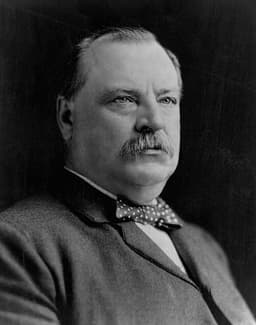
Grover Cleveland
Politician · Modern
53.7Total

Peter Fraser
Politician · Modern
58.1Total
Basic Information
Born
1837
1884
Died
1908
1950
Era
Modern
Modern
Nationality
United States
New Zealand
Occupation
Politician
Politician
Civilization
Western
Western
Score Comparison
Military (10%)
50.0
49.2
Political (20%)
45.0
72.0
Influence (20%)
54.9
56.4
Legacy (20%)
48.3
48.3
Leadership (15%)
79.8
79.8
Strategy (15%)
41.8
42.6
TOTAL
53.7
58.1
Grover Cleveland — Complete Timeline
1884 AD
Election as President of the United States (First Term)Political Action◆ Major
Cleveland, a Democrat, won the 1884 presidential election against Republican James G. Blaine. The campaign was marked by personal attacks, but Cleveland's reputation as a reformer helped him win a narrow victory.
Presidential ElectionDemocratic Party
Impact: national
1887 AD
Signing of the Interstate Commerce ActReform◆ Major
Cleveland signed the Interstate Commerce Act, which created the Interstate Commerce Commission (ICC) to regulate railroad rates and practices. This was the first federal agency to regulate private industry, marking a significant expansion of federal power over commerce.
Railroad RegulationFederal Regulation
Impact: nationalconstructive
1892 AD
Election as President of the United States (Second Term)Political Action◆ Major
Cleveland won the 1892 presidential election against incumbent Benjamin Harrison, becoming the only president to serve two non-consecutive terms. His victory was a repudiation of the McKinley Tariff and Republican economic policies.
Presidential ElectionNon-Consecutive Terms
Impact: national
1894 AD
Intervention in the Pullman StrikePolitical Action◆ Major
Cleveland ordered federal troops to break the Pullman Strike, a nationwide railroad strike led by Eugene V. Debs. The intervention was controversial, as it used federal power to suppress labor unrest, and led to Debs' imprisonment.
Labor StrikeFederal Intervention
Impact: nationaldestructive
Peter Fraser — Complete Timeline
1940 AD
Became Prime Minister of New ZealandPolitical Action◆ Major
Fraser succeeded Michael Joseph Savage as prime minister after Savage's death. He led the Labour government through the challenging years of World War II, maintaining the welfare state and managing the war effort.
Prime MinisterLabour PartyWorld War II
Impact: national
1945 AD
Led New Zealand Through World War IIWar◆ Major
Fraser's government mobilized New Zealand's economy and military for World War II. He maintained close ties with the United Kingdom and the United States, and New Zealand forces fought in North Africa, Europe, and the Pacific.
World War IIWar EffortAllies
Impact: global
Co-founded the United NationsPolitical Action◆ Major
Fraser led the New Zealand delegation to the San Francisco Conference that established the United Nations. He was a strong advocate for the inclusion of small nations and human rights in the UN Charter.
United NationsInternational RelationsHuman Rights
Impact: globalprogressive
1949 AD
Defeated in 1949 ElectionPolitical Action◆ Major
Fraser's Labour government was defeated by the National Party in the 1949 general election. The loss ended 14 years of Labour rule and marked a shift to more conservative policies under Prime Minister Sidney Holland.
ElectionDefeatNational Party
Impact: nationaltragic
Expert Analysis
Origins
Grover Cleveland was born on March 18, 1837, in Caldwell, New Jersey, the fifth of nine children of a Presbyterian minister. His family struggled financially, and Cleveland left school at 16 to work as a clerk and later as a teacher. He studied law on his own and was admitted to the bar in 1859. His early legal career in Buffalo, New York, focused on commercial law, and he gained a reputation for hard work and integrity. He never served in the military, paying a substitute to fight in the Civil War.
Peter Fraser was born on August 28, 1884, in Hill of Fearn, Scotland, to a poor family. He left school at 14 to work as a laborer and became involved in socialist politics. He emigrated to New Zealand in 1910, working as a wharf laborer and gold miner. Fraser was active in the New Zealand Labour Party, becoming a union organizer. He was imprisoned for sedition during World War I for opposing conscription, a formative experience that shaped his later political career.
Rise to Power
Cleveland's political rise was rapid. He served as sheriff of Erie County (1871-1873), then as mayor of Buffalo (1882), where he earned a reputation as a reformer fighting corruption. He became governor of New York in 1883, and in 1884, he won the Democratic nomination for president. In the general election, he defeated Republican James G. Blaine in a close race, winning 48.5% of the popular vote. His campaign was marred by scandal, but his honesty appealed to voters.
Fraser's rise was within the Labour Party. He became a Member of Parliament in 1918 and served in various ministerial roles under Prime Minister Michael Joseph Savage. When Savage died in 1940, Fraser succeeded him as prime minister, leading a coalition government during World War II. He consolidated power by taking on key portfolios, including foreign affairs and armed forces.
Leadership & Governance
Cleveland's leadership was defined by his commitment to laissez-faire economics and limited government. He vetoed more bills than any previous president, including pension bills for Civil War veterans. He signed the Interstate Commerce Act of 1887, creating the first federal regulatory agency, but his enforcement was weak. During the Panic of 1893, he defended the gold standard and repealed the Sherman Silver Purchase Act, deepening the depression. In the Pullman Strike of 1894, he sent federal troops to break the strike, citing the need to keep mail moving, which alienated labor unions.
Fraser led New Zealand through World War II with a focus on mobilizing the home front and maintaining alliances. His government introduced conscription, rationing, and price controls. He worked closely with the United States and Britain, and New Zealand troops fought in North Africa, Europe, and the Pacific. Fraser was a strong advocate for international cooperation, co-founding the United Nations in 1945. He chaired the committee that drafted the UN's provisions for non-self-governing territories, promoting decolonization.
Triumph & Tragedy
Cleveland's greatest success was his defense of the gold standard during the 1893 panic, which he saw as essential for economic stability. However, this policy worsened the depression and led to widespread unemployment. His intervention in the Pullman Strike was seen as a betrayal of workers. He also failed to address racial issues, supporting the Jim Crow system. His overall political score is 45.0, reflecting mixed results.
Fraser's greatest triumph was leading New Zealand through WWII and helping establish the UN, securing a place for small nations. His leadership score of 79.8 is high. However, his government was criticized for its handling of the 1949 waterfront strike, which led to his electoral defeat. He also implemented policies that discriminated against Japanese New Zealanders during the war. His legacy score of 48.3 is moderate.
Character & Destiny
Cleveland was known for his honesty, stubbornness, and independence. He famously said, "I have tried so hard to do right." His refusal to compromise often led to political gridlock. His character shaped his destiny: his integrity won him the presidency, but his inflexibility contributed to his party's losses. His strategy score is 41.8, indicating a lack of strategic flexibility.
Fraser was pragmatic and collaborative, building consensus within his party and with allies. He was deeply committed to social justice and internationalism. His character allowed him to navigate the complexities of war and diplomacy. However, his reliance on union support backfired during the waterfront strike. His strategy score is 42.6, slightly higher than Cleveland's.
Legacy
Cleveland's legacy is mixed. He is remembered as a reformer who fought corruption, but his economic policies are criticized. The Interstate Commerce Act laid the groundwork for federal regulation, but his labor record tarnishes his image. He scored 48.3 in legacy. He is the only president to serve non-consecutive terms, a unique historical footnote.
Fraser's legacy is more positive. He is considered one of New Zealand's greatest prime ministers, remembered for his wartime leadership and role in founding the UN. His advocacy for decolonization influenced international norms. However, his domestic policies were less transformative, and his Labour government's defeat in 1949 marked the end of an era. His legacy score is also 48.3, but his influence score of 56.4 is slightly higher than Cleveland's 54.9.
Conclusion
Peter Fraser had a greater impact than Grover Cleveland. While Cleveland's domestic policies had lasting effects on U.S. regulatory frameworks, Fraser's contributions to international cooperation and the UN were more globally significant. Fraser's leadership score of 79.8 matches Cleveland's, but his political score of 72.0 far exceeds Cleveland's 45.0. Fraser's total score of 58.1 is 4.4 points higher. His role in shaping the post-war world order and his influence on small nations' rights give him the edge. Cleveland was constrained by his era's politics and his own rigidity, while Fraser leveraged a global crisis to leave a enduring mark on international institutions.
Rankings
🥇
Peter FraserLeader
Mil: 49.2Pol: 72.0Inf: 56.4
58.1
🥈
Grover Cleveland
Mil: 50.0Pol: 45.0Inf: 54.9
53.7
+4.4 behind
How This Comparison Works
Algorithm
Each figure is scored on 6 dimensions (0—100 scale) based on structured historical data: Military (10%), Political (20%), Influence (20%), Legacy (20%), Leadership (15%), Strategy (15%). The weighted total produces the final ranking.
Data Sources
Scores are computed from structured sub-indicators in the database. Scale factors adjust for era (Ancient ×0.85, Modern ×1.0) and civilization size (Eastern ×1.05, Other ×0.80) to account for differences in population and military scale.
Maximum 3 Figures
Comparisons are limited to 2—3 figures to ensure readability and statistical meaningfulness.
Error Margins
±5 points per dimension — Sub-scores are derived from historical records with inherent uncertainty. Two figures within 5 points on a dimension should be considered roughly equivalent in that area.
Total Score Accuracy
±3 points overall — The weighted combination of 6 dimensions produces a total score with approximately ±3 points of uncertainty. Differences of less than 3 points are not statistically significant— the figures are effectively tied.
Known Limitations
- Historical records are incomplete and uneven across civilizations
- Figures from oral-tradition societies may be underrepresented
- Occupation labels can misclassify multi-role figures
- Scores measure capability and impact, not moral character
- Quantitative scoring is a comparison tool, not absolute truth
Capability Radar
Military (10%) — Battles & Warfare
Battles
29
28
Win Rate
30
35
Expansion
33
34
Political (20%) — Governance & Reform
Reform
55
60
Diplomacy
65
70
Economy
60
55
Influence (20%) — Cultural & Global Reach
Cultural
30
30
Global
40
50
Legacy (20%) — Historical Impact
Historical
50
50
Longevity
40
40
Leadership (15%) — Power & Stability
Tenure
60
65
Stability
70
65
Strategy (15%) — Tactics & Innovation
Strategy
35
37
Tactics
40
43
Reform
46
43
Similar Comparisons
Comments & Discussion
No comments yet. Be the first to share your thoughts!