Loading...
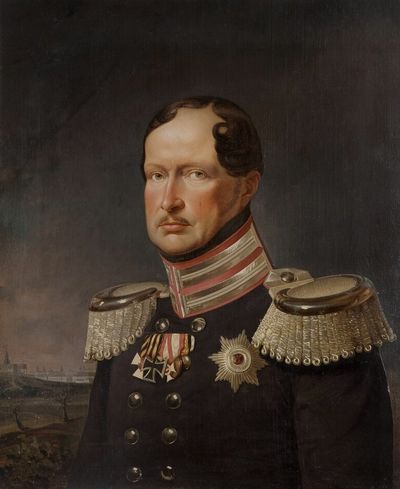
Frederick William III of Prussia
ModernEmperorPrussia1770 — 1840
Prussian king during the Napoleonic Wars.
Compare Frederick William III of Prussia with another historical figure:
Quick Facts
Born
1770
Died
1840
Country
Prussia
Era
Modern
Occupation
Emperor
Score Overview
Military (10%)50
Political (20%)44
Influence (20%)50
Legacy (20%)43
Leadership (15%)74
Strategy (15%)44
Total Score50.4
Frederick William III of Prussia — Complete Timeline
1806 AD
Defeat at the Battle of Jena-AuerstedtWar
Frederick William III led Prussia into war against Napoleon. The Prussian army was decisively defeated at the twin battles of Jena and Auerstedt. The defeat was catastrophic, leading to the collapse of the Prussian state, the occupation of Berlin, and the flight of the royal family to East Prussia.
PrussiaNapoleonWarJena-Auerstedt
Impact: globaltragic
1807 AD
Prussian Reform MovementReform◆ Major
In response to the defeat, Frederick William III supported a series of reforms led by Stein, Hardenberg, Scharnhorst, and Gneisenau. These included the abolition of serfdom, municipal self-government, military reorganization, and educational reform. The reforms modernized Prussia and laid the foundation for its recovery.
PrussiaReformSteinHardenbergModernization
Impact: nationalprogressive
Treaty of TilsitPolitical Action
After the defeat at Jena, Frederick William III was forced to sign the Treaty of Tilsit with Napoleon. Prussia lost half of its territory, including all lands west of the Elbe, and was forced to pay huge indemnities and reduce its army to 42,000 men. Prussia became a French satellite state.
PrussiaNapoleonTreatyTerritory
Impact: regionaltragic
1813 AD
Entry into the Sixth CoalitionWar◆ Major
After Napoleon's disastrous Russian campaign, Frederick William III joined the Sixth Coalition against France. The Prussian army played a key role in the War of Liberation, culminating in the Battle of Leipzig. This restored Prussia's status as a major European power and led to territorial gains at the Congress of Vienna.
PrussiaNapoleonic WarsCoalitionLiberation
Impact: globalconstructive
1815 AD
Congress of ViennaPolitical Action◆ Major
Frederick William III was represented at the Congress of Vienna, which redrew the map of Europe after Napoleon's defeat. Prussia gained significant territories, including the Rhineland, Westphalia, and parts of Saxony, becoming a major German power. The Congress also confirmed the Prussian-led German Confederation.
PrussiaCongress of ViennaTerritoryDiplomacy
Impact: globalconstructive
Detailed Scores
▶View all detailed scores
Military
Strategy
7
Tactics
7
Battles
7
Army Scale
6
War Impact
7
Political
Governance
7
Reform
7
Stability
7
Policy
7
Power
8
Influence
History
8
Global
8
Culture
8
Ideology
9
Legacy
8
People often compare with
See how Frederick William III of Prussia stacks up against other historical figures
Popular Comparisons
Frederick William III of Prussia vs Leopold I
vs Leopold I68
Frederick William III of Prussia vs John III Sobieski
vs John III Sobieski67
Frederick William III of Prussia vs Malietoa Tanumafili II
vs Malietoa Tanumafili II58
Frederick William III of Prussia vs Deria Hassan
vs Deria Hassan47
Frederick William III of Prussia vs Louis III of Hesse
vs Louis III of Hesse45
Frederick William III of Prussia vs Napoleon Bonaparte
vs Napoleon Bonaparte71