Loading...
Frederick William III of Prussia vs Malietoa Tanumafili II
Malietoa Tanumafili II leads by 7.2 pts · 2 figures compared
…
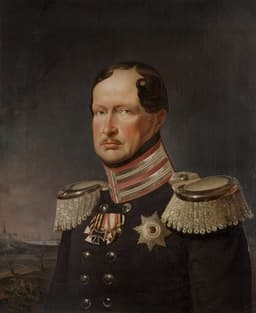
Frederick William III of Prussia
Emperor · Modern
50.4Total

Malietoa Tanumafili II
Emperor · Modern
57.6Total
Basic Information
Born
1770
1913
Died
1840
2007
Era
Modern
Modern
Nationality
Prussia
Samoa
Occupation
Emperor
Emperor
Civilization
Western
Other
Score Comparison
Military (10%)
50.0
48.9
Political (20%)
43.7
68.0
Influence (20%)
50.2
54.9
Legacy (20%)
43.3
46.7
Leadership (15%)
74.0
80.0
Strategy (15%)
43.7
51.3
TOTAL
50.4
57.6
Frederick William III of Prussia — Complete Timeline
1806 AD
Defeat at the Battle of Jena-AuerstedtWar
Frederick William III led Prussia into war against Napoleon. The Prussian army was decisively defeated at the twin battles of Jena and Auerstedt. The defeat was catastrophic, leading to the collapse of the Prussian state, the occupation of Berlin, and the flight of the royal family to East Prussia.
PrussiaNapoleonWarJena-Auerstedt
Impact: globaltragic
1807 AD
Prussian Reform MovementReform◆ Major
In response to the defeat, Frederick William III supported a series of reforms led by Stein, Hardenberg, Scharnhorst, and Gneisenau. These included the abolition of serfdom, municipal self-government, military reorganization, and educational reform. The reforms modernized Prussia and laid the foundation for its recovery.
PrussiaReformSteinHardenbergModernization
Impact: nationalprogressive
Treaty of TilsitPolitical Action
After the defeat at Jena, Frederick William III was forced to sign the Treaty of Tilsit with Napoleon. Prussia lost half of its territory, including all lands west of the Elbe, and was forced to pay huge indemnities and reduce its army to 42,000 men. Prussia became a French satellite state.
PrussiaNapoleonTreatyTerritory
Impact: regionaltragic
1813 AD
Entry into the Sixth CoalitionWar◆ Major
After Napoleon's disastrous Russian campaign, Frederick William III joined the Sixth Coalition against France. The Prussian army played a key role in the War of Liberation, culminating in the Battle of Leipzig. This restored Prussia's status as a major European power and led to territorial gains at the Congress of Vienna.
PrussiaNapoleonic WarsCoalitionLiberation
Impact: globalconstructive
1815 AD
Congress of ViennaPolitical Action◆ Major
Frederick William III was represented at the Congress of Vienna, which redrew the map of Europe after Napoleon's defeat. Prussia gained significant territories, including the Rhineland, Westphalia, and parts of Saxony, becoming a major German power. The Congress also confirmed the Prussian-led German Confederation.
PrussiaCongress of ViennaTerritoryDiplomacy
Impact: globalconstructive
Malietoa Tanumafili II — Complete Timeline
1962 AD
Became Head of State of SamoaPolitical Action◆ Major
Malietoa Tanumafili II became joint Head of State with Tupua Tamasese Mea'ole upon Samoa's independence. He later became sole Head of State for life.
IndependenceLeadership
Impact: national
2007 AD
Hosted the 2007 South Pacific GamesCultural
Samoa hosted the South Pacific Games under Malietoa's patronage, showcasing the nation. The event was a major regional sporting occasion.
SportsRegional Event
Impact: regionalconstructive
Died after 45 years as Head of StateOther◆ Major
Malietoa Tanumafili II died at age 94, ending his 45-year tenure as Head of State. His death marked the end of an era for Samoa.
DeathEnd of Era
Impact: nationaltragic
Expert Analysis
Origins
Frederick William III of Prussia was born on August 3, 1770, in Potsdam, the son of King Frederick William II and Frederika Louisa of Hesse-Darmstadt. His upbringing was marked by a strict military and religious education, typical for a Hohenzollern prince. He ascended the throne in 1797, inheriting a state that had been significantly weakened by the policies of his father. Malietoa Tanumafili II was born on January 4, 1913, in Samoa, into the Malietoa royal line. He was educated at a local school and later at Wesley College in New Zealand. His early life was shaped by Samoan traditions and the influence of colonial administration under New Zealand.
Rise to Power
Frederick William III became king at age 27, succeeding his father. His reign began during a period of European turmoil following the French Revolution. Initially, he pursued a policy of neutrality, but after Napoleon's victories over Austria and Russia, he felt compelled to join the Fourth Coalition in 1806. This led to the catastrophic defeat at the Battle of Jena-Auerstedt on October 14, 1806, where the Prussian army was routed. Malietoa Tanumafili II became joint Head of State with Tupua Tamasese Mea'ole on January 1, 1962, when Samoa gained independence from New Zealand. Upon Mea'ole's death in 1963, he became sole Head of State for life, a position he held until his death in 2007.
Leadership & Governance
Frederick William III's leadership was characterized by caution and conservatism. After the defeat at Jena, he reluctantly supported the Prussian Reform Movement led by Stein, Hardenberg, Scharnhorst, and Gneisenau. These reforms modernized the Prussian state, abolishing serfdom in 1807, reorganizing the army, and introducing municipal self-government. However, Frederick William III often hesitated and resisted change, favoring autocratic rule. In contrast, Malietoa Tanumafili II served as a constitutional figurehead, embodying national unity. He endorsed democratic governance and cultural preservation. His leadership style was consensus-building, and he oversaw Samoa's transition to a stable independent nation. His political score of 68.0 reflects his effective role, while Frederick William III's political score of 43.7 indicates his struggles.
Triumph & Tragedy
Frederick William III's greatest success was the territorial expansion achieved at the Congress of Vienna in 1815, where Prussia gained significant territories in the Rhineland, Westphalia, and Saxony. This laid the foundation for Prussia's future dominance in Germany. His greatest failure was the defeat at Jena-Auerstedt, which led to the Treaty of Tilsit in 1807, costing Prussia half its territory and imposing heavy reparations. Malietoa Tanumafili II's triumph was leading Samoa peacefully through 45 years of independence, fostering national identity and stability. He hosted the 2007 South Pacific Games, boosting regional ties. His tragedy was perhaps the challenge of maintaining Samoa's traditional monarchy in a modernizing world, though he largely succeeded.
Character & Destiny
Frederick William III was known for his piety, reserve, and indecisiveness. He often deferred to advisors, yet his stubbornness could hinder progress. Historians describe him as a well-meaning but ineffective ruler, whose character contributed to Prussia's initial humiliations. His willingness to reform, though forced, eventually benefited Prussia. Malietoa Tanumafili II was revered for his wisdom, dignity, and commitment to service. His long tenure (scored 80.0 in leadership) provided continuity. He was seen as a father figure, embodying the Samoan concept of 'fa'a Samoa' (the Samoan way). His character helped Samoa navigate post-colonial challenges.
Legacy
Frederick William III's legacy is mixed. He is remembered as the king who lost to Napoleon but also as the monarch who initiated reforms that modernized Prussia. His support for the Prussian Reform Movement indirectly contributed to Prussia's rise as a European power. However, his personal score of 43.3 in legacy reflects his overshadowed role. Malietoa Tanumafili II's legacy is that of a unifying figure who presided over Samoa's peaceful development. He is honored as the first Head of State of independent Samoa, and his 45-year rule is a symbol of stability. His legacy score of 46.7 is slightly higher than Frederick William III's.
Conclusion
While Frederick William III's reign saw transformative reforms and territorial gains, his failures in war and indecisive leadership limit his impact. Malietoa Tanumafili II, with a higher total score of 57.6 compared to Frederick William III's 50.4, provided consistent, peaceful leadership for nearly half a century. In terms of lasting positive influence on their nations, Malietoa Tanumafili II had greater impact. His ability to guide Samoa through independence and maintain cultural integrity surpasses Frederick William III's mixed record. Therefore, Malietoa Tanumafili II is the more effective leader.
Rankings
🥇
Malietoa Tanumafili IILeader
Mil: 48.9Pol: 68.0Inf: 54.9
57.6
🥈
Frederick William III of Prussia
Mil: 50.0Pol: 43.7Inf: 50.2
50.4
+7.2 behind
How This Comparison Works
Algorithm
Each figure is scored on 6 dimensions (0—100 scale) based on structured historical data: Military (10%), Political (20%), Influence (20%), Legacy (20%), Leadership (15%), Strategy (15%). The weighted total produces the final ranking.
Data Sources
Scores are computed from structured sub-indicators in the database. Scale factors adjust for era (Ancient ×0.85, Modern ×1.0) and civilization size (Eastern ×1.05, Other ×0.80) to account for differences in population and military scale.
Maximum 3 Figures
Comparisons are limited to 2—3 figures to ensure readability and statistical meaningfulness.
Error Margins
±5 points per dimension — Sub-scores are derived from historical records with inherent uncertainty. Two figures within 5 points on a dimension should be considered roughly equivalent in that area.
Total Score Accuracy
±3 points overall — The weighted combination of 6 dimensions produces a total score with approximately ±3 points of uncertainty. Differences of less than 3 points are not statistically significant— the figures are effectively tied.
Known Limitations
- Historical records are incomplete and uneven across civilizations
- Figures from oral-tradition societies may be underrepresented
- Occupation labels can misclassify multi-role figures
- Scores measure capability and impact, not moral character
- Quantitative scoring is a comparison tool, not absolute truth
Capability Radar
Military (10%) — Battles & Warfare
Battles
20
21
Win Rate
15
29
Expansion
10
27
Political (20%) — Governance & Reform
Reform
40
50
Diplomacy
30
60
Economy
35
40
Influence (20%) — Cultural & Global Reach
Cultural
20
40
Global
20
30
Legacy (20%) — Historical Impact
Historical
40
40
Longevity
30
50
Leadership (15%) — Power & Stability
Tenure
60
70
Stability
25
65
Strategy (15%) — Tactics & Innovation
Strategy
15
30
Tactics
10
37
Reform
30
40
Similar Comparisons
Comments & Discussion
No comments yet. Be the first to share your thoughts!