Loading...
Frederick William III of Prussia vs Louis III of Hesse
Frederick William III of Prussia leads by 5.8 pts · 2 figures compared
…
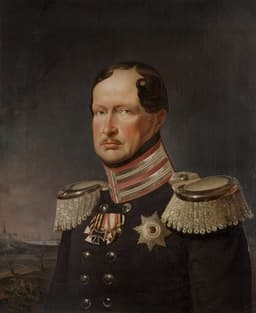
Frederick William III of Prussia
Emperor · Modern
50.4Total
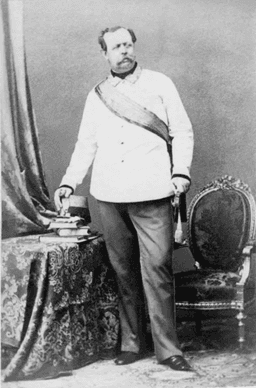
Louis III of Hesse
Emperor · Modern
44.6Total
Basic Information
Born
1770
1806
Died
1840
1877
Era
Modern
Modern
Nationality
Prussia
Hesse-Darmstadt
Occupation
Emperor
Emperor
Civilization
Western
Western
Score Comparison
Military (10%)
50.0
11.2
Political (20%)
43.7
37.9
Influence (20%)
50.2
48.6
Legacy (20%)
43.3
38.3
Leadership (15%)
74.0
67.0
Strategy (15%)
43.7
60.0
TOTAL
50.4
44.6
Frederick William III of Prussia — Complete Timeline
1806 AD
Defeat at the Battle of Jena-AuerstedtWar
Frederick William III led Prussia into war against Napoleon. The Prussian army was decisively defeated at the twin battles of Jena and Auerstedt. The defeat was catastrophic, leading to the collapse of the Prussian state, the occupation of Berlin, and the flight of the royal family to East Prussia.
PrussiaNapoleonWarJena-Auerstedt
Impact: globaltragic
1807 AD
Prussian Reform MovementReform◆ Major
In response to the defeat, Frederick William III supported a series of reforms led by Stein, Hardenberg, Scharnhorst, and Gneisenau. These included the abolition of serfdom, municipal self-government, military reorganization, and educational reform. The reforms modernized Prussia and laid the foundation for its recovery.
PrussiaReformSteinHardenbergModernization
Impact: nationalprogressive
Treaty of TilsitPolitical Action
After the defeat at Jena, Frederick William III was forced to sign the Treaty of Tilsit with Napoleon. Prussia lost half of its territory, including all lands west of the Elbe, and was forced to pay huge indemnities and reduce its army to 42,000 men. Prussia became a French satellite state.
PrussiaNapoleonTreatyTerritory
Impact: regionaltragic
1813 AD
Entry into the Sixth CoalitionWar◆ Major
After Napoleon's disastrous Russian campaign, Frederick William III joined the Sixth Coalition against France. The Prussian army played a key role in the War of Liberation, culminating in the Battle of Leipzig. This restored Prussia's status as a major European power and led to territorial gains at the Congress of Vienna.
PrussiaNapoleonic WarsCoalitionLiberation
Impact: globalconstructive
1815 AD
Congress of ViennaPolitical Action◆ Major
Frederick William III was represented at the Congress of Vienna, which redrew the map of Europe after Napoleon's defeat. Prussia gained significant territories, including the Rhineland, Westphalia, and parts of Saxony, becoming a major German power. The Congress also confirmed the Prussian-led German Confederation.
PrussiaCongress of ViennaTerritoryDiplomacy
Impact: globalconstructive
Louis III of Hesse — Complete Timeline
1848 AD
Accepted Liberal ReformsReform◆ Major
Louis III agreed to a series of liberal reforms, including the abolition of feudal privileges, freedom of the press, and the establishment of a more democratic parliament. These reforms were later partially reversed.
Reforms1848 Revolution
Impact: regionalprogressive
Became Grand Duke of HessePolitical Action◆ Major
Louis III succeeded his father Louis II as Grand Duke of Hesse-Darmstadt during the 1848 revolutions. He was more pragmatic than his father and accepted some liberal reforms to stabilize his rule.
SuccessionHesse-Darmstadt
Impact: regional
1866 AD
Supported Prussia in Austro-Prussian WarPolitical Action◆ Major
Louis III sided with Prussia during the Austro-Prussian War. After Prussia's victory, Hesse-Darmstadt was forced to cede some territories but was allowed to remain independent, unlike Hesse-Kassel.
Austro-Prussian WarPrussian Alliance
Impact: regional
1871 AD
Joined German EmpirePolitical Action◆ Major
Louis III led Hesse-Darmstadt into the newly formed German Empire under Prussian leadership. He became a constituent prince of the empire, losing much of his sovereignty but preserving his throne.
German UnificationEmpire
Impact: regional
Expert Analysis
Origins
Frederick William III of Prussia was born on August 3, 1770, in Potsdam, the son of King Frederick William II and Frederika Louisa of Hesse-Darmstadt. He received a strict military education under the influence of the Prussian army, but was known for his cautious and indecisive nature. His early life was overshadowed by the reign of his father, whose extravagance and mistresses scandalized the court. Frederick William III ascended the throne in 1797, inheriting a kingdom that had been weakened by the partitions of Poland and the strains of the French Revolutionary Wars.
Louis III of Hesse was born on June 9, 1806, in Darmstadt, the son of Grand Duke Louis II and Princess Wilhelmine of Baden. He grew up during the Napoleonic era, when Hesse-Darmstadt was a member of the Confederation of the Rhine under French influence. Louis III studied at the University of Leipzig and later at the University of Göttingen, but his education was interrupted by the death of his father in 1848. He became Grand Duke during the revolutionary year, a time of great political upheaval.
Rise to Power
Frederick William III became king in 1797, but his early reign was marked by neutrality during the Napoleonic Wars. He attempted to avoid conflict but was forced into war in 1806. The Prussian army, still relying on outdated tactics from Frederick the Great, was crushed at the Battle of Jena-Auerstedt on October 14, 1806. The defeat was a turning point: Frederick William III fled to Königsberg and later signed the Treaty of Tilsit in July 1807, ceding half of Prussia's territory to France and paying huge indemnities. This humiliation spurred him to support reforms, though he remained cautious.
Louis III became Grand Duke on June 16, 1848, amid the March Revolutions that swept the German states. He immediately accepted liberal demands, including the abolition of feudal privileges and the establishment of a constitutional monarchy. His early reign was characterized by a pragmatic approach to preserve his throne. In the 1850s, he reversed some reforms but maintained a moderate course. His key turning point came during the Austro-Prussian War of 1866, when he chose to side with Prussia, despite Hesse-Darmstadt's traditional ties to Austria. This decision allowed him to keep his throne after Prussia's victory.
Leadership & Governance
Frederick William III's leadership was defined by his reluctance to embrace change. He scored 74.0 in leadership, but his political score was only 43.7. He initially resisted the Prussian Reform Movement led by Stein and Hardenberg, but after Jena, he reluctantly authorized reforms including the abolition of serfdom (1807), municipal self-government (1808), and military reorganization by Scharnhorst. However, he often slowed or reversed reforms, such as dismissing Stein in 1808 under French pressure. His governance was cautious and reactive, preferring to delegate to capable ministers rather than take bold initiatives.
Louis III, with a political score of 37.9 and leadership of 67.0, governed Hesse-Darmstadt as a constitutional monarch after 1848. He accepted a liberal constitution that established a bicameral parliament and guaranteed basic rights. However, he later restricted freedoms during the reactionary period of the 1850s. His key governance achievement was navigating the unification of Germany: by supporting Prussia, he preserved Hesse-Darmstadt's autonomy within the German Empire. He lost influence over foreign policy but retained control over internal affairs until his death in 1877.
Triumph & Tragedy
Frederick William III's greatest triumph was Prussia's recovery after 1806. He supported reforms that modernized the army and administration, and he boldly joined the Sixth Coalition in 1813 after Napoleon's retreat from Russia. The Prussian army played a crucial role at the Battle of Leipzig (1813) and the subsequent invasion of France. At the Congress of Vienna (1815), Prussia regained lost territories and gained new ones in the Rhineland and Saxony. His tragedy was his initial incompetence: the defeat at Jena-Auerstedt was a disaster that cost Prussia half its territory and millions of lives. His indecision also led to the harsh terms of Tilsit. He scored 50.0 in military and 43.3 in legacy.
Louis III's triumph was successfully leading Hesse-Darmstadt through German unification. He preserved his dynasty and retained internal autonomy, while his state became part of the powerful German Empire. His tragedy was the loss of sovereignty: Hesse-Darmstadt was reduced from a sovereign state to a subnational entity, and Louis III became a figurehead in foreign policy. Additionally, his liberal reforms were partially reversed, and he faced criticism from both conservatives and liberals. He scored 11.2 in military, reflecting his lack of military involvement.
Character & Destiny
Frederick William III was a pious, frugal, and conscientious ruler, but also indecisive and risk-averse. His character shaped his destiny: his hesitation to modernize the army before 1806 led to defeat, but his persistence after the disaster allowed Prussia to rise again. He was known as the 'Pious King' for his religious devotion, which influenced his support for the Prussian Union of churches. Historians note that he lacked the brilliance of Frederick the Great but was a stabilizing force during turbulent times.
Louis III was pragmatic and adaptable, willing to compromise to maintain his position. He was not a strong leader but was shrewd enough to align with the winning side. His character allowed him to survive the revolutions and wars of his era, but it also meant he was overshadowed by more dominant figures like Bismarck and Wilhelm I. He is often remembered as a transitional figure, neither reactionary nor progressive.
Legacy
Frederick William III's legacy is mixed. He is remembered for the Prussian Reform Movement, which laid the groundwork for Prussia's later dominance under his son, Frederick William IV, and Otto von Bismarck. The military reforms he supported enabled Prussia's victories in 1864, 1866, and 1870. However, his initial failures are also part of his legacy. He scored 43.3 in legacy.
Louis III's legacy is more limited. He is remembered as the last Grand Duke of Hesse-Darmstadt before the empire, and for his role in peaceful unification. His internal reforms were largely undone, but his decision to join Prussia ensured the continuity of his dynasty until 1918. He scored 38.3 in legacy.
Conclusion
Frederick William III had a greater impact than Louis III, with a total score of 50.4 compared to 44.6. While Louis III's survival was an achievement, Frederick William III's reign fundamentally shaped Prussian and German history. His failures at Jena led to reforms that transformed Prussia into a modern state, and his eventual victory over Napoleon secured Prussia's status as a great power. Louis III, by contrast, was a minor prince whose choices were largely dictated by Prussia. Frederick William III's influence on the course of European history was far more significant.
Rankings
🥇
Frederick William III of PrussiaLeader
Mil: 50.0Pol: 43.7Inf: 50.2
50.4
🥈
Louis III of Hesse
Mil: 11.2Pol: 37.9Inf: 48.6
44.6
+5.8 behind
How This Comparison Works
Algorithm
Each figure is scored on 6 dimensions (0—100 scale) based on structured historical data: Military (10%), Political (20%), Influence (20%), Legacy (20%), Leadership (15%), Strategy (15%). The weighted total produces the final ranking.
Data Sources
Scores are computed from structured sub-indicators in the database. Scale factors adjust for era (Ancient ×0.85, Modern ×1.0) and civilization size (Eastern ×1.05, Other ×0.80) to account for differences in population and military scale.
Maximum 3 Figures
Comparisons are limited to 2—3 figures to ensure readability and statistical meaningfulness.
Error Margins
±5 points per dimension — Sub-scores are derived from historical records with inherent uncertainty. Two figures within 5 points on a dimension should be considered roughly equivalent in that area.
Total Score Accuracy
±3 points overall — The weighted combination of 6 dimensions produces a total score with approximately ±3 points of uncertainty. Differences of less than 3 points are not statistically significant— the figures are effectively tied.
Known Limitations
- Historical records are incomplete and uneven across civilizations
- Figures from oral-tradition societies may be underrepresented
- Occupation labels can misclassify multi-role figures
- Scores measure capability and impact, not moral character
- Quantitative scoring is a comparison tool, not absolute truth
Capability Radar
Military (10%) — Battles & Warfare
Battles
20
35
Win Rate
15
40
Expansion
10
45
Political (20%) — Governance & Reform
Reform
40
20
Diplomacy
30
30
Economy
35
20
Influence (20%) — Cultural & Global Reach
Cultural
20
10
Global
20
10
Legacy (20%) — Historical Impact
Historical
40
20
Longevity
30
10
Leadership (15%) — Power & Stability
Tenure
60
30
Stability
25
40
Strategy (15%) — Tactics & Innovation
Strategy
15
44
Tactics
10
47
Reform
30
53
Similar Comparisons
Comments & Discussion
No comments yet. Be the first to share your thoughts!