Loading...
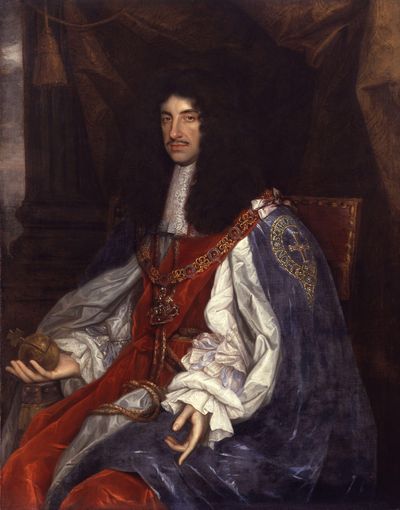
Charles II of England
ModernEmperorEngland1630 — 1685
The Merry Monarch, restored to the throne after Cromwell's death.
Compare Charles II of England with another historical figure:
Quick Facts
Born
1630
Died
1685
Country
England
Era
Modern
Occupation
Emperor
Score Overview
Military (10%)10
Political (20%)60
Influence (20%)62
Legacy (20%)52
Leadership (15%)68
Strategy (15%)40
Total Score52.7
Charles II of England — Complete Timeline
1660 AD
Restoration of the MonarchyPolitical Action
Charles II was invited back to England by Parliament, restoring the monarchy after the death of Oliver Cromwell. The Declaration of Breda promised amnesty and religious tolerance, leading to a peaceful transition and the end of the Commonwealth.
RestorationMonarchyCommonwealth
Impact: nationalconstructive
1666 AD
Great Fire of LondonOther◆ Major
A massive fire destroyed much of London, including St. Paul's Cathedral and thousands of homes. Charles II oversaw the rebuilding efforts, appointing Christopher Wren to redesign the city, which modernized London's architecture.
DisasterRebuildingLondon
Impact: nationaltragic
1670 AD
Secret Treaty of DoverPolitical Action◆ Major
Charles II signed the Secret Treaty of Dover with Louis XIV of France, agreeing to convert to Catholicism and support French wars in exchange for subsidies. This secret pact undermined English Protestant interests and sparked political controversy.
TreatyCatholicismFrance
Impact: regional
1673 AD
Test Act of 1673Reform
Parliament passed the Test Act, requiring all officeholders to receive Anglican communion and renounce transubstantiation. Charles II reluctantly accepted it, which excluded Catholics from public office and deepened religious divisions.
Religious LegislationAnglicanismCatholic Exclusion
Impact: national
1678 AD
Popish PlotPolitical Action◆ Major
Titus Oates fabricated a conspiracy alleging a Catholic plot to assassinate Charles II and install his Catholic brother James. The resulting hysteria led to the execution of innocent Catholics and a political crisis, though Charles remained skeptical.
ConspiracyAnti-CatholicismPolitical Crisis
Impact: nationaldestructive
Detailed Scores
▶View all detailed scores
Military
Strategy
7
Tactics
7
Battles
7
Army Scale
6
War Impact
7
Political
Governance
7
Reform
7
Stability
7
Policy
8
Power
8
Influence
History
8
Global
8
Culture
8
Ideology
9
Legacy
8
People often compare with
See how Charles II of England stacks up against other historical figures
Popular Comparisons
Charles II of England vs William III of Orange
vs William III of Orange62
Charles II of England vs Jeongjo
vs Jeongjo56
Charles II of England vs Kaikhusrau Jahan Begum
vs Kaikhusrau Jahan Begum55
Charles II of England vs Leopold II of Belgium
vs Leopold II of Belgium50
Charles II of England vs Khanderao Gaekwad
vs Khanderao Gaekwad50
Charles II of England vs Seonjo of Joseon
vs Seonjo of Joseon48