Loading...
Charles II of England vs Khanderao Gaekwad
Charles II of England leads by 3.2 pts · 2 figures compared
…
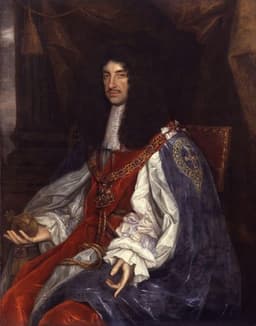
Charles II of England
Emperor · Modern
52.7Total

Khanderao Gaekwad
Emperor · Modern
49.5Total
Basic Information
Born
1630
1828
Died
1685
1870
Era
Modern
Modern
Nationality
England
India
Occupation
Emperor
Emperor
Civilization
Western
Indian
Score Comparison
Military (10%)
10.2
20.0
Political (20%)
60.0
53.8
Influence (20%)
62.0
53.3
Legacy (20%)
52.0
43.3
Leadership (15%)
68.0
66.0
Strategy (15%)
39.6
54.3
TOTAL
52.7
49.5
Charles II of England — Complete Timeline
1660 AD
Restoration of the MonarchyPolitical Action
Charles II was invited back to England by Parliament, restoring the monarchy after the death of Oliver Cromwell. The Declaration of Breda promised amnesty and religious tolerance, leading to a peaceful transition and the end of the Commonwealth.
RestorationMonarchyCommonwealth
Impact: nationalconstructive
1666 AD
Great Fire of LondonOther◆ Major
A massive fire destroyed much of London, including St. Paul's Cathedral and thousands of homes. Charles II oversaw the rebuilding efforts, appointing Christopher Wren to redesign the city, which modernized London's architecture.
DisasterRebuildingLondon
Impact: nationaltragic
1670 AD
Secret Treaty of DoverPolitical Action◆ Major
Charles II signed the Secret Treaty of Dover with Louis XIV of France, agreeing to convert to Catholicism and support French wars in exchange for subsidies. This secret pact undermined English Protestant interests and sparked political controversy.
TreatyCatholicismFrance
Impact: regional
1673 AD
Test Act of 1673Reform
Parliament passed the Test Act, requiring all officeholders to receive Anglican communion and renounce transubstantiation. Charles II reluctantly accepted it, which excluded Catholics from public office and deepened religious divisions.
Religious LegislationAnglicanismCatholic Exclusion
Impact: national
1678 AD
Popish PlotPolitical Action◆ Major
Titus Oates fabricated a conspiracy alleging a Catholic plot to assassinate Charles II and install his Catholic brother James. The resulting hysteria led to the execution of innocent Catholics and a political crisis, though Charles remained skeptical.
ConspiracyAnti-CatholicismPolitical Crisis
Impact: nationaldestructive
Khanderao Gaekwad — Complete Timeline
1856 AD
Ascended the Throne of BarodaPolitical Action◆ Major
Khanderao Gaekwad became Maharaja of Baroda at the age of 28. He inherited a state that was under British oversight and sought to modernize its administration and infrastructure.
SuccessionPrincely StateBaroda
Impact: regional
1860 AD
Introduced Modern Administrative ReformsReform
Khanderao Gaekwad implemented administrative reforms in Baroda, including a more efficient revenue system and a modern judiciary. These changes were part of his efforts to modernize the state's governance.
AdministrationModernizationBaroda
Impact: regionalconstructive
1862 AD
Established the Baroda CollegeReform◆ Major
Khanderao Gaekwad founded the Baroda College (now Maharaja Sayajirao University of Baroda), one of the first modern educational institutions in Gujarat. The college provided Western-style education to the local population.
EducationModernizationBaroda
Impact: regionalprogressive
1865 AD
Constructed the Khanderao MarketReform
Khanderao Gaekwad built the Khanderao Market in Baroda city, a major commercial complex. This project aimed to boost trade and provide a centralized marketplace for local merchants.
InfrastructureTradeBaroda
constructive
Expert Analysis
Origins
Charles II of England was born on May 29, 1630, to King Charles I and Henrietta Maria of France. His early years were marked by the English Civil War, which erupted in 1642. After his father's execution in 1649, Charles spent years in exile in France, the Dutch Republic, and the Spanish Netherlands, living on modest means and relying on foreign courts. His formative experiences were shaped by loss, displacement, and the need to navigate European politics.
Khanderao Gaekwad was born in 1828 into the Gaekwad dynasty of the Maratha Empire, ruling the princely state of Baroda (now Vadodara, Gujarat). His father, Sayajirao Gaekwad II, died when Khanderao was young, and he ascended the throne in 1856 at age 28. He was educated under British supervision, which exposed him to Western administrative practices. His background combined traditional Maratha governance with increasing British influence.
Rise to Power
Charles II's path to power was through the collapse of the English Commonwealth. After Oliver Cromwell's death in 1658, his son Richard proved ineffectual. General George Monck, a former Royalist, marched on London and facilitated the Restoration. In 1660, Charles issued the Declaration of Breda, promising amnesty, religious toleration, and land settlements. Parliament invited him back, and he entered London on May 29, 1660, his 30th birthday. He was crowned on April 23, 1661.
Khanderao Gaekwad became Maharaja of Baroda in 1856 after his father's death. His rise was straightforward as a hereditary ruler, but his authority was limited by the British Raj, which controlled foreign policy and military matters. He focused on internal reforms, gradually asserting his vision for modernization within the constraints of colonial oversight.
Leadership & Governance
Charles II's leadership was characterized by pragmatism and a desire to avoid the absolutism that had cost his father his head. He worked with Parliament, though he often circumvented it through secret subsidies from France. His governance saw the Restoration of the Church of England and the Clarendon Code, which penalized nonconformists. He personally favored religious toleration but was blocked by Parliament. The Secret Treaty of Dover (1670) with Louis XIV promised French support in exchange for Charles's conversion to Catholicism and military aid against the Dutch, a move that undermined his credibility. His leadership score is 68.0, reflecting his ability to maintain power through political maneuvering.
Khanderao Gaekwad scored 66.0 in leadership, focusing on administrative modernization. He introduced a more efficient revenue system, a modern judiciary, and established Baroda College (now Maharaja Sayajirao University) in 1881, a pioneering institution in Gujarat. He also built the Khanderao Market to stimulate trade. His reforms were incremental but laid the groundwork for Baroda's development. However, his political score of 53.8 reflects his limited autonomy under British suzerainty.
Triumph & Tragedy
Charles II's greatest triumph was the restoration of the monarchy after a decade of republican rule, achieving a stable transition that avoided further civil war. He oversaw the rebuilding of London after the Great Fire of 1666, appointing Sir Christopher Wren to redesign St. Paul's Cathedral and many churches. His patronage of the arts and sciences (founding the Royal Society) fostered a cultural renaissance. However, his reign was marred by the Great Plague of 1665 (killing 100,000), the disastrous Second Anglo-Dutch War (1665-1667), and the Popish Plot (1678-1681), which fueled anti-Catholic hysteria. His secret Catholicism and reliance on French subsidies damaged his reputation.
Khanderao Gaekwad's triumphs include founding Baroda College, which became a major educational hub, and implementing reforms that improved administration and trade. His construction of Khanderao Market boosted the local economy. However, his reign was overshadowed by British control; he could not pursue independent foreign policy or military action. His military score of 20.0 reflects the lack of significant campaigns. His legacy score of 43.3 is lower than Charles's 52.0, partly because his achievements were less transformative on a national scale.
Character & Destiny
Charles II was known for his wit, charm, and hedonism, earning the nickname "Merry Monarch." He was politically astute but lazy, preferring to delegate and enjoy life. His character allowed him to navigate crises (like the Exclusion Crisis) by dissolving Parliament and ruling without it, but his secret treaties and Catholic leanings sowed future conflict. His strategy score of 39.6 indicates a reactive rather than proactive approach.
Khanderao Gaekwad was a reformer but cautious, aware of British power. He modernized within limits, avoiding confrontation. His strategy score of 54.3 is higher than Charles's, reflecting a more methodical approach. However, his destiny was constrained by colonialism; his reforms did not spark wider Indian nationalism.
Legacy
Charles II's legacy is mixed: he restored the monarchy and stabilized England but left unresolved tensions between Crown and Parliament, leading to the Glorious Revolution of 1688. His support for science and the arts had lasting impact. He is remembered as a popular but flawed ruler. His influence score is 62.0.
Khanderao Gaekwad's legacy is primarily local: Baroda College evolved into a major university, and his administrative reforms influenced later princely states. However, his impact on Indian history is minor compared to figures like his successor Sayajirao Gaekwad III. His influence score is 53.3.
Conclusion
Charles II of England had a greater impact than Khanderao Gaekwad, with a total score of 52.7 versus 49.5. Charles restored a major European monarchy and shaped England's political evolution, while Khanderao's reforms were confined to a small princely state under British dominance. Charles's decisions affected millions and set the stage for constitutional monarchy, whereas Khanderao's achievements, though commendable, were limited in scale. The 3.2-point gap reflects Charles's broader geopolitical influence.
Rankings
🥇
Charles II of EnglandLeader
Mil: 10.2Pol: 60.0Inf: 62.0
52.7
🥈
Khanderao Gaekwad
Mil: 20.0Pol: 53.8Inf: 53.3
49.5
+3.2 behind
How This Comparison Works
Algorithm
Each figure is scored on 6 dimensions (0—100 scale) based on structured historical data: Military (10%), Political (20%), Influence (20%), Legacy (20%), Leadership (15%), Strategy (15%). The weighted total produces the final ranking.
Data Sources
Scores are computed from structured sub-indicators in the database. Scale factors adjust for era (Ancient ×0.85, Modern ×1.0) and civilization size (Eastern ×1.05, Other ×0.80) to account for differences in population and military scale.
Maximum 3 Figures
Comparisons are limited to 2—3 figures to ensure readability and statistical meaningfulness.
Error Margins
±5 points per dimension — Sub-scores are derived from historical records with inherent uncertainty. Two figures within 5 points on a dimension should be considered roughly equivalent in that area.
Total Score Accuracy
±3 points overall — The weighted combination of 6 dimensions produces a total score with approximately ±3 points of uncertainty. Differences of less than 3 points are not statistically significant— the figures are effectively tied.
Known Limitations
- Historical records are incomplete and uneven across civilizations
- Figures from oral-tradition societies may be underrepresented
- Occupation labels can misclassify multi-role figures
- Scores measure capability and impact, not moral character
- Quantitative scoring is a comparison tool, not absolute truth
Capability Radar
Military (10%) — Battles & Warfare
Battles
10
5
Win Rate
10
5
Expansion
5
5
Political (20%) — Governance & Reform
Reform
60
55
Diplomacy
65
50
Economy
55
55
Influence (20%) — Cultural & Global Reach
Cultural
60
40
Global
50
20
Legacy (20%) — Historical Impact
Historical
65
40
Longevity
55
30
Leadership (15%) — Power & Stability
Tenure
55
60
Stability
50
55
Strategy (15%) — Tactics & Innovation
Strategy
5
5
Tactics
5
5
Reform
15
5
Similar Comparisons
Comments & Discussion
No comments yet. Be the first to share your thoughts!