Loading...
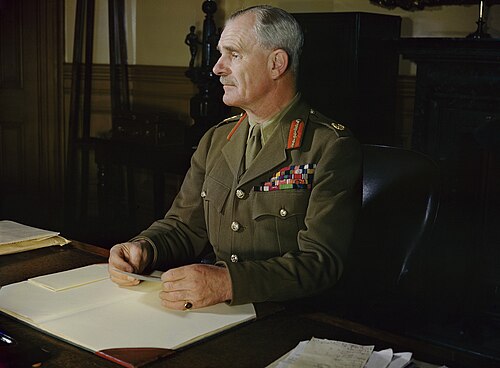
Archibald Wavell
ModernGeneralUnited Kingdom1883 — 1950
British field marshal who defeated the Italians in North Africa.
Compare Archibald Wavell with another historical figure:
Quick Facts
Born
1883
Died
1950
Country
United Kingdom
Era
Modern
Occupation
General
Score Overview
Military (10%)70
Political (20%)47
Influence (20%)55
Legacy (20%)54
Leadership (15%)71
Strategy (15%)55
Total Score57.4
Archibald Wavell — Complete Timeline
1939 AD
Appointed Commander-in-Chief of Middle East CommandOther◆ Major
Wavell was appointed Commander-in-Chief of the Middle East Command in July 1939. He oversaw British forces in Egypt, Sudan, Palestine, and East Africa, preparing for the expected conflict with Italy in North Africa at the outbreak of World War II.
World War IINorth Africa
Impact: national
1940 AD
Launched Operation CompassOther◆ Major
Wavell ordered Operation Compass in December 1940, a British offensive against Italian forces in North Africa. The attack captured 130,000 Italian prisoners, advanced 500 miles into Libya, and destroyed the Italian Tenth Army, achieving the first major Allied land victory of World War II.
World War IINorth AfricaVictory
Impact: nationalconstructive
1941 AD
Defeated Italian Forces in East AfricaOther◆ Major
Wavell's forces conducted a campaign in East Africa from January to May 1941. British, Commonwealth, and Ethiopian troops defeated the Italian army in Eritrea and Ethiopia, capturing 230,000 prisoners and restoring Emperor Haile Selassie to the Ethiopian throne.
World War IIEast AfricaVictory
Impact: nationalconstructive
Relieved of Command in the Middle EastOther◆ Major
Wavell was relieved as Commander-in-Chief of Middle East Command in July 1941 following a series of setbacks, including the failure of Operation Battleaxe to relieve Tobruk and the German capture of Crete. He was replaced by Claude Auchinleck and reassigned to India.
World War IINorth AfricaSetback
Impact: nationaldestructive
1943 AD
Appointed Viceroy of IndiaPolitical Action◆ Major
Wavell was appointed Viceroy and Governor-General of India in October 1943, succeeding Lord Linlithgow. He faced the Bengal famine of 1943, which killed an estimated 2-3 million people, and attempted to negotiate Indian independence with political leaders including Gandhi and Jinnah.
IndiaWorld War IIColonial Administration
Impact: national
Detailed Scores
▶View all detailed scores
Military
Strategy
7
Tactics
7
Battles
7
Army Scale
7
War Impact
7
Political
Governance
7
Reform
7
Stability
7
Policy
8
Power
7
Influence
History
10
Global
9
Culture
10
Ideology
10
Legacy
9
People often compare with
See how Archibald Wavell stacks up against other historical figures
Popular Comparisons
Archibald Wavell vs Napoleon Bonaparte
vs Napoleon Bonaparte71
Archibald Wavell vs Alvaro Obregon
vs Alvaro Obregon62
Archibald Wavell vs Nawab Kapur Singh
vs Nawab Kapur Singh59
Archibald Wavell vs Ayub Khan
vs Ayub Khan55
Archibald Wavell vs Cai E
vs Cai E54
Archibald Wavell vs Prince Rupert of the Rhine
vs Prince Rupert of the Rhine49