Loading...
This comparison has not been analyzed yet.
One-time AI generation (~1 minute). Scores and timeline are already available below.
Archibald Wavell vs Nawab Kapur Singh
Nawab Kapur Singh leads by 1.4 pts · 2 figures compared
…
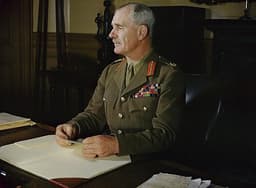
Archibald Wavell
General · Modern
57.4Total

Nawab Kapur Singh
General · Modern
58.8Total
Basic Information
Born
1883
1697
Died
1950
1753
Era
Modern
Modern
Nationality
United Kingdom
India
Occupation
General
General
Civilization
Western
Indian
Score Comparison
Military (10%)
70.0
50.0
Political (20%)
46.6
68.0
Influence (20%)
55.0
59.0
Legacy (20%)
54.0
56.0
Leadership (15%)
71.0
62.0
Strategy (15%)
55.0
55.0
TOTAL
57.4
58.8
Archibald Wavell — Complete Timeline
1939 AD
Appointed Commander-in-Chief of Middle East CommandOther◆ Major
Wavell was appointed Commander-in-Chief of the Middle East Command in July 1939. He oversaw British forces in Egypt, Sudan, Palestine, and East Africa, preparing for the expected conflict with Italy in North Africa at the outbreak of World War II.
World War IINorth Africa
Impact: national
1940 AD
Launched Operation CompassOther◆ Major
Wavell ordered Operation Compass in December 1940, a British offensive against Italian forces in North Africa. The attack captured 130,000 Italian prisoners, advanced 500 miles into Libya, and destroyed the Italian Tenth Army, achieving the first major Allied land victory of World War II.
World War IINorth AfricaVictory
Impact: nationalconstructive
1941 AD
Defeated Italian Forces in East AfricaOther◆ Major
Wavell's forces conducted a campaign in East Africa from January to May 1941. British, Commonwealth, and Ethiopian troops defeated the Italian army in Eritrea and Ethiopia, capturing 230,000 prisoners and restoring Emperor Haile Selassie to the Ethiopian throne.
World War IIEast AfricaVictory
Impact: nationalconstructive
Relieved of Command in the Middle EastOther◆ Major
Wavell was relieved as Commander-in-Chief of Middle East Command in July 1941 following a series of setbacks, including the failure of Operation Battleaxe to relieve Tobruk and the German capture of Crete. He was replaced by Claude Auchinleck and reassigned to India.
World War IINorth AfricaSetback
Impact: nationaldestructive
1943 AD
Appointed Viceroy of IndiaPolitical Action◆ Major
Wavell was appointed Viceroy and Governor-General of India in October 1943, succeeding Lord Linlithgow. He faced the Bengal famine of 1943, which killed an estimated 2-3 million people, and attempted to negotiate Indian independence with political leaders including Gandhi and Jinnah.
IndiaWorld War IIColonial Administration
Impact: national
Nawab Kapur Singh — Complete Timeline
1748 AD
Organized the Dal Khalsa ConfederacyReform◆ Major
Nawab Kapur Singh unified the scattered Sikh misls (bands) into the Dal Khalsa, a confederacy of 11 misls. This structure provided coordinated military and political leadership for the Sikh community against the Mughals and Afghans.
Dal KhalsaMisl SystemSikh Confederacy
Impact: regionalconstructive
This comparison has not been analyzed yet.
One-time AI generation (~1 minute). Scores and timeline are already available below.
Rankings
🥇
Nawab Kapur SinghLeader
Mil: 50.0Pol: 68.0Inf: 59.0
58.8
🥈
Archibald Wavell
Mil: 70.0Pol: 46.6Inf: 55.0
57.4
+1.4 behind
How This Comparison Works
Algorithm
Each figure is scored on 6 dimensions (0—100 scale) based on structured historical data: Military (10%), Political (20%), Influence (20%), Legacy (20%), Leadership (15%), Strategy (15%). The weighted total produces the final ranking.
Data Sources
Scores are computed from structured sub-indicators in the database. Scale factors adjust for era (Ancient ×0.85, Modern ×1.0) and civilization size (Eastern ×1.05, Other ×0.80) to account for differences in population and military scale.
Maximum 3 Figures
Comparisons are limited to 2—3 figures to ensure readability and statistical meaningfulness.
Error Margins
±5 points per dimension — Sub-scores are derived from historical records with inherent uncertainty. Two figures within 5 points on a dimension should be considered roughly equivalent in that area.
Total Score Accuracy
±3 points overall — The weighted combination of 6 dimensions produces a total score with approximately ±3 points of uncertainty. Differences of less than 3 points are not statistically significant— the figures are effectively tied.
Known Limitations
- Historical records are incomplete and uneven across civilizations
- Figures from oral-tradition societies may be underrepresented
- Occupation labels can misclassify multi-role figures
- Scores measure capability and impact, not moral character
- Quantitative scoring is a comparison tool, not absolute truth
Capability Radar
Military (10%) — Battles & Warfare
Battles
65
45
Win Rate
60
50
Expansion
50
55
Political (20%) — Governance & Reform
Reform
30
65
Diplomacy
50
50
Economy
20
35
Influence (20%) — Cultural & Global Reach
Cultural
30
55
Global
45
30
Legacy (20%) — Historical Impact
Historical
55
60
Longevity
40
50
Leadership (15%) — Power & Stability
Tenure
55
40
Stability
35
45
Strategy (15%) — Tactics & Innovation
Strategy
75
60
Tactics
70
55
Reform
40
70
Similar Comparisons
Comments & Discussion
No comments yet. Be the first to share your thoughts!