Loading...
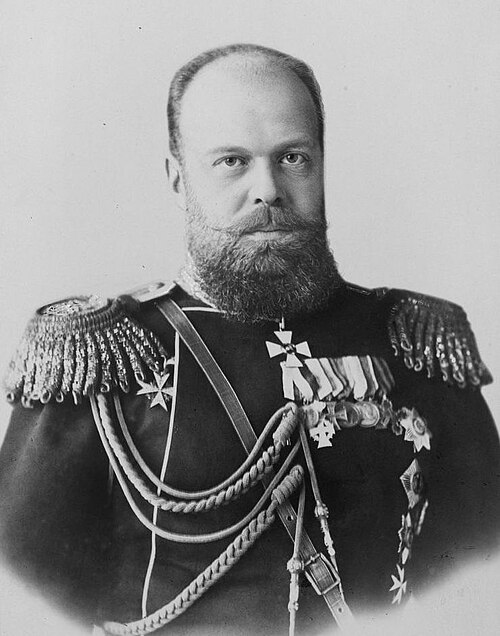
Alexander III of Russia
ModernEmperorRussia1845 — 1894
Peacemaker tsar who reversed many of his father reforms.
Compare Alexander III of Russia with another historical figure:
Quick Facts
Born
1845
Died
1894
Country
Russia
Era
Modern
Occupation
Emperor
Score Overview
Military (10%)21
Political (20%)54
Influence (20%)53
Legacy (20%)43
Leadership (15%)80
Strategy (15%)30
Total Score49.3
Alexander III of Russia — Complete Timeline
1881 AD
Reversal of Alexander II's ReformsReform
Upon ascending the throne, Alexander III issued the Manifesto on Unshakeable Autocracy, rejecting his father's reformist policies. He strengthened the power of the nobility, increased censorship, and expanded the powers of the secret police, reversing many liberalizing measures.
Counter-ReformsAutocracyReaction
Impact: nationaldestructive
1882 AD
May Laws of 1882Political Action◆ Major
Alexander III approved the May Laws, which imposed severe restrictions on Jewish residence, property ownership, and education. These laws confined Jews to the Pale of Settlement, limited their access to higher education, and fueled anti-Semitic discrimination.
Anti-SemitismMay LawsPale of Settlement
Impact: nationaldestructive
1891 AD
Construction of the Trans-Siberian RailwayInvention◆ Major
Alexander III initiated the construction of the Trans-Siberian Railway, linking European Russia to the Pacific port of Vladivostok. The project aimed to develop Siberia and strengthen Russian control over the Far East. It became the longest railway in the world.
Trans-Siberian RailwayInfrastructureSiberia
Impact: globalconstructive
1894 AD
Franco-Russian AlliancePolitical Action◆ Major
Alexander III finalized a military alliance with France, ending Russia's diplomatic isolation. The alliance committed both powers to mutual defense against the Triple Alliance of Germany, Austria-Hungary, and Italy. This pact shaped European alliances leading to World War I.
Franco-Russian AllianceDiplomacyTriple Alliance
Impact: global
Detailed Scores
▶View all detailed scores
Military
Strategy
7
Tactics
7
Battles
7
Army Scale
6
War Impact
7
Political
Governance
7
Reform
7
Stability
7
Policy
8
Power
8
Influence
History
8
Global
8
Culture
8
Ideology
9
Legacy
8
People often compare with
See how Alexander III of Russia stacks up against other historical figures
Popular Comparisons
Alexander III of Russia vs Shah Jahan
vs Shah Jahan68
Alexander III of Russia vs Ivan IV the Terrible
vs Ivan IV the Terrible63
Alexander III of Russia vs Mai Idris Alooma
vs Mai Idris Alooma63
Alexander III of Russia vs Reza Shah
vs Reza Shah59
Alexander III of Russia vs Saif bin Sultan
vs Saif bin Sultan58
Alexander III of Russia vs Amar Singh I
vs Amar Singh I43