Loading...
Alexander III of Russia vs Saif bin Sultan
Saif bin Sultan leads by 8.5 pts · 2 figures compared
…
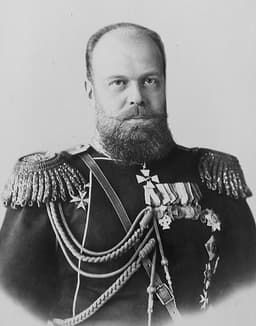
Alexander III of Russia
Emperor · Modern
49.3Total

Saif bin Sultan
Emperor · Modern
57.8Total
Basic Information
Born
1845
1692
Died
1894
1718
Era
Modern
Modern
Nationality
Russia
Oman
Occupation
Emperor
Emperor
Civilization
Western
Middle Eastern
Score Comparison
Military (10%)
21.2
67.5
Political (20%)
53.8
68.0
Influence (20%)
53.3
59.0
Legacy (20%)
43.3
48.3
Leadership (15%)
79.8
53.2
Strategy (15%)
30.3
60.0
TOTAL
49.3
57.8
Alexander III of Russia — Complete Timeline
1881 AD
Reversal of Alexander II's ReformsReform
Upon ascending the throne, Alexander III issued the Manifesto on Unshakeable Autocracy, rejecting his father's reformist policies. He strengthened the power of the nobility, increased censorship, and expanded the powers of the secret police, reversing many liberalizing measures.
Counter-ReformsAutocracyReaction
Impact: nationaldestructive
1882 AD
May Laws of 1882Political Action◆ Major
Alexander III approved the May Laws, which imposed severe restrictions on Jewish residence, property ownership, and education. These laws confined Jews to the Pale of Settlement, limited their access to higher education, and fueled anti-Semitic discrimination.
Anti-SemitismMay LawsPale of Settlement
Impact: nationaldestructive
1891 AD
Construction of the Trans-Siberian RailwayInvention◆ Major
Alexander III initiated the construction of the Trans-Siberian Railway, linking European Russia to the Pacific port of Vladivostok. The project aimed to develop Siberia and strengthen Russian control over the Far East. It became the longest railway in the world.
Trans-Siberian RailwayInfrastructureSiberia
Impact: globalconstructive
1894 AD
Franco-Russian AlliancePolitical Action◆ Major
Alexander III finalized a military alliance with France, ending Russia's diplomatic isolation. The alliance committed both powers to mutual defense against the Triple Alliance of Germany, Austria-Hungary, and Italy. This pact shaped European alliances leading to World War I.
Franco-Russian AllianceDiplomacyTriple Alliance
Impact: global
Saif bin Sultan — Complete Timeline
1698 AD
Expulsion of the Portuguese from East AfricaWar◆ Major
Saif bin Sultan led Omani forces in a campaign that captured Fort Jesus in Mombasa from the Portuguese. This victory ended over a century of Portuguese control along the Swahili coast and established Omani dominance in East Africa.
Omani-Portuguese WarEast AfricaFort Jesus
Impact: regional
Capture of ZanzibarWar◆ Major
Omani forces under Saif bin Sultan seized the island of Zanzibar from Portuguese control. This acquisition became a key base for Omani commercial and political influence in the Indian Ocean trade network.
Omani ExpansionZanzibarIndian Ocean Trade
Impact: regional
1700 AD
Consolidation of Omani Control over the Swahili CoastPolitical Action◆ Major
Following the expulsion of the Portuguese, Saif bin Sultan established Omani administrative control over key coastal cities including Kilwa, Pemba, and Mombasa. This created a unified Omani maritime empire stretching from the Persian Gulf to Mozambique.
Omani EmpireSwahili CoastAdministration
Impact: regional
Expert Analysis
Origins
Alexander III of Russia was born on March 10, 1845, in Saint Petersburg, the second son of Emperor Alexander II and Maria Alexandrovna. Unlike his elder brother Nicholas, who was groomed for the throne, Alexander received a military education typical for a grand duke, emphasizing engineering and practical skills rather than liberal arts. His father's reforms—emancipation of the serfs, judicial and military reforms—deeply influenced Alexander, but he reacted against them, favoring autocratic rule. His early exposure to the Russo-Turkish War (1877-1878) as a commander instilled a sense of Russian nationalism and suspicion of Western influence.
Saif bin Sultan was born around 1650 in the Yaruba dynasty of Oman, a period when Omani maritime power was rising. His family had a tradition of naval warfare against Portuguese incursions. Little is known of his early life, but he likely received training in seamanship and military tactics. The Yaruba imams had consolidated control over interior Oman and sought to challenge Portuguese dominance along the Swahili Coast.
Rise to Power
Alexander III ascended the throne on March 13, 1881, after the assassination of his father, Alexander II, by revolutionary terrorists. This event profoundly shaped his reign: he immediately abandoned his father's reformist path and issued the Manifesto on Unshakeable Autocracy in April 1881, affirming absolute imperial power. He dismissed liberal ministers like Loris-Melikov and appointed conservative figures such as Konstantin Pobedonostsev, who influenced his reactionary policies. His rise was sudden and defensive, driven by a desire to prevent further upheaval.
Saif bin Sultan became Imam of Oman in 1692 after the death of his father, Imam Sultan bin Saif, who had already begun anti-Portuguese campaigns. Saif inherited a strong naval tradition and a united Omani state. His rise was part of a dynastic succession, but his leadership was tested early. He launched a concerted effort to expel the Portuguese from East Africa, building on his father's successes. By 1696, he besieged Fort Jesus in Mombasa, a key Portuguese stronghold, and captured it in 1698 after a two-year siege. This victory established him as a major regional power.
Leadership & Governance
Alexander III ruled as an autocrat, reversing many of his father's reforms. He strengthened the secret police (Okhrana), curtailed local self-government (zemstvos), and imposed Russification policies on non-Russian ethnic groups, including the May Laws of 1882 that severely restricted Jewish rights. His governance was centralized and repressive, aimed at preserving the monarchy. He initiated the Trans-Siberian Railway in 1891, a massive infrastructure project to link European Russia to the Pacific, which boosted economic development but also served military and political purposes. His foreign policy was cautious, avoiding war (earning the nickname 'Peacemaker'), but he formed the Franco-Russian Alliance in 1894 to counter the Triple Alliance.
Saif bin Sultan's governance focused on expanding Omani maritime empire. He established Omani control over the Swahili Coast, appointing governors in captured cities like Mombasa, Kilwa, and Zanzibar. His administration was decentralized, relying on local allies and Omani garrisons. He promoted trade, particularly in cloves and slaves, making Zanzibar a hub. His leadership was military-driven, but he also sought to legitimize his rule through Islamic credentials as Imam. He did not impose religious uniformity, allowing Christian missionaries limited access, but prioritized Omani commercial interests.
Triumph & Tragedy
Alexander III's greatest success was maintaining peace for Russia during his reign, avoiding major wars despite tensions in the Balkans and Central Asia. The Trans-Siberian Railway, though incomplete at his death, laid the foundation for future economic growth. The Franco-Russian Alliance ended Russia's isolation and provided security against Germany. However, his repressive policies alienated intellectuals, minorities, and peasants, sowing seeds for the 1905 Revolution and eventually the 1917 Revolutions. The May Laws intensified Jewish persecution, leading to mass emigration and resentment. His reversal of reforms stalled political modernization, leaving Russia ill-prepared for the 20th century.
Saif bin Sultan's triumph was the expulsion of the Portuguese from East Africa, a decisive blow to European colonialism in the region. The capture of Fort Jesus in 1698 ended Portuguese dominance and opened the Swahili Coast to Omani control. He also captured Zanzibar, which became the center of Omani trade. However, his reign saw the beginning of Omani decline due to internal tribal conflicts and the rise of European powers. After his death in 1711, Omani unity fractured, and the Yaruba dynasty weakened. His empire relied heavily on slave trade, which later drew European abolitionist pressure. His successors could not maintain the gains, and by the 19th century, Oman lost its East African holdings to Britain.
Character & Destiny
Alexander III was known for his strong will, immense physical strength, and stubbornness. He was a devoted family man, but politically inflexible. His reactionary policies were driven by fear of revolution, which ironically accelerated discontent. Historians assess him as a competent administrator but a poor reformer. His leadership score of 79.8 reflects his ability to maintain order, but his political score of 53.8 indicates limited vision. His military score of 21.2 is low due to his peacekeeping approach. His character—pragmatic, cautious, but autocratic—shaped a reign that stabilized Russia temporarily but at the cost of long-term stagnation.
Saif bin Sultan was a warrior-imam, combining religious authority with military ambition. He was decisive and strategic, as shown in the two-year siege of Fort Jesus. His leadership score of 53.2 is moderate, reflecting his reliance on conquest rather than institutional governance. His military score of 67.5 highlights his effectiveness in warfare. His character—bold, expansionist, but perhaps overextending—led to short-term glory but long-term fragility. His destiny was to be a unifier of Omani power, but his empire crumbled after his death due to lack of structural reforms.
Legacy
Alexander III's legacy is mixed. He is remembered as a peacemaker who avoided war, but also as a repressive autocrat who reversed reforms. The Trans-Siberian Railway remains a symbol of his vision, but his Russification policies contributed to ethnic tensions. His son, Nicholas II, continued his father's autocratic path, leading to disaster. In modern Russia, he is often viewed nostalgically as a strong ruler, but historians criticize his failure to modernize. His total score of 49.3 reflects average impact; his political and influence scores (53.8 and 53.3) are moderate.
Saif bin Sultan's legacy is more localized but significant. He is celebrated in Oman as a national hero who expelled the Portuguese. The Omani empire in East Africa lasted for over a century, influencing Swahili culture and trade. However, his empire's reliance on slavery tarnishes his legacy. His total score of 57.8, higher than Alexander's, reflects his military and political achievements (67.5 and 68.0). His influence score of 59.0 is slightly higher, showing his impact on regional history.
Conclusion
While Alexander III maintained peace and built infrastructure, Saif bin Sultan achieved a decisive military victory that reshaped East African geopolitics. Alexander's repressive policies ultimately weakened Russia, while Saif's conquests expanded Omani power, even if temporarily. Saif bin Sultan had a greater impact relative to his resources and context, scoring 57.8 total to Alexander's 49.3. Saif's military (67.5 vs 21.2) and political (68.0 vs 53.8) scores are significantly higher. Alexander's leadership score (79.8) is high, but his overall legacy is less transformative. Therefore, Saif bin Sultan emerges as the more effective leader in terms of tangible achievements.
Rankings
🥇
Saif bin SultanLeader
Mil: 67.5Pol: 68.0Inf: 59.0
57.8
🥈
Alexander III of Russia
Mil: 21.2Pol: 53.8Inf: 53.3
49.3
+8.5 behind
How This Comparison Works
Algorithm
Each figure is scored on 6 dimensions (0—100 scale) based on structured historical data: Military (10%), Political (20%), Influence (20%), Legacy (20%), Leadership (15%), Strategy (15%). The weighted total produces the final ranking.
Data Sources
Scores are computed from structured sub-indicators in the database. Scale factors adjust for era (Ancient ×0.85, Modern ×1.0) and civilization size (Eastern ×1.05, Other ×0.80) to account for differences in population and military scale.
Maximum 3 Figures
Comparisons are limited to 2—3 figures to ensure readability and statistical meaningfulness.
Error Margins
±5 points per dimension — Sub-scores are derived from historical records with inherent uncertainty. Two figures within 5 points on a dimension should be considered roughly equivalent in that area.
Total Score Accuracy
±3 points overall — The weighted combination of 6 dimensions produces a total score with approximately ±3 points of uncertainty. Differences of less than 3 points are not statistically significant— the figures are effectively tied.
Known Limitations
- Historical records are incomplete and uneven across civilizations
- Figures from oral-tradition societies may be underrepresented
- Occupation labels can misclassify multi-role figures
- Scores measure capability and impact, not moral character
- Quantitative scoring is a comparison tool, not absolute truth
Capability Radar
Military (10%) — Battles & Warfare
Battles
10
60
Win Rate
10
65
Expansion
10
65
Political (20%) — Governance & Reform
Reform
40
45
Diplomacy
70
50
Economy
50
40
Influence (20%) — Cultural & Global Reach
Cultural
30
40
Global
30
45
Legacy (20%) — Historical Impact
Historical
40
50
Longevity
30
40
Leadership (15%) — Power & Stability
Tenure
60
55
Stability
70
45
Strategy (15%) — Tactics & Innovation
Strategy
10
60
Tactics
10
55
Reform
20
40
Similar Comparisons
Comments & Discussion
No comments yet. Be the first to share your thoughts!