Loading...
Alexander III of Russia vs Amar Singh I
Alexander III of Russia leads by 6.8 pts · 2 figures compared
…
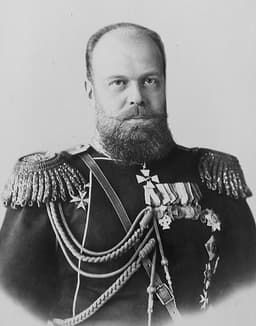
Alexander III of Russia
Emperor · Modern
49.3Total

Amar Singh I
Emperor · Modern
42.5Total
Basic Information
Born
1845
1559
Died
1894
1620
Era
Modern
Modern
Nationality
Russia
India
Occupation
Emperor
Emperor
Civilization
Western
Indian
Score Comparison
Military (10%)
21.2
50.0
Political (20%)
53.8
32.2
Influence (20%)
53.3
47.9
Legacy (20%)
43.3
37.5
Leadership (15%)
79.8
51.9
Strategy (15%)
30.3
35.7
TOTAL
49.3
42.5
Alexander III of Russia — Complete Timeline
1881 AD
Reversal of Alexander II's ReformsReform
Upon ascending the throne, Alexander III issued the Manifesto on Unshakeable Autocracy, rejecting his father's reformist policies. He strengthened the power of the nobility, increased censorship, and expanded the powers of the secret police, reversing many liberalizing measures.
Counter-ReformsAutocracyReaction
Impact: nationaldestructive
1882 AD
May Laws of 1882Political Action◆ Major
Alexander III approved the May Laws, which imposed severe restrictions on Jewish residence, property ownership, and education. These laws confined Jews to the Pale of Settlement, limited their access to higher education, and fueled anti-Semitic discrimination.
Anti-SemitismMay LawsPale of Settlement
Impact: nationaldestructive
1891 AD
Construction of the Trans-Siberian RailwayInvention◆ Major
Alexander III initiated the construction of the Trans-Siberian Railway, linking European Russia to the Pacific port of Vladivostok. The project aimed to develop Siberia and strengthen Russian control over the Far East. It became the longest railway in the world.
Trans-Siberian RailwayInfrastructureSiberia
Impact: globalconstructive
1894 AD
Franco-Russian AlliancePolitical Action◆ Major
Alexander III finalized a military alliance with France, ending Russia's diplomatic isolation. The alliance committed both powers to mutual defense against the Triple Alliance of Germany, Austria-Hungary, and Italy. This pact shaped European alliances leading to World War I.
Franco-Russian AllianceDiplomacyTriple Alliance
Impact: global
Amar Singh I — Complete Timeline
1600 AD
Continued Resistance Against MughalsWar◆ Major
Following his father Maharana Pratap's death, Amar Singh I continued the guerrilla warfare against the Mughals. He refused to submit to Akbar and later Jahangir, maintaining Mewar's independence for over a decade.
ResistanceMughal EmpireGuerrilla Warfare
Impact: regional
1606 AD
Battle of DewarWar
Amar Singh I fought the Mughal army under Jahangir at Dewar. Though initially successful, the prolonged conflict exhausted Mewar's resources, leading to eventual negotiations.
Mughal-Mewar WarBattle
Impact: regional
1615 AD
Treaty of 1615 with JahangirPolitical Action◆ Major
After years of conflict, Amar Singh I submitted to Mughal Emperor Jahangir. He agreed to send his son Karan Singh as a hostage and provide military service, ending Mewar's resistance. In return, Jahangir recognized Mewar's autonomy.
TreatyMughal EmpireMewar
Impact: regional
Expert Analysis
Origins
Alexander III of Russia was born on March 10, 1845, in St. Petersburg, the second son of Emperor Alexander II and Empress Maria Alexandrovna. As a child, he was not expected to inherit the throne, so his education focused on military training rather than statecraft. He was deeply influenced by his tutor, Konstantin Pobedonostsev, a conservative reactionary who instilled in him a belief in autocracy, Orthodoxy, and nationalism. Alexander's formative years were marked by the growing revolutionary movement and the assassination of his father in 1881, which shaped his staunch opposition to reform.
Amar Singh I was born in 1559 in Chittor, Rajasthan, the eldest son of Maharana Pratap, the legendary Rajput ruler who resisted Mughal expansion. He grew up in a period of intense conflict between the Sisodia dynasty and the Mughal Empire under Akbar and later Jahangir. His father's guerrilla tactics and refusal to submit became the foundation of Mewar's resistance. Amar Singh was trained in warfare and statecraft from a young age, inheriting a kingdom exhausted by decades of war.
Rise to Power
Alexander III ascended the throne on March 13, 1881, immediately after the assassination of Alexander II. His first act was to issue the Manifesto on Unshakeable Autocracy, signaling a reversal of his father's liberal reforms. He dismissed reform-minded ministers and surrounded himself with conservatives like Pobedonostsev. His rise was defined by a rejection of constitutionalism, increased censorship, and the expansion of the secret police (Okhrana).
Amar Singh I became the ruler of Mewar in 1597 after the death of his father Maharana Pratap. He inherited a kingdom that had been reduced to a small territory in the Aravalli hills, with a population decimated by war. He continued the guerrilla resistance against the Mughals, refusing to acknowledge Mughal suzerainty. However, after Akbar's death in 1605, the new emperor Jahangir launched a sustained campaign against Mewar, forcing Amar Singh to seek terms.
Leadership & Governance
Alexander III's leadership was characterized by a firm belief in autocracy. He reversed local self-government reforms, tightened censorship of the press, and imposed Russification policies on non-Russian minorities. His May Laws of 1882 severely restricted Jewish rights, confining them to the Pale of Settlement and limiting their economic activities. He also strengthened the position of the nobility and the Orthodox Church. His governance score of 53.8 reflects his political stability but lack of progressive vision.
Amar Singh I's leadership was defined by military resilience and eventual pragmatism. He maintained the morale of his people through years of guerrilla warfare, scoring 50.0 in military. However, his political score of 32.2 indicates his inability to secure long-term independence. In 1615, he signed a treaty with Jahangir, agreeing to send his son as a hostage and provide military service. This submission ended the century-long conflict but preserved Mewar's internal autonomy.
Triumph & Tragedy
Alexander III's greatest success was the Franco-Russian Alliance of 1892-94, which ended Russia's diplomatic isolation and created a counterweight to the Triple Alliance. He also initiated the Trans-Siberian Railway, a monumental project that connected European Russia to the Pacific, boosting economic integration and military mobility. His greatest failure was his rigid conservatism, which suppressed political dissent and sowed the seeds of the 1905 Revolution. The May Laws exacerbated anti-Semitism, leading to pogroms and emigration.
Amar Singh I's triumph was his prolonged resistance against the Mughal Empire, which preserved the honor and identity of Mewar. His submission in 1615, though a defeat, secured a favorable treaty that allowed his dynasty to continue ruling. His tragedy was the loss of independence and the heavy price of war: Mewar's resources were exhausted, and his son lived as a hostage. The treaty also required him to provide troops for Mughal campaigns, which undermined his legacy as a defiant Rajput.
Character & Destiny
Alexander III was known for his strong will, simplicity, and directness. He was a devoted family man who avoided the lavish court life of his predecessors. His obstinacy and distrust of change shaped his reign, but his personal integrity earned him the nickname "The Peacemaker" because he kept Russia out of major wars. However, his refusal to address social and political grievances created a volatile situation that erupted after his death.
Amar Singh I was a pragmatist who balanced the ideals of his father with the realities of power. He continued resistance until it became untenable, then made a strategic peace. His decision to submit was criticized by some Rajputs, but it saved his kingdom from annihilation. His character was marked by resilience and adaptability, but also by a sense of duty that forced him to compromise.
Legacy
Alexander III's legacy is mixed. He strengthened autocracy and Russian nationalism, but his policies intensified ethnic and religious tensions. The Trans-Siberian Railway became a vital artery for Russia, while the Franco-Russian Alliance laid the groundwork for the Entente in World War I. His score of 43.3 in legacy reflects his lasting impact on Russian infrastructure and foreign policy, but also the negative consequences of his suppression of reform.
Amar Singh I's legacy is primarily as a symbol of Rajput resistance and eventual accommodation. The treaty of 1615 allowed Mewar to survive as a princely state until India's independence. His submission is often seen as a necessary evil that preserved the dynasty. His influence score of 47.9 indicates his role in shaping Rajput-Mughal relations, but his legacy is overshadowed by his father Maharana Pratap's more uncompromising stance.
Conclusion
Alexander III had a greater impact on history than Amar Singh I. His total score of 49.3 surpasses Amar Singh's 42.5 by 6.8 points. Alexander III's decisions shaped Russia's domestic and foreign policies for decades, influencing the course of World War I and the Russian Revolution. Amar Singh I's resistance, while valiant, ultimately resulted in submission and limited long-term consequences beyond his region. Alexander III's construction of the Trans-Siberian Railway and his foreign alliances had global implications, whereas Amar Singh I's treaty primarily affected Mewar's immediate survival. Therefore, Alexander III's influence and legacy are more significant on a world scale.
Rankings
🥇
Alexander III of RussiaLeader
Mil: 21.2Pol: 53.8Inf: 53.3
49.3
🥈
Amar Singh I
Mil: 50.0Pol: 32.2Inf: 47.9
42.5
+6.8 behind
How This Comparison Works
Algorithm
Each figure is scored on 6 dimensions (0—100 scale) based on structured historical data: Military (10%), Political (20%), Influence (20%), Legacy (20%), Leadership (15%), Strategy (15%). The weighted total produces the final ranking.
Data Sources
Scores are computed from structured sub-indicators in the database. Scale factors adjust for era (Ancient ×0.85, Modern ×1.0) and civilization size (Eastern ×1.05, Other ×0.80) to account for differences in population and military scale.
Maximum 3 Figures
Comparisons are limited to 2—3 figures to ensure readability and statistical meaningfulness.
Error Margins
±5 points per dimension — Sub-scores are derived from historical records with inherent uncertainty. Two figures within 5 points on a dimension should be considered roughly equivalent in that area.
Total Score Accuracy
±3 points overall — The weighted combination of 6 dimensions produces a total score with approximately ±3 points of uncertainty. Differences of less than 3 points are not statistically significant— the figures are effectively tied.
Known Limitations
- Historical records are incomplete and uneven across civilizations
- Figures from oral-tradition societies may be underrepresented
- Occupation labels can misclassify multi-role figures
- Scores measure capability and impact, not moral character
- Quantitative scoring is a comparison tool, not absolute truth
Capability Radar
Military (10%) — Battles & Warfare
Battles
10
20
Win Rate
10
15
Expansion
10
10
Political (20%) — Governance & Reform
Reform
40
15
Diplomacy
70
20
Economy
50
15
Influence (20%) — Cultural & Global Reach
Cultural
30
15
Global
30
10
Legacy (20%) — Historical Impact
Historical
40
20
Longevity
30
15
Leadership (15%) — Power & Stability
Tenure
60
25
Stability
70
20
Strategy (15%) — Tactics & Innovation
Strategy
10
15
Tactics
10
20
Reform
20
10
Similar Comparisons
Comments & Discussion
No comments yet. Be the first to share your thoughts!