Loading...
Wang Jian vs Xiahou Dun
Wang Jian leads by 10.1 pts · 2 figures compared
…
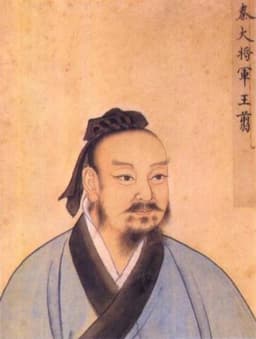
Wang Jian
General · Ancient
54.7Total

Xiahou Dun
General · Ancient
44.6Total
Basic Information
Born
-260
155
Died
-210
220
Era
Ancient
Ancient
Nationality
China
China
Occupation
General
General
Civilization
Eastern
Eastern
Score Comparison
Military (10%)
88.0
52.5
Political (20%)
33.6
32.1
Influence (20%)
56.4
51.0
Legacy (20%)
56.0
44.2
Leadership (15%)
36.9
36.9
Strategy (15%)
72.0
52.5
TOTAL
54.7
44.6
Wang Jian — Complete Timeline
228 BC
Conquest of ZhaoWar◆ Major
Wang Jian led the Qin army to conquer the state of Zhao, capturing King Qian of Zhao. This victory eliminated one of the last major obstacles to Qin unification of China.
ConquestQin StateZhao State
Impact: regionaldestructive
223 BC
Conquest of ChuWar◆ Major
Wang Jian led a Qin army of 600,000 men to conquer the state of Chu. He defeated the Chu general Xiang Yan and captured King Fuchu of Chu, annexing Chu territory into Qin.
ConquestQin StateChu State
Impact: regionaldestructive
222 BC
Conquest of YanWar
Wang Jian led the Qin army to conquer the state of Yan, capturing King Xi of Yan. This victory further consolidated Qin control over northern China.
ConquestQin StateYan State
Impact: regionaldestructive
210 BC
Retirement and DeathOther
After the conquest of Chu, Wang Jian retired from military service. He died in 210 BC, having played a crucial role in the unification of China under Qin Shi Huang.
RetirementQin StateUnification
Impact: national
Xiahou Dun — Complete Timeline
190 AD
Battle of XingyangWar◆ Major
Xiahou Dun served under Cao Cao during the campaign against Dong Zhuo. He was wounded by an arrow in the eye during a skirmish, an injury that defined his later appearance and reputation as the one-eyed general.
Three KingdomsInjuryCao Cao
Impact: nationaltragic
194 AD
Battle of PuyangWar
Xiahou Dun was captured by L
Three KingdomsCaptureLü Bu
Impact: national
200 AD
Battle of GuanduWar◆ Major
Xiahou Dun commanded a detachment of Cao Cao's army during the decisive campaign against Yuan Shao. He helped secure supply lines and participated in the final assault that broke Yuan Shao's forces.
Three KingdomsBattleYuan Shao
Impact: nationalconstructive
202 AD
Battle of BowangWar
Xiahou Dun led an expedition against Liu Bei but was defeated by a fire attack at Bowang. He retreated with heavy losses, a rare defeat in his career.
Three KingdomsDefeatLiu Bei
Impact: nationaldestructive
205 AD
Appointed General of the VanguardPolitical Action◆ Major
Cao Cao appointed Xiahou Dun as General of the Vanguard, one of the highest military posts in Wei. This reflected his trusted status and long service.
Three KingdomsPromotionCao Cao
Impact: nationalconstructive
220 AD
Death and Posthumous HonorsOther
Xiahou Dun died shortly after Cao Cao's death. He was posthumously granted the title of Marquis of Dangtu, honoring his decades of loyalty and service to Wei.
Three KingdomsDeathHonors
Impact: national
Expert Analysis
Origins
Wang Jian was born around 300 BC in the state of Qin during the Warring States period. Little is known of his early life, but he rose through the ranks of the Qin military due to his strategic acumen. Xiahou Dun, born around 155 AD in the late Eastern Han dynasty, hailed from a family of officials in Pei Commandery. He was a relative of Cao Cao, which facilitated his early entry into Cao's service. Both men came from backgrounds that emphasized military service, but Wang Jian's origins were more obscure, while Xiahou Dun's family connections gave him a head start.
Rise to Power
Wang Jian's rise came under King Ying Zheng of Qin. He first distinguished himself in the conquest of Zhao in 228 BC, leading a massive army to capture King Qian of Zhao and annex the state. This victory eliminated a major rival and showcased his ability to command large forces. In 226 BC, he conquered Yan, capturing King Xi. His greatest achievement came in 224 BC when he led a 600,000-strong army against Chu, defeating the famed general Xiang Yan and annexing the state. Xiahou Dun rose to prominence during Cao Cao's campaigns. He first gained notice at the Battle of Xingyang in 190 AD, where he was wounded by an arrow in the eye, an injury that became his defining feature. His loyalty was proven when he was captured by Lü Bu in 194 AD but was ransomed. Cao Cao appointed him General of the Vanguard, a high post, reflecting his trust. He played a role in the Battle of Guandu in 200 AD, securing supply lines against Yuan Shao. However, his independent command at Bowang in 202 AD ended in defeat by Liu Bei's fire attack.
Leadership & Governance
Wang Jian's leadership style emphasized meticulous planning and overwhelming force. He insisted on a massive army of 600,000 for the Chu campaign, despite Qin's initial reluctance. He used psychological warfare, such as feigning weakness to lull the Chu forces into complacency. In governance, he was a military commander who focused on conquest rather than administration. Xiahou Dun's leadership was marked by personal bravery and loyalty. He was known for his frugality and care for his troops, but his strategic decisions were less sophisticated. He relied on frontal assaults and was outmaneuvered by Liu Bei at Bowang. In governance, he served as a regional commander but did not implement lasting reforms.
Triumph & Tragedy
Wang Jian's triumphs were the conquests of Zhao, Yan, and Chu, which directly enabled Qin's unification of China in 221 BC. His use of a huge army and patient strategy against Chu is considered a masterpiece. His tragedy was that after these victories, he retired and died in 210 BC, not living to see the full unification. He also failed to capture the last state, Qi, which surrendered later. Xiahou Dun's triumph was his unwavering service to Cao Cao, culminating in his appointment as General of the Vanguard. He was a symbol of loyalty. His tragedy was his defeat at Bowang, which exposed his limitations as an independent commander. He died in 220 AD, shortly after Cao Cao's death, without achieving major independent victories.
Character & Destiny
Wang Jian was cautious, pragmatic, and calculating. He demanded the resources he needed and was willing to wait for the right moment. This character led to his success in large-scale campaigns. Xiahou Dun was brave and loyal but impulsive. His injury at Xingyang and capture by Lü Bu show his willingness to take risks, but his defeat at Bowang reveals a lack of strategic depth. Historical assessments note that Wang Jian was a key architect of unification, while Xiahou Dun was a reliable but not brilliant general.
Legacy
Wang Jian's legacy is as one of the greatest generals of the Warring States, whose conquests made the Qin unification possible. His strategies influenced later Chinese military thought. He scored 56.0 in legacy. Xiahou Dun is remembered as a loyal one-eyed general in the Romance of the Three Kingdoms, but his historical impact is limited. He scored 44.2 in legacy. Wang Jian's conquests changed the political landscape of China, while Xiahou Dun's service upheld Cao Wei but did not alter history's course.
Conclusion
Wang Jian had a greater impact on history than Xiahou Dun. His military score of 88.0 dwarfs Xiahou Dun's 52.5, reflecting his decisive role in unifying China. While Xiahou Dun was a capable and loyal officer, his achievements were subordinate to Cao Cao's larger plans. Wang Jian's conquests directly led to the first imperial dynasty, a transformation that shaped Chinese history for millennia. Therefore, Wang Jian is the superior figure in terms of historical impact.
Rankings
🥇
Wang JianLeader
Mil: 88.0Pol: 33.6Inf: 56.4
54.7
🥈
Xiahou Dun
Mil: 52.5Pol: 32.1Inf: 51.0
44.6
+10.1 behind
How This Comparison Works
Algorithm
Each figure is scored on 6 dimensions (0—100 scale) based on structured historical data: Military (10%), Political (20%), Influence (20%), Legacy (20%), Leadership (15%), Strategy (15%). The weighted total produces the final ranking.
Data Sources
Scores are computed from structured sub-indicators in the database. Scale factors adjust for era (Ancient ×0.85, Modern ×1.0) and civilization size (Eastern ×1.05, Other ×0.80) to account for differences in population and military scale.
Maximum 3 Figures
Comparisons are limited to 2—3 figures to ensure readability and statistical meaningfulness.
Error Margins
±5 points per dimension — Sub-scores are derived from historical records with inherent uncertainty. Two figures within 5 points on a dimension should be considered roughly equivalent in that area.
Total Score Accuracy
±3 points overall — The weighted combination of 6 dimensions produces a total score with approximately ±3 points of uncertainty. Differences of less than 3 points are not statistically significant— the figures are effectively tied.
Known Limitations
- Historical records are incomplete and uneven across civilizations
- Figures from oral-tradition societies may be underrepresented
- Occupation labels can misclassify multi-role figures
- Scores measure capability and impact, not moral character
- Quantitative scoring is a comparison tool, not absolute truth
Capability Radar
Military (10%) — Battles & Warfare
Battles
85
45
Win Rate
90
50
Expansion
90
30
Political (20%) — Governance & Reform
Reform
20
15
Diplomacy
30
35
Economy
20
25
Influence (20%) — Cultural & Global Reach
Cultural
40
35
Global
50
20
Legacy (20%) — Historical Impact
Historical
70
40
Longevity
60
35
Leadership (15%) — Power & Stability
Tenure
40
40
Stability
30
30
Strategy (15%) — Tactics & Innovation
Strategy
85
50
Tactics
80
55
Reform
60
20
Similar Comparisons
Comments & Discussion
No comments yet. Be the first to share your thoughts!