Loading...
Teodoro Obiang Nguema vs Victoriano Huerta
Teodoro Obiang Nguema leads by 10.5 pts · 2 figures compared
…

Teodoro Obiang Nguema
General · Modern
51.1Total
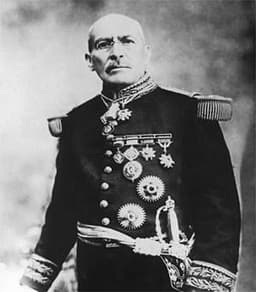
Victoriano Huerta
General · Modern
40.6Total
Basic Information
Born
1942
1850
Died
—
1916
Era
Modern
Modern
Nationality
Equatorial Guinea
Mexico
Occupation
General
General
Civilization
Other
Western
Score Comparison
Military (10%)
67.2
10.0
Political (20%)
30.8
32.2
Influence (20%)
47.9
49.4
Legacy (20%)
46.7
40.8
Leadership (15%)
70.0
41.5
Strategy (15%)
56.6
60.0
TOTAL
51.1
40.6
Teodoro Obiang Nguema — Complete Timeline
1979 AD
Seized Power in a Coup d'ÉtatPolitical Action
Teodoro Obiang Nguema Mbasogo led a coup that overthrew his uncle, President Francisco Mac
CoupPower Seizure
Impact: nationaldestructive
Executed Political RivalsPolitical Action◆ Major
Obiang ordered the execution of his uncle and several former officials, consolidating his power. The executions were part of a broader purge of political opponents and marked the start of his repressive regime.
ExecutionRepression
Impact: nationaldestructive
1996 AD
Re-elected in Controversial ElectionsPolitical Action◆ Major
Obiang won a presidential election with 97.8% of the vote, but the election was widely criticized as fraudulent by international observers. He has since been re-elected multiple times in similarly disputed polls.
Election FraudAuthoritarianism
Impact: nationaldestructive
2004 AD
Survived a Coup AttemptPolitical Action◆ Major
Obiang survived a coup attempt allegedly involving foreign mercenaries, including Mark Thatcher. The plot was foiled, and the perpetrators were tried and imprisoned, further entrenching Obiang's rule.
Coup AttemptSurvival
Impact: national
2022 AD
Became Longest-Serving Current Head of StatePolitical Action◆ Major
Obiang became the longest-serving current head of state in the world, surpassing Paul Biya of Cameroon. His tenure has been marked by authoritarianism, corruption, and human rights abuses.
LongevityAuthoritarianism
Impact: global
Victoriano Huerta — Complete Timeline
1913 AD
Coup d'état against Francisco I. MaderoPolitical Action
Huerta, as commander of the Mexican federal army, orchestrated a coup against President Francisco I. Madero during the Ten Tragic Days. Madero and Vice President Pino Su
CoupMexican RevolutionMadero
Impact: nationaldestructive
Presidency of MexicoPolitical Action◆ Major
Huerta served as President of Mexico from February 1913 to July 1914. His regime was characterized by authoritarian rule, suppression of opposition, and reliance on the federal army, but it faced widespread rebellion from revolutionary factions.
PresidencyDictatorshipMexican Revolution
Impact: nationaldestructive
Dissolution of CongressPolitical Action
Huerta dissolved the Mexican Congress in October 1913 after it refused to approve his policies. He ruled by decree, arresting or exiling many deputies, which further alienated moderate politicians and intensified opposition to his regime.
CongressAuthoritarianismRepression
Impact: nationaldestructive
1914 AD
Defeat by Constitutionalist ArmyWar
Huerta's federal forces were defeated by the Constitutionalist Army led by Venustiano Carranza,
Mexican RevolutionDefeatExile
Impact: nationaltragic
Exile and DeathPolitical Action
After his resignation, Huerta fled to Spain and later to the United States. He was arrested by U.S. authorities in 1915 for plotting to return to power and died in custody in El Paso, Texas, in 1916, ending his political ambitions.
ExileDeathEnd of Career
Impact: nationaltragic
Expert Analysis
Origins
Teodoro Obiang Nguema Mbasogo was born on January 5, 1942, in Acoacán, Spanish Guinea (now Equatorial Guinea). He grew up in the Fang ethnic group, his uncle Francisco Macías Nguema later becoming the country's first president. Obiang attended military academies in Spain, graduating as a lieutenant. He served in the colonial guard and rose through the ranks under his uncle's regime.
Victoriano Huerta Márquez was born on December 22, 1845, in Colotlán, Jalisco, Mexico, to a poor indigenous Huichol family. He joined the military as a cadet and excelled, eventually becoming a general under President Porfirio Díaz. Huerta was known for his strict discipline and alcoholism, but also for his military competence.
Rise to Power
Obiang seized power in a bloodless coup on August 3, 1979, overthrowing his uncle, Francisco Macías Nguema, whose brutal rule had killed tens of thousands. Obiang, then Minister of Defense, led a military junta. He quickly ordered the execution of his uncle and several officials, consolidating control. By 1982, he had transformed the junta into a civilian presidency with a new constitution.
Huerta rose to national prominence during the Mexican Revolution. In 1913, he conspired with U.S. Ambassador Henry Lane Wilson and rebel generals to overthrow President Francisco I. Madero. During the Ten Tragic Days (February 9–19, 1913), Huerta's forces bombarded Mexico City, leading to Madero's arrest and execution. Huerta assumed the presidency on February 19, 1913, with support from the old Porfirian elite.
Leadership & Governance
Obiang's leadership score of 70.0 reflects his firm grip on power for over four decades. He rules through a combination of patronage, repression, and manipulation of ethnic rivalries. His Democratic Party of Equatorial Guinea (PDGE) dominates all political institutions. Elections are routinely rigged; in 2016, he claimed 93.7% of the vote. He has survived numerous coup attempts, most notably in 2004 involving foreign mercenaries. Economically, he has used oil revenues to enrich his inner circle, while the majority of the population lives in poverty.
Huerta's political score of 32.2 indicates his short and turbulent rule. He dissolved Congress in October 1913 and ruled by decree, arresting or exiling opponents. His regime was authoritarian but faced constant rebellion from Constitutionalist forces led by Venustiano Carranza, Álvaro Obregón, and Pancho Villa. Huerta's military score of 10.0 reflects his eventual defeat, despite early successes. He imposed martial law and suppressed dissent, but his reliance on the federal army proved insufficient against the popular uprising.
Triumph & Tragedy
Obiang's greatest success is his longevity: he became the world's longest-serving current head of state in 2016, surpassing Paul Biya. He has maintained stability and exploited Equatorial Guinea's oil wealth, making it one of Africa's largest oil exporters. However, his tragedy is the extreme corruption and human rights abuses. The UN and Amnesty International have documented torture, forced disappearances, and political imprisonment. The country's wealth is concentrated among a small elite, with 70% of the population living below the poverty line.
Huerta's triumph was briefly uniting the old regime and stabilizing Mexico City after Madero's chaotic rule. He suppressed the Zapatista uprising in Morelos temporarily. But his tragedy was his overthrow after only 17 months. His defeat at the Battle of Zacatecas (June 23, 1914) by Pancho Villa's forces forced his resignation. Huerta fled to Spain, then the U.S., where he was arrested for plotting to return to power. He died in U.S. custody in 1916, an alcoholic and broken man.
Character & Destiny
Obiang is described as calculating and ruthless, willing to eliminate family members to secure power. His leadership score of 70.0 suggests effective control, but his political score of 30.8 indicates a lack of democratic legitimacy. He has maintained power through a network of loyalists and security forces. His destiny is to be one of Africa's longest-serving dictators, likely dying in office.
Huerta was known for his alcoholism, paranoia, and harsh discipline. His strategy score of 60.0 shows some military acumen, but his political score of 32.2 reflects his inability to build broad support. His character—authoritarian and unyielding—led him to alienate potential allies. His destiny was a short, violent rule ending in exile and death.
Legacy
Obiang's legacy is mixed: he brought stability to a country torn by his uncle's tyranny, but at the cost of democracy and human rights. His influence score of 47.9 reflects his limited global impact, though he has used oil wealth to gain diplomatic support from former colonial powers like Spain and France. His legacy will likely be as a symbol of African autocracy.
Huerta's legacy is overwhelmingly negative. He is remembered as a traitor who overthrew a democratically elected president and plunged Mexico into a more violent phase of the Revolution. His influence score of 49.4 is slightly higher than Obiang's, due to his role in a major historical event. However, his total score of 40.6 is lower than Obiang's 51.1.
Conclusion
Teodoro Obiang Nguema has had a greater impact than Victoriano Huerta, despite Huerta's role in a more significant historical event. Obiang's total score of 51.1 exceeds Huerta's 40.6, with higher marks in military (67.2 vs 10.0), leadership (70.0 vs 41.5), and strategy (56.6 vs 60.0). Obiang's four-decade rule has shaped an entire nation, for better or worse, while Huerta's brief presidency was a failed interlude in a larger revolution. Obiang's longevity and control of oil resources give him a lasting impact that Huerta, who died in obscurity, lacks. Thus, Obiang emerges as the more significant historical figure.
Rankings
🥇
Teodoro Obiang NguemaLeader
Mil: 67.2Pol: 30.8Inf: 47.9
51.1
🥈
Victoriano Huerta
Mil: 10.0Pol: 32.2Inf: 49.4
40.6
+10.5 behind
How This Comparison Works
Algorithm
Each figure is scored on 6 dimensions (0—100 scale) based on structured historical data: Military (10%), Political (20%), Influence (20%), Legacy (20%), Leadership (15%), Strategy (15%). The weighted total produces the final ranking.
Data Sources
Scores are computed from structured sub-indicators in the database. Scale factors adjust for era (Ancient ×0.85, Modern ×1.0) and civilization size (Eastern ×1.05, Other ×0.80) to account for differences in population and military scale.
Maximum 3 Figures
Comparisons are limited to 2—3 figures to ensure readability and statistical meaningfulness.
Error Margins
±5 points per dimension — Sub-scores are derived from historical records with inherent uncertainty. Two figures within 5 points on a dimension should be considered roughly equivalent in that area.
Total Score Accuracy
±3 points overall — The weighted combination of 6 dimensions produces a total score with approximately ±3 points of uncertainty. Differences of less than 3 points are not statistically significant— the figures are effectively tied.
Known Limitations
- Historical records are incomplete and uneven across civilizations
- Figures from oral-tradition societies may be underrepresented
- Occupation labels can misclassify multi-role figures
- Scores measure capability and impact, not moral character
- Quantitative scoring is a comparison tool, not absolute truth
Capability Radar
Military (10%) — Battles & Warfare
Battles
50
45
Win Rate
54
40
Expansion
60
25
Political (20%) — Governance & Reform
Reform
5
15
Diplomacy
30
20
Economy
10
15
Influence (20%) — Cultural & Global Reach
Cultural
5
15
Global
10
10
Legacy (20%) — Historical Impact
Historical
10
25
Longevity
70
10
Leadership (15%) — Power & Stability
Tenure
95
20
Stability
20
10
Strategy (15%) — Tactics & Innovation
Strategy
61
45
Tactics
67
50
Reform
65
30
Similar Comparisons
Comments & Discussion
No comments yet. Be the first to share your thoughts!