Loading...
Mathieu Kerekou vs Victoriano Huerta
Mathieu Kerekou leads by 6.0 pts · 2 figures compared
…

Mathieu Kerekou
General · Modern
46.6Total
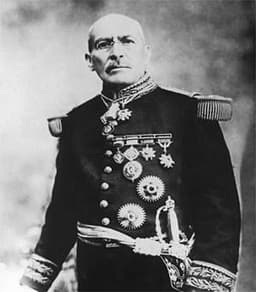
Victoriano Huerta
General · Modern
40.6Total
Basic Information
Born
1933
1850
Died
—
1916
Era
Modern
Modern
Nationality
Benin
Mexico
Occupation
General
General
Civilization
Other
Western
Score Comparison
Military (10%)
22.6
10.0
Political (20%)
45.0
32.2
Influence (20%)
54.1
49.4
Legacy (20%)
46.7
40.8
Leadership (15%)
66.0
41.5
Strategy (15%)
25.0
60.0
TOTAL
46.6
40.6
Mathieu Kerekou — Complete Timeline
1972 AD
Seized Power in Military CoupPolitical Action◆ Major
Kerekou led a military coup that overthrew the government of Hubert Maga, establishing a Marxist-Leninist regime. He declared the country a People's Republic and nationalized key sectors of the economy.
CoupBeninMarxism
Impact: nationaldestructive
1974 AD
Implemented Marxist PoliciesReform◆ Major
Kerekou adopted a Marxist-Leninist ideology, nationalizing banks, insurance companies, and industries. He also collectivized agriculture and established state farms. These policies led to economic decline and isolation.
MarxismNationalizationBenin
Impact: national
1989 AD
Abandoned Marxism and Transitioned to DemocracyReform
Facing economic collapse and popular unrest, Kerekou renounced Marxism, initiated political reforms, and called a national conference that led to multiparty elections. This peaceful transition was a landmark in Africa.
DemocratizationBeninNational Conference
Impact: regionalconstructive
1991 AD
Lost Presidential ElectionPolitical Action◆ Major
Kerekou lost the presidential election to Nic
ElectionBeninPeaceful Transfer
Impact: nationalconstructive
1996 AD
Re-elected President of BeninPolitical Action◆ Major
Kerekou won the presidential election, returning to power through democratic means. His victory demonstrated the consolidation of democracy in Benin, as he had transformed from a Marxist dictator to an elected leader.
ElectionBeninReturn to Power
Impact: nationalconstructive
2006 AD
Retired from PresidencyPolitical Action◆ Major
Kerekou stepped down after two terms, respecting constitutional term limits. He was succeeded by Thomas Boni Yayi. His peaceful departure further solidified Benin's democratic reputation.
Term LimitsPeaceful TransitionBenin
Impact: nationalconstructive
Victoriano Huerta — Complete Timeline
1913 AD
Coup d'état against Francisco I. MaderoPolitical Action
Huerta, as commander of the Mexican federal army, orchestrated a coup against President Francisco I. Madero during the Ten Tragic Days. Madero and Vice President Pino Su
CoupMexican RevolutionMadero
Impact: nationaldestructive
Presidency of MexicoPolitical Action◆ Major
Huerta served as President of Mexico from February 1913 to July 1914. His regime was characterized by authoritarian rule, suppression of opposition, and reliance on the federal army, but it faced widespread rebellion from revolutionary factions.
PresidencyDictatorshipMexican Revolution
Impact: nationaldestructive
Dissolution of CongressPolitical Action
Huerta dissolved the Mexican Congress in October 1913 after it refused to approve his policies. He ruled by decree, arresting or exiling many deputies, which further alienated moderate politicians and intensified opposition to his regime.
CongressAuthoritarianismRepression
Impact: nationaldestructive
1914 AD
Defeat by Constitutionalist ArmyWar
Huerta's federal forces were defeated by the Constitutionalist Army led by Venustiano Carranza,
Mexican RevolutionDefeatExile
Impact: nationaltragic
Exile and DeathPolitical Action
After his resignation, Huerta fled to Spain and later to the United States. He was arrested by U.S. authorities in 1915 for plotting to return to power and died in custody in El Paso, Texas, in 1916, ending his political ambitions.
ExileDeathEnd of Career
Impact: nationaltragic
Expert Analysis
Origins
Mathieu Kerekou was born on September 2, 1933, in Kouffou, Dahomey (now Benin), into a Bariba family. He attended local schools and then joined the French army, serving in Indochina and Senegal. After independence, he returned to Dahomey and joined the army, rising to the rank of major. His military background shaped his early career, but he had no formal political education.
Victoriano Huerta was born on December 23, 1850, in Colotlán, Jalisco, Mexico, to a poor indigenous Huichol family. He entered the Military Academy at Chapultepec at age 15, excelling in mathematics and engineering. He served in the Mexican army under Porfirio Díaz, participating in campaigns against indigenous rebels and modernizing the military. His technical training and loyalty to Díaz defined his early career.
Rise to Power
Kerekou seized power in a military coup on October 26, 1972, overthrowing the government of President Hubert Maga. At the time, Dahomey had experienced multiple coups and political instability. Kerekou established a Marxist-Leninist regime, renaming the country Benin in 1975. He consolidated power by eliminating rivals and creating a single party, the People's Revolutionary Party of Benin (PRPB). His rise was swift, capitalizing on the failure of civilian governments.
Huerta rose to prominence as a loyalist under President Porfirio Díaz and later served President Francisco I. Madero. During the Ten Tragic Days in February 1913, Huerta turned against Madero, forming an alliance with conservative forces and U.S. Ambassador Henry Lane Wilson. He orchestrated a coup, arrested Madero, and assumed the presidency after Madero's assassination. His rise was marked by betrayal and violence.
Leadership & Governance
Kerekou's leadership evolved dramatically. Initially, he implemented Marxist policies: nationalizing banks, insurance companies, and key industries; collectivizing agriculture; and establishing state farms. He suppressed opposition and controlled the media. However, by the late 1980s, economic collapse forced him to abandon Marxism. In 1990, he initiated a national conference that led to a new constitution and multiparty elections. He lost the 1991 election but returned to win in 1996 and 2001, governing as a democrat. His political score of 45.0 reflects this adaptive, if pragmatic, approach.
Huerta's governance was authoritarian and repressive. He dissolved Congress in October 1913, ruling by decree. He suppressed press freedom, arrested opponents, and used the military to maintain control. His regime lacked popular support and relied on the federal army, which was demoralized. He attempted to raise funds through foreign loans and internal taxes, but his rule was chaotic. His political score of 32.2 indicates his failure to build a stable government.
Triumph & Tragedy
Kerekou's greatest triumph was his peaceful transition from Marxism to democracy. He called the 1990 national conference, which led to free elections. He lost the 1991 election and conceded defeat, a rare act in Africa. His return to power in 1996 through elections showed the consolidation of democracy. However, his Marxist period was a tragedy: economic stagnation, human rights abuses, and repression. The economy contracted, and agricultural production fell. His military score of 22.6 reflects his limited military achievements.
Huerta's triumph was briefly stabilizing Mexico after Madero's chaotic rule, but his regime was never secure. His greatest tragedy was his failure to hold power: he faced widespread rebellion, including the Constitutionalist Army led by Carranza, Villa, and Obregón. He resigned in July 1914 after military defeats. His legacy is that of a usurper who plunged Mexico into civil war. His military score of 10.0 is among the lowest, indicating his ineffective command.
Character & Destiny
Kerekou was pragmatic and adaptable. He abandoned ideology when it became untenable, showing political survival instincts. He was also willing to accept defeat, which allowed him to return later. His character was shaped by a desire to maintain power, but he ultimately respected democratic processes. Historians note his ability to read political winds.
Huerta was ruthless and authoritarian. He was known for his alcoholism and paranoid tendencies. His decision to murder Madero created a legitimacy crisis that doomed his presidency. He refused to compromise with opponents, leading to isolation. His character sealed his fate: he died in exile, under arrest in the United States in 1916.
Legacy
Kerekou's legacy is mixed but significant. He is remembered for transitioning Benin from Marxism to democracy, a model in Africa. His peaceful concession in 1991 and subsequent return to power demonstrated that democracy could work. However, his Marxist years left a legacy of economic hardship. His influence score of 54.1 reflects his role as a pioneer of democratic transitions.
Huerta's legacy is overwhelmingly negative. He is seen as a traitor and a dictator who destabilized Mexico. His coup triggered the most violent phase of the Mexican Revolution, causing hundreds of thousands of deaths. He is remembered as a cautionary figure. His legacy score of 40.8 reflects his infamy.
Conclusion
Mathieu Kerekou had a greater impact than Victoriano Huerta. Kerekou's shift from Marxism to democracy scored 46.7 in legacy, while Huerta scored 40.8. Kerekou's political score of 45.0 versus Huerta's 32.2 underscores his superior governance. Huerta's military score of 10.0 is abysmal, while Kerekou's 22.6 is low but not catastrophic. Overall, Kerekou's total score of 46.6 versus Huerta's 40.6 reflects his more enduring influence. Kerekou's peaceful transition and democratic consolidation outweigh Huerta's brief, violent rule. While neither was a great leader, Kerekou's adaptability and respect for democracy mark him as more consequential.
Rankings
🥇
Mathieu KerekouLeader
Mil: 22.6Pol: 45.0Inf: 54.1
46.6
🥈
Victoriano Huerta
Mil: 10.0Pol: 32.2Inf: 49.4
40.6
+6.0 behind
How This Comparison Works
Algorithm
Each figure is scored on 6 dimensions (0—100 scale) based on structured historical data: Military (10%), Political (20%), Influence (20%), Legacy (20%), Leadership (15%), Strategy (15%). The weighted total produces the final ranking.
Data Sources
Scores are computed from structured sub-indicators in the database. Scale factors adjust for era (Ancient ×0.85, Modern ×1.0) and civilization size (Eastern ×1.05, Other ×0.80) to account for differences in population and military scale.
Maximum 3 Figures
Comparisons are limited to 2—3 figures to ensure readability and statistical meaningfulness.
Error Margins
±5 points per dimension — Sub-scores are derived from historical records with inherent uncertainty. Two figures within 5 points on a dimension should be considered roughly equivalent in that area.
Total Score Accuracy
±3 points overall — The weighted combination of 6 dimensions produces a total score with approximately ±3 points of uncertainty. Differences of less than 3 points are not statistically significant— the figures are effectively tied.
Known Limitations
- Historical records are incomplete and uneven across civilizations
- Figures from oral-tradition societies may be underrepresented
- Occupation labels can misclassify multi-role figures
- Scores measure capability and impact, not moral character
- Quantitative scoring is a comparison tool, not absolute truth
Capability Radar
Military (10%) — Battles & Warfare
Battles
10
45
Win Rate
10
40
Expansion
5
25
Political (20%) — Governance & Reform
Reform
65
15
Diplomacy
60
20
Economy
40
15
Influence (20%) — Cultural & Global Reach
Cultural
30
15
Global
25
10
Legacy (20%) — Historical Impact
Historical
40
25
Longevity
30
10
Leadership (15%) — Power & Stability
Tenure
70
20
Stability
45
10
Strategy (15%) — Tactics & Innovation
Strategy
10
45
Tactics
10
50
Reform
15
30
Similar Comparisons
Comments & Discussion
No comments yet. Be the first to share your thoughts!