Loading...
Soe Win vs William Tecumseh Sherman
William Tecumseh Sherman leads by 19.9 pts · 2 figures compared
…
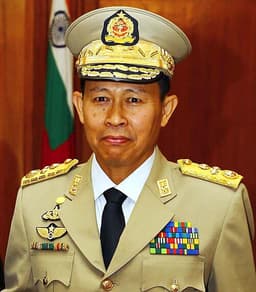
Soe Win
General · Modern
41.7Total

William Tecumseh Sherman
General · Modern
61.6Total
Basic Information
Born
1947
1820
Died
—
1891
Era
Modern
Modern
Nationality
Myanmar
United States
Occupation
General
General
Civilization
Eastern
Western
Score Comparison
Military (10%)
25.9
72.0
Political (20%)
30.8
42.2
Influence (20%)
48.6
65.0
Legacy (20%)
40.0
68.0
Leadership (15%)
57.6
50.7
Strategy (15%)
36.8
72.0
TOTAL
41.7
61.6
Soe Win — Complete Timeline
2004 AD
Appointed Prime Minister of MyanmarPolitical Action◆ Major
Soe Win was appointed Prime Minister of Myanmar by the State Peace and Development Council, succeeding Khin Nyunt. He served as a key figure in the military junta's government.
Military JuntaGovernment Appointment
Impact: national
2007 AD
Saffron Revolution CrackdownPolitical Action
As Prime Minister, Soe Win oversaw the military's violent suppression of the Saffron Revolution, a series of anti-government protests led by Buddhist monks. The crackdown resulted in numerous deaths, arrests, and international condemnation.
Saffron RevolutionHuman RightsRepression
Impact: nationaldestructive
Death in OfficeOther
Soe Win died in office on October 12, 2007, from leukemia. His death occurred shortly after the Saffron Revolution crackdown, and he was succeeded by Thein Sein.
DeathSuccession
Impact: national
William Tecumseh Sherman — Complete Timeline
1862 AD
Battle of ShilohWar◆ Major
Sherman commanded a division at Shiloh, where his initial failure to entrench led to a surprise Confederate attack. Despite heavy losses, he rallied his troops and contributed to the Union victory, though the battle was criticized for poor preparation.
American Civil WarWestern TheaterBloody Battle
Impact: nationaltragic
1863 AD
Battle of VicksburgWar
Sherman played a key role in Grant's Vicksburg Campaign, leading assaults and siege operations. The capture of Vicksburg gave the Union control of the Mississippi River, splitting the Confederacy in two.
American Civil WarSiegeMississippi River
Impact: national
1864 AD
March to the SeaWar
Sherman led 60,000 Union troops from Atlanta to Savannah, destroying railroads, factories, and civilian property in a 300-mile swath. The campaign aimed to break Confederate morale and economic capacity, and resulted in the capture of Savannah.
American Civil WarTotal WarScorched Earth
Impact: nationaldestructive
1865 AD
Carolinas CampaignWar◆ Major
Sherman led his army through the Carolinas, destroying infrastructure and supplies. The campaign culminated in the capture of Columbia, South Carolina, and the surrender of Confederate forces under Joseph Johnston, effectively ending the war in the East.
American Civil WarTotal WarConfederate Surrender
Impact: nationaldestructive
Expert Analysis
Origins
Soe Win was born in 1948 in Myanmar (then Burma) into a military family. He attended the Defence Services Academy and rose through the ranks of the Tatmadaw (Myanmar Armed Forces). His early career was shaped by the country's isolationist military regime, and he gained a reputation as a hardliner within the State Peace and Development Council (SPDC).
William Tecumseh Sherman was born in 1820 in Lancaster, Ohio, to a prominent legal family. After his father's death, he was raised by Senator Thomas Ewing. He graduated from West Point in 1840, sixth in his class. Sherman served in the Second Seminole War and the Mexican-American War, but resigned his commission in 1853 to try banking and law, failing at both. He returned to military service in 1861 as a colonel in the Union Army.
Rise to Power
Soe Win's rise was slow within the military hierarchy. He became a key figure in the SPDC under Senior General Than Shwe. In October 2004, he was appointed Prime Minister after a purge of Prime Minister Khin Nyunt, who was seen as too moderate. Soe Win's appointment signaled a harder line against dissent, particularly the pro-democracy movement led by Aung San Suu Kyi. He held power until his death in 2007.
Sherman's rise accelerated during the Civil War. After initial setbacks, he gained Grant's trust. At the Battle of Shiloh (April 1862), Sherman commanded a division but failed to entrench, leading to a surprise Confederate attack. Despite this, he rallied his troops and performed well on the second day. Grant's confidence in him never wavered. Sherman became commander of the Military Division of the Mississippi in 1864, leading the Atlanta Campaign and capturing the city on September 2, 1864. This victory boosted Lincoln's re-election prospects.
Leadership & Governance
Soe Win's leadership was authoritarian and secretive. As Prime Minister, he oversaw the military's suppression of the Saffron Revolution in September 2007. The crackdown involved beatings, arrests, and shootings of Buddhist monks and protesters. Soe Win's governance focused on maintaining the junta's control, with no reforms or engagement with the opposition. His military score of 25.9 reflects limited strategic acumen, while his political score of 30.8 indicates minimal diplomatic skill.
Sherman's leadership was innovative and ruthless. He pioneered 'total war', targeting not just enemy armies but also the economic and psychological capacity to wage war. His March to the Sea (November-December 1864) saw 60,000 Union troops destroy a 300-mile swath of Georgia, tearing up railroads, burning factories, and confiscating food. He justified this as necessary to break the Confederacy's will. Sherman's strategy score of 72.0 reflects his effectiveness, though his political score of 42.2 shows he was less adept in peacetime governance.
Triumph & Tragedy
Soe Win's greatest 'triumph' from the junta's perspective was maintaining regime stability, but his only notable action was the Saffron Revolution crackdown, which drew international condemnation. His tragedy was dying of leukemia in October 2007, shortly after the protests, leaving a legacy of repression. He achieved no lasting positive reforms.
Sherman's greatest triumph was the March to the Sea, which hastened the end of the Civil War. He also captured Savannah and Columbia, South Carolina. His tragedy was the human cost: his campaigns caused widespread suffering among civilians, and he was criticized for the burning of Columbia. Later, as Commanding General of the Army, he faced challenges in the Indian Wars, but his legacy remains tied to his Civil War campaigns.
Character & Destiny
Soe Win was a loyalist to Than Shwe, known for his hardline stance. His character was shaped by the paranoia of the junta, leading to isolation and poor decision-making. He died in office, having failed to address Myanmar's problems. Historians assess him as a minor figure in a repressive regime.
Sherman was volatile, energetic, and deeply loyal to Grant. He suffered from depression early in his career but found purpose in war. His decision-making was bold and often controversial. He famously said 'War is cruelty' and refused to sugarcoat its horrors. His character drove him to pursue total war, which shaped his destiny as one of the Union's most effective generals.
Legacy
Soe Win's legacy is negative: he is remembered as the enforcer of the Saffron Revolution crackdown. Myanmar's transition to a civilian government in 2011 did not rehabilitate his image. His influence score of 48.6 is inflated by his position, but his legacy score of 40.0 reflects his obscurity.
Sherman's legacy is profound. His concept of total war influenced military strategy into the 20th century. He is remembered as a brilliant strategist and a ruthless commander. His legacy score of 68.0 reflects his enduring fame. The March to the Sea remains a subject of study in military academies.
Conclusion
Sherman had greater impact. His military score of 72.0, strategy score of 72.0, and legacy score of 68.0 far exceed Soe Win's scores of 25.9, 36.8, and 40.0, respectively. Sherman's tactics reshaped warfare, while Soe Win's actions had no lasting strategic importance. Sherman's influence extends beyond his era; Soe Win is a footnote. The 19.9-point gap in total scores (61.6 vs 41.7) underscores Sherman's historical significance.
Rankings
🥇
William Tecumseh ShermanLeader
Mil: 72.0Pol: 42.2Inf: 65.0
61.6
🥈
Soe Win
Mil: 25.9Pol: 30.8Inf: 48.6
41.7
+19.9 behind
How This Comparison Works
Algorithm
Each figure is scored on 6 dimensions (0—100 scale) based on structured historical data: Military (10%), Political (20%), Influence (20%), Legacy (20%), Leadership (15%), Strategy (15%). The weighted total produces the final ranking.
Data Sources
Scores are computed from structured sub-indicators in the database. Scale factors adjust for era (Ancient ×0.85, Modern ×1.0) and civilization size (Eastern ×1.05, Other ×0.80) to account for differences in population and military scale.
Maximum 3 Figures
Comparisons are limited to 2—3 figures to ensure readability and statistical meaningfulness.
Error Margins
±5 points per dimension — Sub-scores are derived from historical records with inherent uncertainty. Two figures within 5 points on a dimension should be considered roughly equivalent in that area.
Total Score Accuracy
±3 points overall — The weighted combination of 6 dimensions produces a total score with approximately ±3 points of uncertainty. Differences of less than 3 points are not statistically significant— the figures are effectively tied.
Known Limitations
- Historical records are incomplete and uneven across civilizations
- Figures from oral-tradition societies may be underrepresented
- Occupation labels can misclassify multi-role figures
- Scores measure capability and impact, not moral character
- Quantitative scoring is a comparison tool, not absolute truth
Capability Radar
Military (10%) — Battles & Warfare
Battles
10
85
Win Rate
10
80
Expansion
10
75
Political (20%) — Governance & Reform
Reform
10
20
Diplomacy
10
40
Economy
10
25
Influence (20%) — Cultural & Global Reach
Cultural
10
75
Global
10
65
Legacy (20%) — Historical Impact
Historical
20
80
Longevity
10
70
Leadership (15%) — Power & Stability
Tenure
30
30
Stability
10
20
Strategy (15%) — Tactics & Innovation
Strategy
10
95
Tactics
10
90
Reform
10
70
Similar Comparisons
Comments & Discussion
No comments yet. Be the first to share your thoughts!