Loading...
Shinzo Abe vs Zulfikar Ali Bhutto
Shinzo Abe leads by 2.3 pts · 2 figures compared
…

Shinzo Abe
Politician · Modern
53.5Total
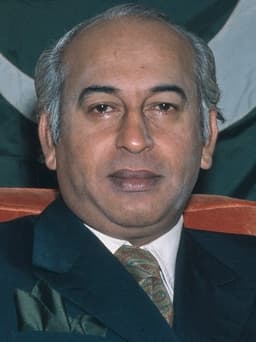
Zulfikar Ali Bhutto
Politician · Modern
51.2Total
Basic Information
Born
1954
1928
Died
—
—
Era
Modern
Modern
Nationality
Japan
Pakistan
Occupation
Politician
Politician
Civilization
Eastern
Indian
Score Comparison
Military (10%)
10.0
32.0
Political (20%)
70.3
55.0
Influence (20%)
56.7
61.0
Legacy (20%)
52.0
50.0
Leadership (15%)
72.0
40.0
Strategy (15%)
40.0
60.0
TOTAL
53.5
51.2
Shinzo Abe — Complete Timeline
2012 AD
Launch of AbenomicsReform◆ Major
Upon returning to office in December 2012, Prime Minister Shinzo Abe introduced a three-pronged economic policy known as Abenomics, consisting of aggressive monetary easing, fiscal stimulus, and structural reforms. The policy aimed to end deflation and revive Japan's stagnant economy, leading to a significant stock market rally and a weaker yen.
Economic PolicyMonetary PolicyJapan
Impact: nationalconstructive
2013 AD
Passage of the State Secrecy LawPolitical Action◆ Major
Abe's government passed the State Secrecy Law in December 2013, which broadened the definition of state secrets and imposed stricter penalties for leaks. Critics argued the law threatened press freedom and government transparency, while supporters claimed it was necessary for national security and intelligence sharing with allies.
LegislationCivil LibertiesNational Security
Impact: nationaldestructive
2014 AD
Reinterpretation of Article 9Political Action
In July 2014, Abe's cabinet approved a reinterpretation of Article 9 of Japan's pacifist constitution, allowing the Self-Defense Forces to exercise collective self-defense. This enabled Japan to come to the aid of an ally under attack, marking a significant shift in post-war defense policy and sparking intense domestic debate.
Constitutional ChangeDefense PolicyJapan
Impact: regional
2021 AD
Hosting the 2020 Tokyo OlympicsCultural◆ Major
Despite the COVID-19 pandemic, Abe's government pushed for the postponement and eventual holding of the 2020 Summer Olympics in Tokyo in 2021. The event proceeded largely without spectators and under strict health protocols, representing a major logistical and political undertaking that was widely seen as a test of Japan's organizational capabilities.
OlympicsPandemicInternational Event
Impact: global
2022 AD
Assassination of Shinzo AbePolitical Action
On July 8, 2022, former Prime Minister Shinzo Abe was shot and killed while giving a campaign speech in Nara, Japan. The assassination, carried out by a lone gunman with a homemade firearm, shocked the nation and the world, prompting widespread condemnation and a review of security protocols for political figures.
AssassinationViolencePolitical Violence
Impact: nationaltragic
Zulfikar Ali Bhutto — Complete Timeline
1971 AD
Became President of PakistanPolitical Action◆ Major
After the secession of East Pakistan (Bangladesh), Zulfikar Ali Bhutto took over as President of Pakistan. He inherited a defeated and dismembered nation.
PresidentPost-WarPakistan
Impact: national
1972 AD
Nationalized IndustriesReform◆ Major
Bhutto's government nationalized major industries, including steel, banking, and oil. This policy aimed to reduce economic inequality but led to inefficiencies and a decline in private investment.
NationalizationEconomic PolicySocialism
Impact: national
Simla AgreementPolitical Action◆ Major
Bhutto signed the Simla Agreement with Indian Prime Minister Indira Gandhi. The agreement established a Line of Control in Kashmir and committed both nations to bilateral resolution of disputes.
Peace TreatyKashmirIndia
Impact: regional
1973 AD
Constitution of 1973Reform
Bhutto oversaw the drafting and adoption of Pakistan's current constitution, which established a parliamentary system and declared Pakistan an Islamic republic. It remains the country's supreme law.
ConstitutionParliamentary SystemIslamic Republic
Impact: nationalconstructive
1979 AD
Executed by HangingPolitical Action
Bhutto was executed by hanging after being convicted of conspiracy to murder a political opponent. The trial was widely criticized as politically motivated by General Zia-ul-Haq's military regime.
ExecutionControversial TrialZia-ul-Haq
Impact: nationaltragic
Expert Analysis
Origins
Shinzo Abe was born on September 21, 1954, into a prominent political family in Tokyo. His grandfather, Nobusuke Kishi, served as prime minister, and his father, Shintaro Abe, was foreign minister. Abe graduated from Seikei University and later studied at the University of Southern California. He entered politics in 1982, winning a seat in the House of Representatives.
Zulfikar Ali Bhutto was born on January 5, 1928, in Larkana, Sindh, into a wealthy landowning family. He studied at the University of Southern California and the University of California, Berkeley, earning a degree in political science, and later studied law at Christ Church, Oxford. Bhutto entered politics in the 1950s, serving in various ministerial positions under President Ayub Khan.
Rise to Power
Abe rose quickly through the Liberal Democratic Party (LDP) ranks, serving as chief cabinet secretary under Prime Minister Junichiro Koizumi. He became Japan's youngest post-war prime minister in 2006 at age 52, but resigned after a year due to scandals and health issues. He made a comeback in 2012, winning a landslide victory on a platform of economic revival and national security.
Bhutto became a prominent figure in the 1960s as foreign minister, advocating for a more independent foreign policy. After Pakistan's defeat in the 1971 war and the secession of East Pakistan, Bhutto took over as president in December 1971. He later became prime minister after the 1973 constitution was enacted. His rise was fueled by populist rhetoric and promises of social justice.
Leadership & Governance
Abe's leadership was defined by 'Abenomics,' a three-pronged strategy of aggressive monetary easing, fiscal stimulus, and structural reforms. He also pursued a more assertive foreign policy, including a reinterpretation of Article 9 to allow collective self-defense, passed state secrecy laws, and strengthened the US-Japan alliance. His governance style was pragmatic and focused on economic growth, though critics pointed to limited progress on structural reforms.
Bhutto implemented a socialist agenda, nationalizing major industries such as steel, banking, and oil. He also introduced land reforms and expanded state control over the economy. His foreign policy achievements include the Simla Agreement with India, which established the Line of Control in Kashmir. However, his governance was marked by authoritarian tendencies, suppression of political opponents, and a deteriorating economy. His leadership score of 40.0 reflects a mixed record.
Triumph & Tragedy
Abe's triumphs include becoming Japan's longest-serving prime minister (8 years, 8 months), revitalizing the Japanese economy with initial success in Abenomics, and hosting the 2020 Tokyo Olympics. His tragedies include the failure to achieve sustained economic growth, rising public debt, and the controversy over the state secrets law. His assassination on July 8, 2022, while campaigning, shocked the world.
Bhutto's triumphs include the adoption of Pakistan's 1973 constitution, which remains in force, and the Simla Agreement, which temporarily reduced tensions with India. His tragedy is his downfall: after being overthrown in a military coup in 1977, he was controversially executed in 1979 for conspiracy to murder a political opponent. His legacy is tainted by economic mismanagement and authoritarianism.
Character & Destiny
Abe was a cautious, strategic leader who prioritized stability and long-term goals. His assassination, carried out by a lone gunman, cut short his potential further influence. He scored 72.0 in leadership and 40.0 in strategy, indicating a methodical but not visionary approach.
Bhutto was charismatic and ambitious, but also impulsive and authoritarian. His decision to nationalize industries alienated business elites, and his heavy-handed tactics against opponents led to his downfall. He scored 40.0 in leadership and 60.0 in strategy, reflecting a more tactical but less principled approach.
Legacy
Abe's legacy is mixed: Abenomics partially succeeded in boosting stock markets and corporate profits but failed to achieve 2% inflation target or sustainable growth. His security policies shifted Japan toward a more active military role, but constitutional revision remains incomplete. He is remembered as a skilled politician who restored LDP dominance.
Bhutto's legacy is deeply contested: he is celebrated by supporters as a champion of the poor and a defender of Pakistan's sovereignty, but criticized for economic failures and human rights abuses. The 1973 constitution endures, but his nationalization policies are widely seen as damaging. His execution made him a martyr in some circles.
Conclusion
While both leaders had significant impact, Shinzo Abe's influence on Japan's economy and security policy was more tangible and sustained. Abe scored 53.5 overall to Bhutto's 51.2, a gap of 2.3. Abe's Abenomics, though imperfect, reshaped Japan's economic trajectory for a decade, and his security reforms altered the national debate. Bhutto's legacy is more ambiguous: his constitution remains, but his economic policies failed. Abe's leadership score of 72.0 versus Bhutto's 40.0 underscores his greater effectiveness. Therefore, Abe had a more positive and lasting impact.
Rankings
🥇
Shinzo AbeLeader
Mil: 10.0Pol: 70.3Inf: 56.7
53.5
🥈
Zulfikar Ali Bhutto
Mil: 32.0Pol: 55.0Inf: 61.0
51.2
+2.3 behind
How This Comparison Works
Algorithm
Each figure is scored on 6 dimensions (0—100 scale) based on structured historical data: Military (10%), Political (20%), Influence (20%), Legacy (20%), Leadership (15%), Strategy (15%). The weighted total produces the final ranking.
Data Sources
Scores are computed from structured sub-indicators in the database. Scale factors adjust for era (Ancient ×0.85, Modern ×1.0) and civilization size (Eastern ×1.05, Other ×0.80) to account for differences in population and military scale.
Maximum 3 Figures
Comparisons are limited to 2—3 figures to ensure readability and statistical meaningfulness.
Error Margins
±5 points per dimension — Sub-scores are derived from historical records with inherent uncertainty. Two figures within 5 points on a dimension should be considered roughly equivalent in that area.
Total Score Accuracy
±3 points overall — The weighted combination of 6 dimensions produces a total score with approximately ±3 points of uncertainty. Differences of less than 3 points are not statistically significant— the figures are effectively tied.
Known Limitations
- Historical records are incomplete and uneven across civilizations
- Figures from oral-tradition societies may be underrepresented
- Occupation labels can misclassify multi-role figures
- Scores measure capability and impact, not moral character
- Quantitative scoring is a comparison tool, not absolute truth
Capability Radar
Military (10%) — Battles & Warfare
Battles
0
41
Win Rate
0
45
Expansion
0
49
Political (20%) — Governance & Reform
Reform
75
70
Diplomacy
80
60
Economy
70
55
Influence (20%) — Cultural & Global Reach
Cultural
50
50
Global
65
55
Legacy (20%) — Historical Impact
Historical
60
60
Longevity
40
40
Leadership (15%) — Power & Stability
Tenure
85
65
Stability
65
30
Strategy (15%) — Tactics & Innovation
Strategy
0
55
Tactics
0
58
Reform
15
57
Similar Comparisons
Comments & Discussion
No comments yet. Be the first to share your thoughts!