Loading...
Muhammad Naguib vs Zulfikar Ali Bhutto
Zulfikar Ali Bhutto leads by 2.6 pts · 2 figures compared
…

Muhammad Naguib
Politician · Modern
48.6Total
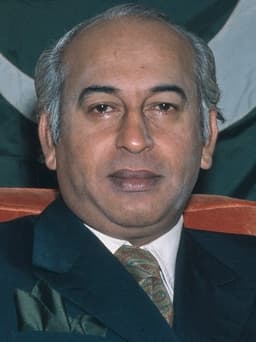
Zulfikar Ali Bhutto
Politician · Modern
51.2Total
Basic Information
Born
1901
1928
Died
1984
—
Era
Modern
Modern
Nationality
Egypt
Pakistan
Occupation
Politician
Politician
Civilization
Middle Eastern
Indian
Score Comparison
Military (10%)
39.9
32.0
Political (20%)
42.3
55.0
Influence (20%)
54.9
61.0
Legacy (20%)
43.3
50.0
Leadership (15%)
55.3
40.0
Strategy (15%)
53.8
60.0
TOTAL
48.6
51.2
Muhammad Naguib — Complete Timeline
1952 AD
Led the 1952 Egyptian RevolutionPolitical Action
Muhammad Naguib (same as Mohamed Naguib) was the leader of the Free Officers movement that overthrew King Farouk. He became the first president of Egypt, but was sidelined by Nasser within two years.
RevolutionFree OfficersRepublic
Impact: nationalconstructive
1954 AD
Sidelined by Gamal Abdel NasserPolitical Action◆ Major
Naguib was forced to resign as president and placed under house arrest after a power struggle with Nasser. He was removed from all positions and kept under surveillance for nearly 30 years, becoming a symbol of the revolution's internal conflicts.
CoupNasserHouse Arrest
Impact: nationaltragic
1972 AD
Released from House ArrestPolitical Action
President Anwar Sadat released Naguib from house arrest in 1972 as part of a political reconciliation. Naguib lived quietly until his death in 1984, but his role in the revolution was later rehabilitated in historical accounts.
ReleaseRehabilitationLegacy
Impact: national
Zulfikar Ali Bhutto — Complete Timeline
1971 AD
Became President of PakistanPolitical Action◆ Major
After the secession of East Pakistan (Bangladesh), Zulfikar Ali Bhutto took over as President of Pakistan. He inherited a defeated and dismembered nation.
PresidentPost-WarPakistan
Impact: national
1972 AD
Nationalized IndustriesReform◆ Major
Bhutto's government nationalized major industries, including steel, banking, and oil. This policy aimed to reduce economic inequality but led to inefficiencies and a decline in private investment.
NationalizationEconomic PolicySocialism
Impact: national
Simla AgreementPolitical Action◆ Major
Bhutto signed the Simla Agreement with Indian Prime Minister Indira Gandhi. The agreement established a Line of Control in Kashmir and committed both nations to bilateral resolution of disputes.
Peace TreatyKashmirIndia
Impact: regional
1973 AD
Constitution of 1973Reform
Bhutto oversaw the drafting and adoption of Pakistan's current constitution, which established a parliamentary system and declared Pakistan an Islamic republic. It remains the country's supreme law.
ConstitutionParliamentary SystemIslamic Republic
Impact: nationalconstructive
1979 AD
Executed by HangingPolitical Action
Bhutto was executed by hanging after being convicted of conspiracy to murder a political opponent. The trial was widely criticized as politically motivated by General Zia-ul-Haq's military regime.
ExecutionControversial TrialZia-ul-Haq
Impact: nationaltragic
Expert Analysis
Origins
Muhammad Naguib was born on February 20, 1901, in Khartoum, Sudan (then part of Egypt), into a military family. He graduated from the Royal Military Academy in Cairo and served in the Egyptian Army, participating in the 1948 Arab-Israeli War. His background as a respected officer with nationalist sympathies set the stage for his role in the Free Officers Movement. Zulfikar Ali Bhutto was born on January 5, 1928, in Larkana, Sindh (now Pakistan), into a wealthy landowning family. He studied at the University of California, Berkeley, and Oxford University, earning a law degree. His aristocratic background and Western education contrasted with Naguib's military roots.
Rise to Power
Naguib rose to prominence as the public face of the Free Officers, a secret group of junior officers led by Gamal Abdel Nasser. On July 23, 1952, they launched a coup that overthrew King Farouk. Naguib, as the senior officer, became the first President of Egypt in June 1953. However, real power lay with Nasser and the Revolutionary Command Council. Bhutto's rise began as a young politician in Pakistan, serving as Foreign Minister under President Ayub Khan from 1963. He resigned in 1966 over differences and founded the Pakistan People's Party (PPP) in 1967. After Pakistan's defeat in the 1971 war and the secession of Bangladesh, Bhutto became President in December 1971, later Prime Minister under the 1973 Constitution.
Leadership & Governance
Naguib advocated for a return to civilian rule and a parliamentary system, clashing with Nasser's preference for military control. He introduced land reforms and sought to reduce the monarchy's influence. However, his tenure was brief (1952-1954) and lacked deep structural changes. Bhutto, by contrast, pursued sweeping reforms: nationalizing major industries (steel, banking, oil) in 1972, implementing land reforms, and drafting the 1973 Constitution, which established a parliamentary system with an Islamic character. His governance style was authoritarian, suppressing dissent through police and military intelligence. While Naguib scored 55.3 in leadership, Bhutto scored 40.0, reflecting his contentious rule.
Triumph & Tragedy
Naguib's greatest triumph was leading the 1952 Revolution, ending the monarchy and British influence. His tragedy was his swift sidelining: in November 1954, he was forced to resign after a power struggle with Nasser, placed under house arrest until 1972. He died in 1984, largely forgotten. Bhutto's triumph was the 1973 Constitution, uniting Pakistan's diverse provinces, and the Simla Agreement (1972), which secured the release of Pakistani prisoners and defined the Line of Control in Kashmir. His tragedy was his execution on April 4, 1979, after a controversial murder conviction, making him the first elected Prime Minister to be executed. Bhutto scored 61.0 in influence versus Naguib's 54.9.
Character & Destiny
Naguib was cautious and principled, preferring democratic processes over military rule. His indecisiveness in the power struggle allowed Nasser to consolidate control. Bhutto was charismatic, ambitious, and ruthless. He centralized power, suppressed opposition, and alienated the military, leading to his downfall. Naguib's character led to a quiet end; Bhutto's defiance and polarizing nature led to his dramatic execution. Historians note Naguib as a tragic figure, while Bhutto is seen as a flawed visionary who shaped Pakistan's identity.
Legacy
Naguib's legacy is overshadowed by Nasser's, but he is remembered as the grandfather of the revolution. His push for civilian rule influenced later democratic movements in Egypt. Bhutto's legacy is profound: the 1973 Constitution remains Pakistan's framework; his populist policies reshaped the economy; his execution created a martyr narrative for the PPP. However, his authoritarianism and nationalization contributed to economic inefficiency. In terms of scores, Bhutto's total 51.2 edges Naguib's 48.6, with Bhutto scoring higher in political (55.0 vs 42.3) and influence (61.0 vs 54.9).
Conclusion
While Naguib initiated a revolution, his impact was limited by his brief tenure and subsequent obscurity. Bhutto, despite his flaws, fundamentally transformed Pakistan's political system, constitution, and economy. His influence endures through the PPP and the 1973 Constitution. Therefore, Zulfikar Ali Bhutto had a greater and more lasting impact than Muhammad Naguib, as reflected in his higher overall score of 51.2 versus 48.6.
Rankings
🥇
Zulfikar Ali BhuttoLeader
Mil: 32.0Pol: 55.0Inf: 61.0
51.2
🥈
Muhammad Naguib
Mil: 39.9Pol: 42.3Inf: 54.9
48.6
+2.6 behind
How This Comparison Works
Algorithm
Each figure is scored on 6 dimensions (0—100 scale) based on structured historical data: Military (10%), Political (20%), Influence (20%), Legacy (20%), Leadership (15%), Strategy (15%). The weighted total produces the final ranking.
Data Sources
Scores are computed from structured sub-indicators in the database. Scale factors adjust for era (Ancient ×0.85, Modern ×1.0) and civilization size (Eastern ×1.05, Other ×0.80) to account for differences in population and military scale.
Maximum 3 Figures
Comparisons are limited to 2—3 figures to ensure readability and statistical meaningfulness.
Error Margins
±5 points per dimension — Sub-scores are derived from historical records with inherent uncertainty. Two figures within 5 points on a dimension should be considered roughly equivalent in that area.
Total Score Accuracy
±3 points overall — The weighted combination of 6 dimensions produces a total score with approximately ±3 points of uncertainty. Differences of less than 3 points are not statistically significant— the figures are effectively tied.
Known Limitations
- Historical records are incomplete and uneven across civilizations
- Figures from oral-tradition societies may be underrepresented
- Occupation labels can misclassify multi-role figures
- Scores measure capability and impact, not moral character
- Quantitative scoring is a comparison tool, not absolute truth
Capability Radar
Military (10%) — Battles & Warfare
Battles
5
41
Win Rate
5
45
Expansion
5
49
Political (20%) — Governance & Reform
Reform
40
70
Diplomacy
40
60
Economy
20
55
Influence (20%) — Cultural & Global Reach
Cultural
20
50
Global
20
55
Legacy (20%) — Historical Impact
Historical
30
60
Longevity
20
40
Leadership (15%) — Power & Stability
Tenure
30
65
Stability
20
30
Strategy (15%) — Tactics & Innovation
Strategy
5
55
Tactics
5
58
Reform
10
57
Similar Comparisons
Comments & Discussion
No comments yet. Be the first to share your thoughts!