Loading...
Michael Sata vs Zulfikar Ali Bhutto
Zulfikar Ali Bhutto leads by 6.3 pts · 2 figures compared
…

Michael Sata
Politician · Modern
44.9Total
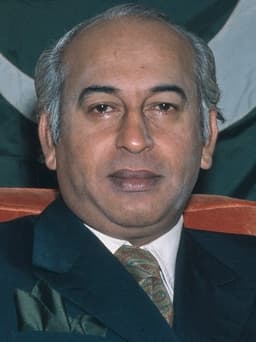
Zulfikar Ali Bhutto
Politician · Modern
51.2Total
Basic Information
Born
1937
1928
Died
—
—
Era
Modern
Modern
Nationality
Zambia
Pakistan
Occupation
Politician
Politician
Civilization
Other
Indian
Score Comparison
Military (10%)
17.7
32.0
Political (20%)
43.7
55.0
Influence (20%)
50.2
61.0
Legacy (20%)
40.0
50.0
Leadership (15%)
67.0
40.0
Strategy (15%)
40.2
60.0
TOTAL
44.9
51.2
Michael Sata — Complete Timeline
2011 AD
Implemented Populist Economic PoliciesReform◆ Major
Sata introduced policies including a windfall tax on mining profits, increased minimum wage, and subsidies for farmers. These measures aimed to redistribute wealth but faced criticism from business and investors.
PopulismEconomic PolicyMining Tax
Impact: nationalconstructive
Elected President of ZambiaPolitical Action◆ Major
Sata won the presidential election as the candidate of the Patriotic Front, defeating incumbent Rupiah Banda. His victory marked the first peaceful transfer of power to an opposition party in Zambia's history.
ElectionZambiaPeaceful Transition
Impact: nationalconstructive
2014 AD
Died in OfficeOther◆ Major
Sata died at a London hospital on October 28, 2014, after a prolonged illness. His death triggered a constitutional crisis over succession, eventually resolved by the vice president assuming office.
DeathZambiaSuccession Crisis
Impact: nationaltragic
Zulfikar Ali Bhutto — Complete Timeline
1971 AD
Became President of PakistanPolitical Action◆ Major
After the secession of East Pakistan (Bangladesh), Zulfikar Ali Bhutto took over as President of Pakistan. He inherited a defeated and dismembered nation.
PresidentPost-WarPakistan
Impact: national
1972 AD
Nationalized IndustriesReform◆ Major
Bhutto's government nationalized major industries, including steel, banking, and oil. This policy aimed to reduce economic inequality but led to inefficiencies and a decline in private investment.
NationalizationEconomic PolicySocialism
Impact: national
Simla AgreementPolitical Action◆ Major
Bhutto signed the Simla Agreement with Indian Prime Minister Indira Gandhi. The agreement established a Line of Control in Kashmir and committed both nations to bilateral resolution of disputes.
Peace TreatyKashmirIndia
Impact: regional
1973 AD
Constitution of 1973Reform
Bhutto oversaw the drafting and adoption of Pakistan's current constitution, which established a parliamentary system and declared Pakistan an Islamic republic. It remains the country's supreme law.
ConstitutionParliamentary SystemIslamic Republic
Impact: nationalconstructive
1979 AD
Executed by HangingPolitical Action
Bhutto was executed by hanging after being convicted of conspiracy to murder a political opponent. The trial was widely criticized as politically motivated by General Zia-ul-Haq's military regime.
ExecutionControversial TrialZia-ul-Haq
Impact: nationaltragic
Expert Analysis
Origins
Michael Sata was born on July 6, 1937, in Mpika, Northern Rhodesia (now Zambia), to a poor family. He left school at age 15 and worked as a police officer, then a railway clerk, rising through union ranks. Sata had no formal higher education but learned politics through labor activism. Zulfikar Ali Bhutto was born on January 5, 1928, in Larkana, Sindh, British India, into a wealthy feudal landowning family. He studied at the University of Southern California (B.A. in political science) and the University of California, Berkeley (honors), then earned an LLB from Christ Church, Oxford. Bhutto was called to the bar at Lincoln's Inn. Their origins contrast sharply: Sata's rise from poverty versus Bhutto's elite background.
Rise to Power
Sata entered politics in the 1960s as a member of the United National Independence Party (UNIP). He served as MP, minister of local government, and minister of health under Kenneth Kaunda. In 1991, he joined the Movement for Multiparty Democracy (MMD) but later broke away to form the Patriotic Front (PF) in 2001. He ran for president four times, losing in 2001, 2006, and 2008, before winning in 2011 against incumbent Rupiah Banda. His victory was the first peaceful transfer of power to an opposition candidate in Zambia. Bhutto rose rapidly: he served as Foreign Minister under President Ayub Khan from 1963, then founded the Pakistan People's Party (PPP) in 1967. After the 1970 elections, the PPP won a majority in West Pakistan. Following the secession of East Pakistan (Bangladesh) in 1971, Bhutto became President in December 1971, inheriting a defeated nation.
Leadership & Governance
Sata's leadership was populist and confrontational. He introduced a windfall tax on mining profits, increased the minimum wage by over 100%, and subsidized fertilizers for farmers. He also expelled Chinese traders, accusing them of undercutting local businesses. His governance style was personalist and often combative with the judiciary and media. Bhutto's governance was more systematic: he oversaw the 1973 Constitution, which established parliamentary democracy and declared Pakistan an Islamic republic. He nationalized major industries—steel, banking, oil—to reduce inequality, but these led to inefficiency and capital flight. Bhutto also pursued a nuclear program (scoring 32.0 in military strategy) and signed the Simla Agreement with India in 1972, establishing the Line of Control in Kashmir. While Sata scored 67.0 in leadership, Bhutto scored 40.0, reflecting his authoritarian tendencies and inability to manage economic fallout.
Triumph & Tragedy
Sata's greatest triumph was winning the presidency after three defeats, symbolizing democratic change. His populist policies improved living standards for urban poor and farmers. However, his failure to diversify the economy left Zambia vulnerable to copper price shocks. He also died in office on October 28, 2014, triggering a constitutional crisis over succession. Bhutto's triumph was the 1973 Constitution, which remains Pakistan's framework, and the Simla Agreement, which stabilized relations with India. His tragedy was his execution on April 4, 1979, after a controversial murder trial. Bhutto's nationalizations alienated business elites and caused economic stagnation, contributing to his downfall. Bhutto scored 61.0 in influence versus Sata's 50.2, reflecting his broader geopolitical role.
Character & Destiny
Sata was known as "King Cobra" for his sharp tongue and combative style. He was a pragmatic populist, shifting from UNIP to MMD to PF. His health was poor, and he kept his illness secret, leading to succession chaos. Bhutto was charismatic and intellectually confident, but also arrogant and vindictive. He purged rivals and alienated the military, which eventually turned on him. His decision to order the murder of political opponent Ahmed Raza Kasuri (for which he was convicted) sealed his fate. Both men's characters led to their downfalls: Sata's secrecy about his health, Bhutto's ruthlessness.
Legacy
Sata's legacy is mixed: he is remembered as a champion of the poor but criticized for economic mismanagement. His PF party remained in power until 2021, but his policies were largely reversed. Bhutto's legacy is profound: he shaped Pakistan's constitution, nuclear program, and foreign policy. He is revered as a martyr by PPP supporters, but his nationalizations are blamed for economic decline. Bhutto scores 50.0 in legacy versus Sata's 40.0, indicating greater enduring impact.
Conclusion
Zulfikar Ali Bhutto had a greater impact than Michael Sata. Bhutto scored 51.2 overall versus Sata's 44.9, with higher scores in military (32.0 vs 17.7), political (55.0 vs 43.7), influence (61.0 vs 50.2), strategy (60.0 vs 40.2), and legacy (50.0 vs 40.0). Sata's leadership score (67.0 vs 40.0) reflects his effective populist campaigning, but Bhutto's constitutional and geopolitical achievements reshaped a nation of over 200 million. Sata's impact was limited to Zambia's domestic politics and was short-lived. Bhutto's 1973 Constitution still governs Pakistan, and his nuclear program altered South Asian security. While both were flawed populists, Bhutto's reach and enduring influence make him the more significant historical figure.
Rankings
🥇
Zulfikar Ali BhuttoLeader
Mil: 32.0Pol: 55.0Inf: 61.0
51.2
🥈
Michael Sata
Mil: 17.7Pol: 43.7Inf: 50.2
44.9
+6.3 behind
How This Comparison Works
Algorithm
Each figure is scored on 6 dimensions (0—100 scale) based on structured historical data: Military (10%), Political (20%), Influence (20%), Legacy (20%), Leadership (15%), Strategy (15%). The weighted total produces the final ranking.
Data Sources
Scores are computed from structured sub-indicators in the database. Scale factors adjust for era (Ancient ×0.85, Modern ×1.0) and civilization size (Eastern ×1.05, Other ×0.80) to account for differences in population and military scale.
Maximum 3 Figures
Comparisons are limited to 2—3 figures to ensure readability and statistical meaningfulness.
Error Margins
±5 points per dimension — Sub-scores are derived from historical records with inherent uncertainty. Two figures within 5 points on a dimension should be considered roughly equivalent in that area.
Total Score Accuracy
±3 points overall — The weighted combination of 6 dimensions produces a total score with approximately ±3 points of uncertainty. Differences of less than 3 points are not statistically significant— the figures are effectively tied.
Known Limitations
- Historical records are incomplete and uneven across civilizations
- Figures from oral-tradition societies may be underrepresented
- Occupation labels can misclassify multi-role figures
- Scores measure capability and impact, not moral character
- Quantitative scoring is a comparison tool, not absolute truth
Capability Radar
Military (10%) — Battles & Warfare
Battles
23
41
Win Rate
27
45
Expansion
28
49
Political (20%) — Governance & Reform
Reform
40
70
Diplomacy
35
60
Economy
30
55
Influence (20%) — Cultural & Global Reach
Cultural
20
50
Global
20
55
Legacy (20%) — Historical Impact
Historical
25
60
Longevity
15
40
Leadership (15%) — Power & Stability
Tenure
45
65
Stability
25
30
Strategy (15%) — Tactics & Innovation
Strategy
37
55
Tactics
38
58
Reform
41
57
Similar Comparisons
Comments & Discussion
No comments yet. Be the first to share your thoughts!