Loading...
Ahmed Ben Bella vs Zulfikar Ali Bhutto
Ahmed Ben Bella leads by 6.4 pts · 2 figures compared
…

Ahmed Ben Bella
Politician · Modern
57.6Total
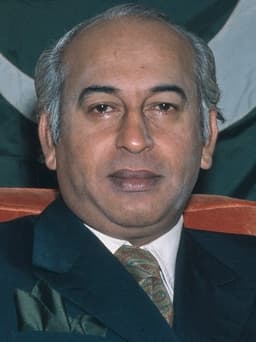
Zulfikar Ali Bhutto
Politician · Modern
51.2Total
Basic Information
Born
1916
1928
Died
2012
—
Era
Modern
Modern
Nationality
Algeria
Pakistan
Occupation
Politician
Politician
Civilization
Middle Eastern
Indian
Score Comparison
Military (10%)
36.6
32.0
Political (20%)
68.0
55.0
Influence (20%)
60.0
61.0
Legacy (20%)
49.2
50.0
Leadership (15%)
74.0
40.0
Strategy (15%)
53.0
60.0
TOTAL
57.6
51.2
Ahmed Ben Bella — Complete Timeline
1950 AD
Imprisonment by French AuthoritiesPolitical Action◆ Major
Ahmed Ben Bella was arrested by French authorities for his role in the Algerian nationalist movement. He was imprisoned in France, becoming a symbol of the struggle for independence and gaining international attention for the Algerian cause.
ImprisonmentNationalismAlgerian War
Impact: regional
1962 AD
Evian AccordsPolitical Action
Ben Bella, as a leader of the National Liberation Front (FLN), participated in negotiations that resulted in the Evian Accords. These agreements ended the Algerian War and granted Algeria independence from France after 132 years of colonial rule.
IndependenceTreatyAlgerian War
Impact: regionalconstructive
1963 AD
Election as First PresidentPolitical Action◆ Major
Ahmed Ben Bella was elected as the first President of independent Algeria. He established a socialist government, nationalized industries, and pursued land reform. His presidency marked the beginning of Algeria's post-colonial state-building.
PresidencySocialismState-Building
Impact: national
1965 AD
Overthrow by Houari BoumediennePolitical Action◆ Major
Ben Bella was overthrown in a military coup led by his defense minister, Houari Boumedienne. He was placed under house arrest for 14 years, ending his presidency and his influence over Algerian politics. The coup marked a shift toward military rule.
CoupBoumedienneHouse Arrest
Impact: nationaltragic
Zulfikar Ali Bhutto — Complete Timeline
1971 AD
Became President of PakistanPolitical Action◆ Major
After the secession of East Pakistan (Bangladesh), Zulfikar Ali Bhutto took over as President of Pakistan. He inherited a defeated and dismembered nation.
PresidentPost-WarPakistan
Impact: national
1972 AD
Nationalized IndustriesReform◆ Major
Bhutto's government nationalized major industries, including steel, banking, and oil. This policy aimed to reduce economic inequality but led to inefficiencies and a decline in private investment.
NationalizationEconomic PolicySocialism
Impact: national
Simla AgreementPolitical Action◆ Major
Bhutto signed the Simla Agreement with Indian Prime Minister Indira Gandhi. The agreement established a Line of Control in Kashmir and committed both nations to bilateral resolution of disputes.
Peace TreatyKashmirIndia
Impact: regional
1973 AD
Constitution of 1973Reform
Bhutto oversaw the drafting and adoption of Pakistan's current constitution, which established a parliamentary system and declared Pakistan an Islamic republic. It remains the country's supreme law.
ConstitutionParliamentary SystemIslamic Republic
Impact: nationalconstructive
1979 AD
Executed by HangingPolitical Action
Bhutto was executed by hanging after being convicted of conspiracy to murder a political opponent. The trial was widely criticized as politically motivated by General Zia-ul-Haq's military regime.
ExecutionControversial TrialZia-ul-Haq
Impact: nationaltragic
Expert Analysis
Origins
Ahmed Ben Bella, born in 1916 in Maghnia, French Algeria, came from a modest peasant family. He served in the French army during World War II, earning military medals, but later became disillusioned with colonial rule. His early activism in the nationalist movement led to his role in the 1945 Setif uprising and subsequent founding of the Special Organisation (OS) in 1947, a paramilitary group for independence. He was imprisoned by the French in 1950 but escaped in 1952, eventually becoming a key leader of the National Liberation Front (FLN) during the Algerian War of Independence (1954–1962).
Zulfikar Ali Bhutto, born in 1928 in Larkana, Sindh, into a wealthy feudal family, studied at the University of California, Berkeley, and Oxford. He returned to Pakistan and entered politics, serving as Minister of Commerce under President Ayub Khan in 1958. He later founded the Pakistan People's Party (PPP) in 1967, advocating for Islamic socialism and democracy. His early career was marked by sharp criticism of the military regime and his role in the 1970 elections, which saw the PPP win a majority in West Pakistan.
Rise to Power
Ben Bella's rise to power culminated in the Evian Accords of March 1962, which ended the Algerian War. As a charismatic leader of the FLN, he emerged as the face of the revolution. In September 1962, he was elected as Algeria's first president, defeating rival factions. His political score of 68.0 reflects his ability to unify the nationalist movement, though his military score of 36.6 indicates limited direct combat command.
Bhutto's rise was swift after Pakistan's defeat in the 1971 war with India, which led to the secession of East Pakistan (Bangladesh). He took over as President in December 1971, inheriting a shattered nation. His political score of 55.0 is lower than Ben Bella's, but he successfully negotiated the Simla Agreement in July 1972 with India, securing the release of 90,000 Pakistani prisoners of war. He also introduced a new constitution in 1973, transitioning to a parliamentary system with himself as Prime Minister.
Leadership & Governance
Ben Bella's governance was marked by rapid socialist reforms. He nationalized industries, including oil and gas, and implemented land redistribution. He pursued a non-aligned foreign policy, supporting anti-colonial movements. However, his leadership score of 74.0 is tempered by authoritarian tendencies; he suppressed opposition and centralized power. His strategy score of 53.0 reflects mixed success: while he consolidated the FLN's control, his economic policies led to inefficiencies.
Bhutto's leadership score of 40.0 is notably lower. He also nationalized major industries—steel, banking, oil—but his policies suffered from poor implementation and corruption. His strategy score of 60.0, however, is higher than Ben Bella's, as he navigated Pakistan's post-1971 crisis effectively. He strengthened ties with China and the Muslim world. But his governance became increasingly repressive; he used the military to crush dissent in Balochistan (1973–1977) and faced allegations of rigging the 1977 elections.
Triumph & Tragedy
Ben Bella's greatest triumph was leading Algeria to independence and establishing its first government. He became a symbol of anti-colonial struggle globally. However, his tragedy was his overthrow in a bloodless coup in June 1965 by his defense minister, Houari Boumedienne. He spent 14 years under house arrest, his socialist policies later reversed. His legacy score of 49.2 reflects this mixed record.
Bhutto's triumph includes the 1973 Constitution, which remains Pakistan's foundational legal document, and the Simla Agreement, which established the Line of Control in Kashmir. His tragedy is his execution in April 1979, following a controversial murder conviction. The trial was widely seen as politically motivated, orchestrated by General Zia-ul-Haq, who overthrew him in 1977. Bhutto's execution made him a martyr for democracy in Pakistan.
Character & Destiny
Ben Bella was charismatic and idealistic, with a strong belief in socialism and pan-Arabism. His character—decisive but intolerant of dissent—led to his downfall. He failed to build broad-based institutions, relying on personal loyalty. His influence score of 60.0 indicates his impact as a revolutionary figure, but his inability to secure his own position reflects a strategic blind spot.
Bhutto was ambitious, articulate, and shrewd. He had a high influence score of 61.0, driven by his ability to mobilize masses with socialist rhetoric. However, his arrogance and vindictiveness alienated allies. His leadership score of 40.0 is partly due to his authoritarian turn and failure to uphold democratic norms, which ultimately led to his overthrow and execution.
Legacy
Ben Bella's legacy is as a founding father of Algeria. His socialist policies laid the groundwork for the state's welfare system, though many were reversed. He remains a symbol of anti-imperialism. His total score of 57.6 reflects his foundational role but limited long-term governance.
Bhutto's legacy is more contested. The 1973 Constitution endures, but his nationalizations are criticized for harming the economy. He is revered by PPP supporters as a martyr for democracy. His total score of 51.2 is lower, partly due to his failure to consolidate democratic institutions.
Conclusion
Ahmed Ben Bella had a greater impact than Zulfikar Ali Bhutto. His total score of 57.6 exceeds Bhutto's 51.2, driven by higher leadership (74.0 vs. 40.0) and political (68.0 vs. 55.0) scores. Ben Bella's role in ending colonialism and establishing an independent state is a more foundational achievement than Bhutto's, whose policies, while important, were often flawed. Bhutto's execution also tarnished his legacy, whereas Ben Bella's overthrow allowed him to remain a symbol of resistance. Thus, Ben Bella's influence on Algeria and the decolonization movement outweighs Bhutto's on Pakistan.
Rankings
🥇
Ahmed Ben BellaLeader
Mil: 36.6Pol: 68.0Inf: 60.0
57.6
🥈
Zulfikar Ali Bhutto
Mil: 32.0Pol: 55.0Inf: 61.0
51.2
+6.4 behind
How This Comparison Works
Algorithm
Each figure is scored on 6 dimensions (0—100 scale) based on structured historical data: Military (10%), Political (20%), Influence (20%), Legacy (20%), Leadership (15%), Strategy (15%). The weighted total produces the final ranking.
Data Sources
Scores are computed from structured sub-indicators in the database. Scale factors adjust for era (Ancient ×0.85, Modern ×1.0) and civilization size (Eastern ×1.05, Other ×0.80) to account for differences in population and military scale.
Maximum 3 Figures
Comparisons are limited to 2—3 figures to ensure readability and statistical meaningfulness.
Error Margins
±5 points per dimension — Sub-scores are derived from historical records with inherent uncertainty. Two figures within 5 points on a dimension should be considered roughly equivalent in that area.
Total Score Accuracy
±3 points overall — The weighted combination of 6 dimensions produces a total score with approximately ±3 points of uncertainty. Differences of less than 3 points are not statistically significant— the figures are effectively tied.
Known Limitations
- Historical records are incomplete and uneven across civilizations
- Figures from oral-tradition societies may be underrepresented
- Occupation labels can misclassify multi-role figures
- Scores measure capability and impact, not moral character
- Quantitative scoring is a comparison tool, not absolute truth
Capability Radar
Military (10%) — Battles & Warfare
Battles
5
41
Win Rate
5
45
Expansion
5
49
Political (20%) — Governance & Reform
Reform
55
70
Diplomacy
60
60
Economy
40
55
Influence (20%) — Cultural & Global Reach
Cultural
50
50
Global
50
55
Legacy (20%) — Historical Impact
Historical
55
60
Longevity
40
40
Leadership (15%) — Power & Stability
Tenure
60
65
Stability
30
30
Strategy (15%) — Tactics & Innovation
Strategy
5
55
Tactics
5
58
Reform
10
57
Similar Comparisons
Comments & Discussion
No comments yet. Be the first to share your thoughts!