Loading...
Hugo Chavez vs Shinzo Abe
Shinzo Abe leads by 2.6 pts · 2 figures compared
…
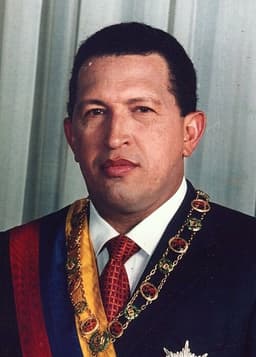
Hugo Chavez
Politician · Modern
50.9Total

Shinzo Abe
Politician · Modern
53.5Total
Basic Information
Born
1954
1954
Died
—
—
Era
Modern
Modern
Nationality
Venezuela
Japan
Occupation
Politician
Politician
Civilization
Western
Eastern
Score Comparison
Military (10%)
10.0
10.0
Political (20%)
62.7
70.3
Influence (20%)
56.7
56.7
Legacy (20%)
49.2
52.0
Leadership (15%)
68.0
72.0
Strategy (15%)
38.3
40.0
TOTAL
50.9
53.5
Hugo Chavez — Complete Timeline
1992 AD
Failed 1992 coup attemptPolitical Action◆ Major
Chávez, then a lieutenant colonel, led a failed military coup against President Carlos Andrés Pérez. The coup was crushed, and Chávez was imprisoned. His televised speech accepting responsibility made him a national figure and martyr for the poor.
CoupImprisonmentPolitical Rise
Impact: national
1998 AD
Election as President of VenezuelaPolitical Action
Chávez won the presidential election with 56% of the vote, running on a platform of anti-corruption and social justice. His victory marked the beginning of the Bolivarian Revolution, a leftist movement aimed at transforming Venezuela's political and economic system.
ElectionBolivarian RevolutionPopulism
Impact: nationalconstructive
2001 AD
Nationalization of oil industryReform◆ Major
Chávez enacted a new Hydrocarbons Law that increased state control over the oil industry, raising royalties and taxes on foreign companies. He also reasserted control over PDVSA, the state oil company, using oil revenues to fund social programs.
NationalizationOilEconomic Policy
Impact: nationalconstructive
2002 AD
2002 coup attempt and return to powerPolitical Action◆ Major
Chávez was briefly overthrown in a coup led by business and military sectors, but was restored to power after 47 hours due to mass protests and loyalist military units. The coup attempt deepened political polarization in Venezuela.
CoupPolitical CrisisReturn
Impact: national
2004 AD
Creation of the Bolivarian Alliance for the Americas (ALBA)Political Action◆ Major
Chávez founded ALBA as an alternative to the Free Trade Area of the Americas, promoting regional integration based on solidarity, barter, and social welfare. The alliance included Cuba, Bolivia, and other leftist governments in Latin America.
Regional IntegrationSocialismAnti-imperialism
Impact: regionalconstructive
Shinzo Abe — Complete Timeline
2012 AD
Launch of AbenomicsReform◆ Major
Upon returning to office in December 2012, Prime Minister Shinzo Abe introduced a three-pronged economic policy known as Abenomics, consisting of aggressive monetary easing, fiscal stimulus, and structural reforms. The policy aimed to end deflation and revive Japan's stagnant economy, leading to a significant stock market rally and a weaker yen.
Economic PolicyMonetary PolicyJapan
Impact: nationalconstructive
2013 AD
Passage of the State Secrecy LawPolitical Action◆ Major
Abe's government passed the State Secrecy Law in December 2013, which broadened the definition of state secrets and imposed stricter penalties for leaks. Critics argued the law threatened press freedom and government transparency, while supporters claimed it was necessary for national security and intelligence sharing with allies.
LegislationCivil LibertiesNational Security
Impact: nationaldestructive
2014 AD
Reinterpretation of Article 9Political Action
In July 2014, Abe's cabinet approved a reinterpretation of Article 9 of Japan's pacifist constitution, allowing the Self-Defense Forces to exercise collective self-defense. This enabled Japan to come to the aid of an ally under attack, marking a significant shift in post-war defense policy and sparking intense domestic debate.
Constitutional ChangeDefense PolicyJapan
Impact: regional
2021 AD
Hosting the 2020 Tokyo OlympicsCultural◆ Major
Despite the COVID-19 pandemic, Abe's government pushed for the postponement and eventual holding of the 2020 Summer Olympics in Tokyo in 2021. The event proceeded largely without spectators and under strict health protocols, representing a major logistical and political undertaking that was widely seen as a test of Japan's organizational capabilities.
OlympicsPandemicInternational Event
Impact: global
2022 AD
Assassination of Shinzo AbePolitical Action
On July 8, 2022, former Prime Minister Shinzo Abe was shot and killed while giving a campaign speech in Nara, Japan. The assassination, carried out by a lone gunman with a homemade firearm, shocked the nation and the world, prompting widespread condemnation and a review of security protocols for political figures.
AssassinationViolencePolitical Violence
Impact: nationaltragic
Expert Analysis
Origins
Hugo Chávez was born on July 28, 1954, in Sabaneta, Barinas, Venezuela, into a working-class family. His parents were schoolteachers, and he grew up in modest circumstances. Chávez attended the Venezuelan Academy of Military Sciences, graduating in 1975 as a sub-lieutenant. His early military career included counterinsurgency operations and exposure to leftist ideas.
Shinzo Abe was born on September 21, 1954, in Tokyo, Japan, into a prominent political family. His grandfather, Nobusuke Kishi, served as prime minister, and his father, Shintaro Abe, was foreign minister. Abe studied political science at Seikei University and later at the University of Southern California. He entered politics in 1982 as a secretary to his father.
Rise to Power
Chávez first gained national attention on February 4, 1992, when he led a failed coup against President Carlos Andrés Pérez. The coup collapsed, and Chávez was imprisoned for two years. After his pardon in 1994, he reinvented himself as a populist candidate, winning the presidency in December 1998 with 56% of the vote. His rise was fueled by public anger over corruption and inequality.
Abe's rise was more gradual. He was first elected to the House of Representatives in 1993. He served as Deputy Chief Cabinet Secretary under Prime Minister Junichiro Koizumi and later as Chief Cabinet Secretary. In September 2006, at age 52, he became Japan's youngest post-war prime minister. His first term lasted only a year, ending in resignation due to political scandals and health issues. He staged a political comeback, returning as prime minister in December 2012 after a landslide victory.
Leadership & Governance
Chávez's leadership style was charismatic, confrontational, and centralized. He concentrated power in the executive, weakened checks and balances, and used state media to broadcast his message. He implemented the Bolivarian Revolution, nationalizing key industries like oil, telecommunications, and electricity. The 2001 Hydrocarbons Law raised royalties and taxes on foreign oil companies, increasing state control. He also created social programs called misiones (missions) that expanded healthcare, education, and food subsidies. However, his economic policies led to inflation, shortages, and a decline in oil production from 3.5 million barrels per day in 1998 to 2.4 million in 2012.
Abe's governance was pragmatic and reform-oriented. He introduced Abenomics, a three-arrow strategy of aggressive monetary easing, fiscal stimulus, and structural reforms. The Bank of Japan adopted a 2% inflation target, and the government increased public works spending. On security, Abe reinterpreted Article 9 of the constitution in 2014, allowing the Self-Defense Forces to exercise collective self-defense. He also passed the State Secrecy Law in 2013, broadening government secrecy. Critics argued that Abenomics benefited corporations more than workers, and the secrecy law stifled press freedom.
Triumph & Tragedy
Chávez's greatest triumph was reducing poverty and inequality. Poverty fell from 50% in 1998 to 27% in 2011, and extreme poverty from 20% to 8%. He also founded the Bolivarian Alliance for the Americas (ALBA) in 2004, promoting regional integration based on solidarity. However, his greatest failure was economic mismanagement. Inflation soared to 27% in 2012, and oil production fell. His policies created dependency on oil revenue and failed to diversify the economy. The 2002 coup attempt, though he survived, exposed deep societal divisions.
Abe's triumph was restoring Japan's economic growth and international standing. During his second term, Japan's GDP grew by an average of 1.2% annually, and the Nikkei stock index rose from 10,000 to over 20,000. He also secured the 2020 Tokyo Olympics, boosting national pride. His tragedy was his assassination on July 8, 2022, during a campaign speech in Nara. The killing, by a lone gunman, shocked the world and cut short his potential legacy. Additionally, his handling of the COVID-19 pandemic was criticized for slow vaccine rollout.
Character & Destiny
Chávez was a charismatic, confrontational leader who thrived on conflict. He often used inflammatory rhetoric against the US and domestic opponents. His personality—a mix of messianic zeal and authoritarian tendencies—shaped his fate. He centralized power, weakened institutions, and ignored economic realities, leading to Venezuela's eventual collapse. Historians note his polarizing nature; to supporters, he was a champion of the poor; to critics, a demagogue.
Abe was a pragmatic, cautious, and determined politician. He was known for his persistence, returning to power after his first failed term. His assassination was a tragic outcome of his political career, but his policies (Abenomics, security reforms) had lasting impact. He scored 72.0 in leadership, reflecting his ability to navigate complex political landscapes.
Legacy
Chávez's legacy is mixed. He transformed Venezuela's politics and society, but his economic model proved unsustainable. His influence extended across Latin America, inspiring leftist movements in Bolivia, Ecuador, and Nicaragua. However, his policies left Venezuela with hyperinflation, corruption, and a collapsed economy. His total score of 50.9 reflects the short-term gains and long-term costs.
Abe's legacy is more durable. Abenomics revived Japan's economy temporarily, and his security reinterpretation changed Japan's pacifist stance. He also strengthened the US-Japan alliance. His assassination made him a martyr for some, but his political achievements remain. With a total score of 53.5, he edges out Chávez in overall impact.
Conclusion
Shinzo Abe had a greater impact than Hugo Chávez. While Chávez's domestic reforms were transformative, his economic mismanagement led to crisis. Abe's policies stabilized Japan's economy and redefined its security role. Abe's total score of 53.5 surpasses Chávez's 50.9, reflecting more sustainable and globally significant changes. Chávez's legacy is cautionary; Abe's is enduring.
Rankings
🥇
Shinzo AbeLeader
Mil: 10.0Pol: 70.3Inf: 56.7
53.5
🥈
Hugo Chavez
Mil: 10.0Pol: 62.7Inf: 56.7
50.9
+2.6 behind
How This Comparison Works
Algorithm
Each figure is scored on 6 dimensions (0—100 scale) based on structured historical data: Military (10%), Political (20%), Influence (20%), Legacy (20%), Leadership (15%), Strategy (15%). The weighted total produces the final ranking.
Data Sources
Scores are computed from structured sub-indicators in the database. Scale factors adjust for era (Ancient ×0.85, Modern ×1.0) and civilization size (Eastern ×1.05, Other ×0.80) to account for differences in population and military scale.
Maximum 3 Figures
Comparisons are limited to 2—3 figures to ensure readability and statistical meaningfulness.
Error Margins
±5 points per dimension — Sub-scores are derived from historical records with inherent uncertainty. Two figures within 5 points on a dimension should be considered roughly equivalent in that area.
Total Score Accuracy
±3 points overall — The weighted combination of 6 dimensions produces a total score with approximately ±3 points of uncertainty. Differences of less than 3 points are not statistically significant— the figures are effectively tied.
Known Limitations
- Historical records are incomplete and uneven across civilizations
- Figures from oral-tradition societies may be underrepresented
- Occupation labels can misclassify multi-role figures
- Scores measure capability and impact, not moral character
- Quantitative scoring is a comparison tool, not absolute truth
Capability Radar
Military (10%) — Battles & Warfare
Battles
0
0
Win Rate
0
0
Expansion
0
0
Political (20%) — Governance & Reform
Reform
70
75
Diplomacy
60
80
Economy
40
70
Influence (20%) — Cultural & Global Reach
Cultural
60
50
Global
55
65
Legacy (20%) — Historical Impact
Historical
55
60
Longevity
40
40
Leadership (15%) — Power & Stability
Tenure
75
85
Stability
30
65
Strategy (15%) — Tactics & Innovation
Strategy
0
0
Tactics
0
0
Reform
10
15
Similar Comparisons
Comments & Discussion
No comments yet. Be the first to share your thoughts!