Loading...
Prayut Chan-o-cha vs Shi Dakai
Shi Dakai leads by 11.5 pts · 2 figures compared
…
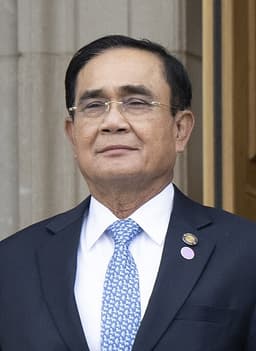
Prayut Chan-o-cha
General · Modern
48.1Total
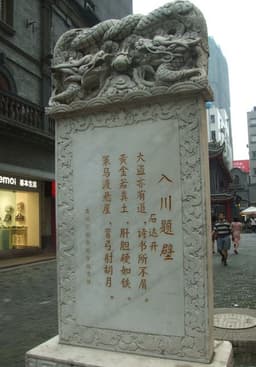
Shi Dakai
General · Modern
59.6Total
Basic Information
Born
1954
1831
Died
—
1863
Era
Modern
Modern
Nationality
Thailand
China
Occupation
General
General
Civilization
Eastern
Eastern
Score Comparison
Military (10%)
10.2
76.0
Political (20%)
68.0
45.0
Influence (20%)
51.8
56.7
Legacy (20%)
40.8
54.0
Leadership (15%)
68.0
72.0
Strategy (15%)
35.7
68.1
TOTAL
48.1
59.6
Prayut Chan-o-cha — Complete Timeline
2014 AD
Led the 2014 military coupPolitical Action
General Prayut Chan-o-cha, as Army Commander-in-Chief, led a coup d'
CoupMilitaryThailand
Impact: nationaldestructive
Appointed Prime Minister by military legislaturePolitical Action◆ Major
Following the coup, Prayut was appointed Prime Minister by the military-controlled National Legislative Assembly. He assumed executive power, leading a government that promised reforms and national reconciliation.
AppointmentMilitary RuleThailand
Impact: national
2017 AD
Promulgation of the 2017 ConstitutionReform◆ Major
Prayut's government oversaw the drafting and approval of a new constitution that strengthened the military's political role and created a fully appointed Senate. The charter was criticized for entrenching military influence.
ConstitutionMilitaryThailand
Impact: national
2019 AD
Re-elected Prime Minister after 2019 electionPolitical Action◆ Major
Prayut was re-elected Prime Minister following a general election that was criticized for being manipulated to favor pro-military parties. He formed a coalition government, continuing his rule under a civilian facade.
ElectionContinuityThailand
Impact: national
Shi Dakai — Complete Timeline
1851 AD
Jintian UprisingWar◆ Major
Shi Dakai joined the Taiping Rebellion at its inception in Jintian, Guangxi. As a core leader, he helped organize the rebel forces and was appointed Wing King, becoming one of the key military commanders of the Taiping Heavenly Kingdom.
Taiping RebellionUprisingMilitary Command
Impact: national
1854 AD
Battle of XiangtanWar◆ Major
Shi Dakai led Taiping forces to a major victory at Xiangtan, Hunan, defeating Qing imperial troops. This battle secured Taiping control over key territories in the Yangtze River valley and demonstrated his military skill.
Taiping RebellionBattleVictory
Impact: regional
1856 AD
Tianjing IncidentPolitical Action
Shi Dakai returned to Tianjing (Nanjing) after the internal purge of the Eastern King Yang Xiuqing and the murder of the Northern King Wei Changhui. He condemned the violence and was forced to flee, leading to a split in Taiping leadership.
Taiping RebellionInternal ConflictPurge
Impact: nationaltragic
1858 AD
Campaign in Zhejiang and FujianWar
Shi Dakai led a separate Taiping army into Zhejiang and Fujian provinces, capturing several cities. This campaign expanded Taiping influence into southeastern China but also isolated his forces from the main Taiping base.
Taiping RebellionCampaignExpansion
Impact: regional
1863 AD
Battle of Baishui RiverWar◆ Major
Shi Dakai's army was trapped and defeated by Qing forces at the Baishui River in Sichuan. He was captured and executed shortly after, marking the end of his military career and a significant loss for the Taiping cause.
Taiping RebellionBattleDefeatDeath
Impact: nationaltragic
Expert Analysis
Shi Dakai vs Prayut Chan-o-cha
# The General as King, The General as Premier: Shi Dakai and Prayut Chan-o-cha
In the summer of 1863, on the banks of the Baishui River in Sichuan, a 32-year-old rebel king knelt before his captors. Shi Dakai, the Wing King of the Taiping Heavenly Kingdom, had been betrayed by a river that swelled too quickly for his army to cross. He faced execution by slow slicing, a death reserved for the most dangerous enemies of the Qing dynasty. A century and a half later, in Bangkok, a Thai general in his sixties sat in a government building, having just been re-elected prime minister in an election his critics called a sham. Prayut Chan-o-cha did not kneel. He did not die. He went on to sign trade agreements and pose for official photographs. Both men were generals. Both seized power in times of crisis. One ended in a pool of his own blood; the other in a tailored suit. What made the difference?
Origins
Shi Dakai was born in 1831 into a wealthy Hakka family in Guangxi, southern China. His father was a landowner who provided him with a classical Confucian education, but the young Shi was restless. The Qing Empire was crumbling—opium wars, peasant uprisings, foreign humiliation. When a failed examination candidate named Hong Xiuquan proclaimed himself the brother of Jesus Christ and launched the Taiping Rebellion in 1851, the 20-year-old Shi joined without hesitation. He was not a mystic. He was a pragmatist who saw the Qing as corrupt and the Taiping as a vehicle for order.
Prayut Chan-o-cha was born in 1954 in Nakhon Ratchasima, Thailand, into a military family. His father was a sergeant major. The Cold War was the backdrop of his youth: Thailand was a frontline state against communism, and the army was the guardian of the nation. Prayut attended the Chulachomklao Royal Military Academy, a breeding ground for future coup leaders. He learned discipline, hierarchy, and the idea that the military must step in when civilians fail. The Thai monarchy, deeply revered, was the ultimate authority; the army was its sword.
The eras shaped them. Shi Dakai lived in a time of total war, where empires fell and new kingdoms rose from blood. Prayut lived in an age of managed instability, where coups were political resets, not revolutions.
Rise to Power
Shi Dakai rose through sheer battlefield brilliance. At the Battle of Xiangtan in 1854, he led Taiping forces to a crushing victory over Qing imperial troops, securing Hunan province. His reputation as a "Wing King" was earned—he was the strategist who could outmaneuver larger armies. By 1856, he was one of the most powerful men in the Taiping capital, Tianjing (Nanjing). But the rebellion was devouring itself.
Prayut's rise was institutional. He climbed the ranks of the Royal Thai Army for decades, becoming Commander-in-Chief in 2010. His moment came in 2014, after months of street protests between rival political factions. The civilian government was paralyzed. On May 22, Prayut appeared on national television in military uniform, flanked by officers, and announced a coup. "To restore peace and order," he said. There was no battle. There was no bloodshed—only tanks at intersections and the suspension of the constitution.
Leadership & Governance
Shi Dakai governed as a warlord-king. He was known for his personal integrity—unlike other Taiping leaders, he did not indulge in harems or hoard treasure. He treated captured Qing officials with respect, sometimes releasing them. His military campaigns were masterpieces of mobility: he marched his army across half of China, from Guangxi to Sichuan, capturing cities and evading encirclement. But he lacked a political vision beyond the Taiping's apocalyptic Christianity. He was a general, not a statesman. When the Taiping capital fell into factional murder—the Tianjing Incident of 1856, where the Eastern King Yang Xiuqing was purged and the Western King Wei Changhui massacred thousands—Shi Dakai could only flee with his loyal troops. He could not reform the movement from within.
Prayut governed as a manager-general. After the 2014 coup, he appointed himself prime minister through a military-controlled legislature. His rule was technocratic and authoritarian. He oversaw the 2017 constitution, which entrenched military influence: an appointed senate, a weakened parliament, and a judiciary that answered to the army. Economic growth continued, but political dissent was crushed. Journalists were jailed. Protesters were charged with sedition. Prayut did not seek to transform Thailand; he sought to stabilize it on the military's terms. His strategy was not conquest but control.
Triumph & Tragedy
Shi Dakai's greatest triumph was his campaign in Zhejiang and Fujian in 1858, where he captured multiple cities and expanded Taiping influence deep into the Qing heartland. It was a feat of logistics and daring. His tragedy was the Battle of Baishui River in 1863. Trapped against a flooded river, his army destroyed, he surrendered himself to spare his remaining men. The Qing executed him anyway, slowly, as a warning. His death was the end of a dream—the Taiping Heavenly Kingdom collapsed three years later.
Prayut's triumph was his re-election in 2019, after an election widely seen as rigged in his favor. He had managed the transition from coup leader to civilian premier without losing power. His tragedy is less dramatic but more corrosive: he governs a deeply divided country, where his legitimacy is questioned by millions, and where the monarchy he defends is aging and uncertain. He has no glorious defeat—only a slow erosion of trust.
Character & Destiny
Shi Dakai was a man of honor in a brutal age. He could have fled to the mountains and survived, but he chose to face death for his followers. His Confucian upbringing demanded loyalty, even to a flawed cause. His destiny was shaped by the chaos of a dying dynasty: there was no room for compromise, only annihilation.
Prayut is a man of order in a chaotic political system. He does not seek glory; he seeks stability. His character is cautious, bureaucratic, even dull. His destiny is shaped by Thailand's cycle of coups—the army intervenes, writes a constitution, holds a flawed election, and waits for the next crisis. He is not a revolutionary. He is a caretaker with a gun.
Legacy
Shi Dakai is remembered in China as a tragic hero—a brilliant general whose loyalty was wasted on a doomed cause. His poetry survives, and his story is taught in schools as a lesson in both courage and the limits of rebellion. His legacy score of 65.9 reflects a figure admired but not foundational.
Prayut Chan-o-cha is still alive, still in power. His legacy is unfinished. But history will likely remember him as a consolidator, not a creator—a general who preserved the old order rather than building a new one. His influence score of 73.2 is high because he reshaped Thailand's institutions, but his legacy score of 57.2 suggests that power without transformation fades quickly.
Conclusion
Two generals, two Eastern nations, two centuries apart. Shi Dakai fought for a kingdom of heaven on earth and died screaming. Prayut Chan-o-cha fought for a kingdom of order and lives in an air-conditioned office. The difference is not in their swords but in their worlds. Shi Dakai lived in a time when failure meant death and victory meant everything. Prayut lives in a time when failure means a new constitution and victory means another term. The general who becomes king must be prepared to die for his crown. The general who becomes premier must be prepared to smile for the cameras. History rewards both, but in very different currencies.
Rankings
🥇
Shi DakaiLeader
Mil: 76.0Pol: 45.0Inf: 56.7
59.6
🥈
Prayut Chan-o-cha
Mil: 10.2Pol: 68.0Inf: 51.8
48.1
+11.5 behind
How This Comparison Works
Algorithm
Each figure is scored on 6 dimensions (0—100 scale) based on structured historical data: Military (10%), Political (20%), Influence (20%), Legacy (20%), Leadership (15%), Strategy (15%). The weighted total produces the final ranking.
Data Sources
Scores are computed from structured sub-indicators in the database. Scale factors adjust for era (Ancient ×0.85, Modern ×1.0) and civilization size (Eastern ×1.05, Other ×0.80) to account for differences in population and military scale.
Maximum 3 Figures
Comparisons are limited to 2—3 figures to ensure readability and statistical meaningfulness.
Error Margins
±5 points per dimension — Sub-scores are derived from historical records with inherent uncertainty. Two figures within 5 points on a dimension should be considered roughly equivalent in that area.
Total Score Accuracy
±3 points overall — The weighted combination of 6 dimensions produces a total score with approximately ±3 points of uncertainty. Differences of less than 3 points are not statistically significant— the figures are effectively tied.
Known Limitations
- Historical records are incomplete and uneven across civilizations
- Figures from oral-tradition societies may be underrepresented
- Occupation labels can misclassify multi-role figures
- Scores measure capability and impact, not moral character
- Quantitative scoring is a comparison tool, not absolute truth
Capability Radar
Military (10%) — Battles & Warfare
Battles
5
75
Win Rate
5
70
Expansion
5
75
Political (20%) — Governance & Reform
Reform
30
50
Diplomacy
40
45
Economy
35
40
Influence (20%) — Cultural & Global Reach
Cultural
20
55
Global
20
40
Legacy (20%) — Historical Impact
Historical
20
60
Longevity
15
45
Leadership (15%) — Power & Stability
Tenure
60
55
Stability
25
35
Strategy (15%) — Tactics & Innovation
Strategy
15
80
Tactics
10
85
Reform
20
60
Similar Comparisons
Comments & Discussion
围炉史话6/16/2026
石达开在绝境中从容赴死,是因为他知道自己在为什么而战——哪怕败了,也是英雄。而巴育呢?政变上台后赖着不走,靠操控选举延续权力。一个是翼王渡河未济,一个是将军坐享其成。说到底,区别在于:有人宁可玉碎,有人只管瓦全。这不是命运,这是选择。石达开虽死犹生,巴育活着却丢了脊骨。
BoldScribe976/16/2026
Shi Dakai chose to die for a hopeless cause; Prayut chose to live for raw power. One was a rebel king with a moral compass, betrayed by a river and his own Qing-hunting allies. The other is a Bangkok strongman who rigged elections to stay premier, signing trade deals while critics rot in jail. History remembers the martyr; current events endure the dictator. The difference is not just fate—it's integrity versus survival at any cost.