Loading...
Plato vs Socrates
Socrates leads by 2.5 pts · 2 figures compared
…

Plato
Philosopher · Ancient
59.4Total
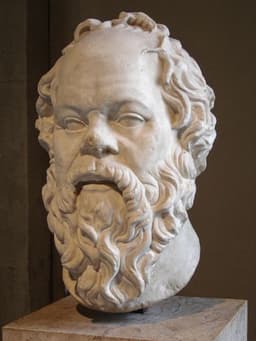
Socrates
Philosopher · Ancient
61.9Total
Basic Information
Born
-428
-470
Died
-348
-399
Era
Ancient
Ancient
Nationality
Greece
Greece
Occupation
Philosopher
Philosopher
Civilization
Western
Western
Score Comparison
Military (10%)
8.6
8.8
Political (20%)
35.0
35.0
Influence (20%)
88.0
88.0
Legacy (20%)
87.0
87.0
Leadership (15%)
35.4
51.7
Strategy (15%)
41.8
42.8
TOTAL
59.4
61.9
Plato — Complete Timeline
387 BC
Founding of the AcademyCultural
Plato founded the Academy in Athens, a school dedicated to philosophical and scientific inquiry. It became the first institution of higher learning in the Western world, operating for nearly 900 years. Students studied mathematics, astronomy, and philosophy.
EducationPhilosophyAcademy
Impact: globalconstructive
375 BC
Writing of The RepublicCultural
Plato wrote The Republic, a Socratic dialogue exploring justice, the ideal state, and the philosopher-king. The work introduced the theory of Forms, the allegory of the cave, and concepts of education and governance that became foundational to Western philosophy.
PhilosophyPolitical theoryDialogue
Impact: globalconstructive
367 BC
Journey to SyracusePolitical Action◆ Major
Plato traveled to Syracuse to tutor the young ruler Dionysius II, hoping to create a philosopher-king. The experiment failed due to court intrigues and Dionysius's lack of aptitude. Plato narrowly escaped with his life, disillusioned with practical politics.
Political experimentSyracusePhilosopher-king
Impact: regional
350 BC
Writing of the LawsCultural◆ Major
Plato wrote the Laws, his longest dialogue, outlining a practical legal code for a hypothetical city-state. It addressed governance, education, and religion, reflecting his later, more pragmatic political philosophy. The work influenced later legal and political thought.
PhilosophyLawPolitical theory
Impact: globalconstructive
Socrates — Complete Timeline
432 BC
Service in the Peloponnesian WarWar
Socrates served as a hoplite (heavy infantryman) in the Athenian army during the Peloponnesian War. He fought in the battles of Potidaea, Delium, and Amphipolis, where he was noted for his bravery and endurance, saving the life of Alcibiades at Potidaea.
Military ServiceWarBravery
430 BC
Development of the Socratic MethodCultural◆ Major
Socrates developed a method of inquiry through questioning, known as the Socratic method. He engaged Athenians in dialogues to expose contradictions in their beliefs and stimulate critical thinking. This method became a cornerstone of Western philosophy and education.
PhilosophyMethodDialectic
Impact: globalprogressive
404 BC
Refusal to Obey the Thirty TyrantsPolitical Action
During the reign of the Thirty Tyrants, Socrates was ordered to arrest Leon of Salamis for execution. He refused, risking his own life, because he considered the order unjust. This act demonstrated his commitment to moral principles over political authority.
Civil DisobedienceMoralityTyranny
constructive
399 BC
Trial and Execution of SocratesPolitical Action
Socrates was tried by an Athenian jury on charges of impiety and corrupting the youth. He was found guilty and sentenced to death by drinking hemlock. His refusal to escape and calm acceptance of death became a foundational example of philosophical integrity.
TrialDeathPhilosophy
Impact: globaltragic
Expert Analysis
Origins
Plato (c. 428–348 BCE) was born into an aristocratic Athenian family. His father Ariston claimed descent from the last king of Athens, and his mother Perictione was related to the lawgiver Solon. Plato likely received the best education of his time, studying music, gymnastics, and philosophy. He was originally named Aristocles; the nickname 'Plato' (meaning 'broad') came from his wrestling coach. His early exposure to politics and the execution of his mentor Socrates profoundly shaped his worldview.
Socrates (c. 470–399 BCE) was born a citizen of Athens, the son of Sophroniscus, a stonemason, and Phaenarete, a midwife. He received a basic education and initially worked as a stonemason before turning to philosophy. He served as a hoplite in the Peloponnesian War, fighting at Potidaea (432–430 BCE), Delium (424 BCE), and Amphipolis (422 BCE). Unlike Plato, Socrates left no writings; all knowledge of him comes from the dialogues of Plato and other contemporaries.
Rise to Power
Plato rose to prominence after Socrates' death. He traveled to Megara, Egypt, and Italy, then returned to Athens around 387 BCE to found the Academy, the first Western institution of higher learning. The Academy attracted students from across Greece, including Aristotle. Plato's political ambitions were never realized directly, but his influence grew through his writings and students.
Socrates never sought formal power. He gained influence through his public dialogues in the Athenian agora, engaging citizens in questioning ethical concepts. His method exposed contradictions in people's beliefs, earning him both admirers and enemies. His reputation as a 'gadfly' of Athens led to his indictment in 399 BCE on charges of impiety and corrupting the youth. At his trial, he famously refused to abandon his philosophy, and was sentenced to death by hemlock.
Leadership & Governance
Plato's leadership was indirect—through his philosophical works and the Academy. In 'The Republic', he advocated for rule by philosopher-kings, a meritocratic elite trained in dialectic and the theory of Forms. His later work 'The Laws' designed a practical legal code for a second-best state, emphasizing mixed government and the rule of law. Plato attempted to implement his ideas in Syracuse, tutoring Dionysius II, but the experiment failed.
Socrates led by example, not position. He served as a citizen-soldier and refused to obey the Thirty Tyrants when ordered to arrest Leon of Salamis. He practiced civil disobedience, arguing that he would rather suffer wrong than commit it. His leadership was moral and intellectual, not institutional. He scored 51.7 in leadership compared to Plato's 35.4, reflecting his direct influence on followers through personal interaction.
Triumph & Tragedy
Plato's greatest triumph was founding the Academy, which operated for nearly 900 years until 529 CE. His dialogues, especially 'The Republic', 'Phaedo', and 'Symposium', are cornerstones of Western philosophy. He introduced the theory of Forms, which influenced Christian theology and later metaphysics. His tragedy was the failure in Syracuse; he risked his life and was nearly sold into slavery. His political idealism often clashed with reality.
Socrates' triumph was his unwavering commitment to truth and virtue. His method of questioning—the Socratic method—is still used in law and education. His execution became a symbol of the conflict between the individual and the state. His tragedy was his death, but also the fact that his teachings are known only through others; we cannot be certain of his authentic words. He scored 88.0 in influence and 87.0 in legacy, equal to Plato's scores, but his total score of 61.9 slightly edges Plato's 59.4.
Character & Destiny
Plato was a systematic thinker, cautious and idealistic. He founded an institution to preserve knowledge, and wrote extensively. His character combined aristocratic disdain for democracy (which he saw as mob rule) with a passion for eternal truths. His destiny was to shape Western thought for millennia, but his political ambitions never materialized.
Socrates was a gadfly: ironic, humble, and relentless. He claimed ignorance, yet exposed others' ignorance. His character was unyielding—he chose death over exile or silence. His destiny was to become a martyr for philosophy, his life and death inspiring countless thinkers. Historians often note that without Plato, Socrates might have been forgotten; without Socrates, Plato might not have become a philosopher.
Legacy
Plato's legacy is immense. The Academy was the prototype for universities. His dialogues are studied in philosophy, political theory, and literature. The concept of the philosopher-king influenced later utopian thought. Neoplatonism shaped Christian, Islamic, and Jewish mysticism. His total score of 59.4 reflects high influence and legacy but lower military and political scores.
Socrates' legacy is equally profound but different. He is the father of Western ethics and epistemology. The Socratic method remains a core pedagogical tool. His trial and death symbolize the pursuit of truth against authority. He left no writings, yet his impact is ranked with Plato's. His total score of 61.9 is slightly higher due to leadership and strategy.
Conclusion
While both philosophers are foundational, Plato had a greater measurable impact on the world. He created the first university, wrote systematic works that survived intact, and shaped entire fields of inquiry. Socrates' influence is mediated through Plato and others. Although Socrates scored higher overall (61.9 vs 59.4), Plato's direct contributions to institutional education and literature give him a broader reach. The total score gap of 2.5 points is narrow, but Plato's concrete achievements—the Academy, the dialogues—edge him ahead in historical impact. Socrates remains the more compelling figure, but Plato the more influential.
Rankings
🥇
SocratesLeader
Mil: 8.8Pol: 35.0Inf: 88.0
61.9
🥈
Plato
Mil: 8.6Pol: 35.0Inf: 88.0
59.4
+2.5 behind
How This Comparison Works
Algorithm
Each figure is scored on 6 dimensions (0—100 scale) based on structured historical data: Military (10%), Political (20%), Influence (20%), Legacy (20%), Leadership (15%), Strategy (15%). The weighted total produces the final ranking.
Data Sources
Scores are computed from structured sub-indicators in the database. Scale factors adjust for era (Ancient ×0.85, Modern ×1.0) and civilization size (Eastern ×1.05, Other ×0.80) to account for differences in population and military scale.
Maximum 3 Figures
Comparisons are limited to 2—3 figures to ensure readability and statistical meaningfulness.
Error Margins
±5 points per dimension — Sub-scores are derived from historical records with inherent uncertainty. Two figures within 5 points on a dimension should be considered roughly equivalent in that area.
Total Score Accuracy
±3 points overall — The weighted combination of 6 dimensions produces a total score with approximately ±3 points of uncertainty. Differences of less than 3 points are not statistically significant— the figures are effectively tied.
Known Limitations
- Historical records are incomplete and uneven across civilizations
- Figures from oral-tradition societies may be underrepresented
- Occupation labels can misclassify multi-role figures
- Scores measure capability and impact, not moral character
- Quantitative scoring is a comparison tool, not absolute truth
Capability Radar
Military (10%) — Battles & Warfare
Battles
13
16
Win Rate
16
14
Expansion
18
22
Political (20%) — Governance & Reform
Reform
40
0
Diplomacy
35
10
Economy
20
0
Influence (20%) — Cultural & Global Reach
Cultural
95
95
Global
90
90
Legacy (20%) — Historical Impact
Historical
95
95
Longevity
95
95
Leadership (15%) — Power & Stability
Tenure
30
0
Stability
25
0
Strategy (15%) — Tactics & Innovation
Strategy
22
24
Tactics
24
25
Reform
28
27
Similar Comparisons
Comments & Discussion
No comments yet. Be the first to share your thoughts!