Loading...
Han Feizi vs Socrates
Socrates leads by 7.1 pts · 2 figures compared
…

Han Feizi
Philosopher · Ancient
54.8Total
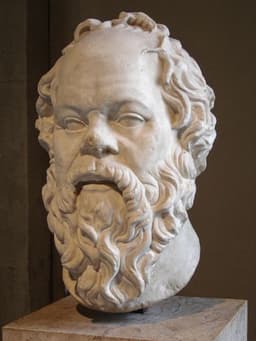
Socrates
Philosopher · Ancient
61.9Total
Basic Information
Born
-280
-470
Died
-233
-399
Era
Ancient
Ancient
Nationality
China
Greece
Occupation
Philosopher
Philosopher
Civilization
Eastern
Western
Score Comparison
Military (10%)
8.9
8.8
Political (20%)
35.0
35.0
Influence (20%)
65.0
88.0
Legacy (20%)
75.0
87.0
Leadership (15%)
62.6
51.7
Strategy (15%)
42.3
42.8
TOTAL
54.8
61.9
Han Feizi — Complete Timeline
240 BC
Wrote the Han FeiziCultural◆ Major
Han Feizi authored the Han Feizi, a foundational text of Legalist philosophy. The work synthesized earlier Legalist ideas, advocating for strict laws, centralized authority, and a system of rewards and punishments to govern the state effectively.
PhilosophyLegalist TextStatecraft
Impact: regional
233 BC
Imprisoned and Poisoned by Li SiPolitical Action◆ Major
Han Feizi was sent as an envoy to the Qin state, where his former classmate Li Si, now a Qin minister, became jealous of his abilities. Li Si had Han Feizi imprisoned on false charges and forced him to commit suicide by poison, ending his life before his ideas were fully implemented.
DeathPolitical RivalryQin
Impact: nationaltragic
Socrates — Complete Timeline
432 BC
Service in the Peloponnesian WarWar
Socrates served as a hoplite (heavy infantryman) in the Athenian army during the Peloponnesian War. He fought in the battles of Potidaea, Delium, and Amphipolis, where he was noted for his bravery and endurance, saving the life of Alcibiades at Potidaea.
Military ServiceWarBravery
430 BC
Development of the Socratic MethodCultural◆ Major
Socrates developed a method of inquiry through questioning, known as the Socratic method. He engaged Athenians in dialogues to expose contradictions in their beliefs and stimulate critical thinking. This method became a cornerstone of Western philosophy and education.
PhilosophyMethodDialectic
Impact: globalprogressive
404 BC
Refusal to Obey the Thirty TyrantsPolitical Action
During the reign of the Thirty Tyrants, Socrates was ordered to arrest Leon of Salamis for execution. He refused, risking his own life, because he considered the order unjust. This act demonstrated his commitment to moral principles over political authority.
Civil DisobedienceMoralityTyranny
constructive
399 BC
Trial and Execution of SocratesPolitical Action
Socrates was tried by an Athenian jury on charges of impiety and corrupting the youth. He was found guilty and sentenced to death by drinking hemlock. His refusal to escape and calm acceptance of death became a foundational example of philosophical integrity.
TrialDeathPhilosophy
Impact: globaltragic
Expert Analysis
Origins
Han Feizi (c. 280–233 BCE) was born a prince of the Han state during the Warring States period, a time of political fragmentation and constant warfare. He was a student of the Confucian scholar Xunzi, but his philosophy diverged sharply, emphasizing law and state power. His writings, collected in the *Han Feizi*, synthesized earlier Legalist ideas from Shang Yang and Shen Buhai. Socrates (c. 470–399 BCE) was born in Athens during its Golden Age. He was the son of a sculptor and a midwife, and he served as a hoplite in the Peloponnesian War. He left no writings; his teachings are known through Plato's dialogues. His early exposure to natural philosophy gave way to a focus on ethics and epistemology.
Rise to Power
Han Feizi's rise was intellectual rather than political. His writings caught the attention of Qin Shi Huang, who admired his Legalist doctrines. However, Han Feizi's path to influence was blocked by his former classmate Li Si, who became a minister in Qin. When Han Feizi was sent as an envoy to Qin, Li Si, fearing rivalry, had him imprisoned and poisoned in 233 BCE. Despite his death, his ideas were implemented by Li Si and Qin Shi Huang, leading to the unification of China. Socrates rose to prominence through his public dialogues in Athens, challenging citizens and sophists with his method of questioning. He gained a following among the youth, including Plato, but also made enemies. His role as a gadfly culminated in his trial in 399 BCE on charges of impiety and corrupting the youth. He was found guilty and sentenced to death.
Leadership & Governance
Han Feizi's philosophy advocated for a system of strict laws (fa), statecraft (shu), and power (shi). He believed that human nature is inherently selfish and that only a strong legal system with clear rewards and punishments could maintain order. His ideas were implemented by Qin Shi Huang, who standardized laws, writing, and measures, and centralized power. Socrates, in contrast, did not seek political office but engaged in moral inquiry. He used the Socratic method to question assumptions and expose contradictions, aiming to improve the soul. He criticized Athenian democracy for its reliance on rhetoric and ignorance, but he also obeyed the law, refusing to escape his death sentence.
Triumph & Tragedy
Han Feizi's triumph was the influence of his ideas on the Qin unification, which ended centuries of war and established a centralized bureaucracy. His legalist system provided the foundation for imperial China. However, his tragedy was his personal death—poisoned by a rival—and the harshness of Qin rule, which led to rebellion and the dynasty's fall after only 15 years. Socrates' triumph was the development of the Socratic method and his unwavering commitment to truth, which laid the groundwork for Western philosophy. His trial and death became a symbol of intellectual integrity. His tragedy was his execution by a democratic state, a failure of the system he critiqued.
Character & Destiny
Han Feizi was a philosopher of power, but he suffered from a speech impediment that limited his political influence. His character was shaped by his aristocratic background and his disappointment with the failure of his own state. He was pragmatic and cynical, seeing law as the only remedy for chaos. His destiny was to die as a victim of the very political machinations he analyzed. Socrates was known for his ironic humility and relentless questioning. He claimed to know nothing and sought wisdom through dialogue. His character was defiant; he refused to compromise his principles even in the face of death. His destiny was to become a martyr for philosophy.
Legacy
Han Feizi's legacy is immense in Chinese history. His ideas became the basis for legalist governance, influencing not only the Qin but later dynasties that adopted a mix of Confucianism and Legalism. The *Han Feizi* remains a classic of political thought. In terms of scores, his Legacy score is 75.0, reflecting his long-term impact on Chinese statecraft. Socrates' legacy is foundational to Western philosophy. He inspired Plato and Aristotle, and his method is still used in education and law. His Influence score is 88.0, and Legacy is 87.0, showing his broader global impact. While Han Feizi shaped China's political structure, Socrates shaped Western intellectual tradition.
Conclusion
Comparing Han Feizi and Socrates, Socrates has a higher total score (61.9 vs 54.8) and greater global influence. His ideas transcended his culture and time, becoming universal in Western thought. Han Feizi's impact, while profound, is more regionally confined to Chinese political history. Socrates' method of critical inquiry and his emphasis on ethics have had a more enduring and widespread effect. Therefore, Socrates had greater overall impact, as reflected in his higher scores across influence and legacy.
Rankings
🥇
SocratesLeader
Mil: 8.8Pol: 35.0Inf: 88.0
61.9
🥈
Han Feizi
Mil: 8.9Pol: 35.0Inf: 65.0
54.8
+7.1 behind
How This Comparison Works
Algorithm
Each figure is scored on 6 dimensions (0—100 scale) based on structured historical data: Military (10%), Political (20%), Influence (20%), Legacy (20%), Leadership (15%), Strategy (15%). The weighted total produces the final ranking.
Data Sources
Scores are computed from structured sub-indicators in the database. Scale factors adjust for era (Ancient ×0.85, Modern ×1.0) and civilization size (Eastern ×1.05, Other ×0.80) to account for differences in population and military scale.
Maximum 3 Figures
Comparisons are limited to 2—3 figures to ensure readability and statistical meaningfulness.
Error Margins
±5 points per dimension — Sub-scores are derived from historical records with inherent uncertainty. Two figures within 5 points on a dimension should be considered roughly equivalent in that area.
Total Score Accuracy
±3 points overall — The weighted combination of 6 dimensions produces a total score with approximately ±3 points of uncertainty. Differences of less than 3 points are not statistically significant— the figures are effectively tied.
Known Limitations
- Historical records are incomplete and uneven across civilizations
- Figures from oral-tradition societies may be underrepresented
- Occupation labels can misclassify multi-role figures
- Scores measure capability and impact, not moral character
- Quantitative scoring is a comparison tool, not absolute truth
Capability Radar
Military (10%) — Battles & Warfare
Battles
14
16
Win Rate
16
14
Expansion
24
22
Political (20%) — Governance & Reform
Reform
85
0
Diplomacy
20
10
Economy
30
0
Influence (20%) — Cultural & Global Reach
Cultural
70
95
Global
75
90
Legacy (20%) — Historical Impact
Historical
85
95
Longevity
90
95
Leadership (15%) — Power & Stability
Tenure
0
0
Stability
40
0
Strategy (15%) — Tactics & Innovation
Strategy
24
24
Tactics
24
25
Reform
27
27
Similar Comparisons
Comments & Discussion
No comments yet. Be the first to share your thoughts!