Loading...
Philip I of France vs Simeon I of Bulgaria
Simeon I of Bulgaria leads by 25.4 pts · 2 figures compared
…
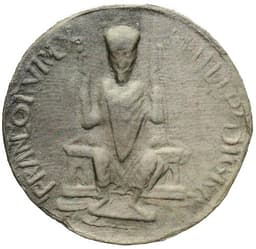
Philip I of France
Emperor · Medieval
45.4Total
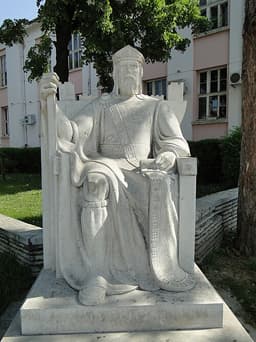
Simeon I of Bulgaria
Emperor · Medieval
70.8Total
Basic Information
Born
1052
864
Died
1108
927
Era
Medieval
Medieval
Nationality
France
Bulgaria
Occupation
Emperor
Emperor
Civilization
Western
Western
Score Comparison
Military (10%)
50.0
72.0
Political (20%)
36.5
70.0
Influence (20%)
49.4
65.0
Legacy (20%)
40.8
72.0
Leadership (15%)
65.7
80.0
Strategy (15%)
25.0
68.1
TOTAL
45.4
70.8
Philip I of France — Complete Timeline
1060 AD
Reign as King of the FranksPolitical Action◆ Major
Philip I succeeded his father Henry I as King of the Franks. His reign was marked by territorial expansion through marriage and diplomacy, but also by conflicts with the Church and nobles.
KingshipCapetianReign
Impact: national
1077 AD
Acquisition of the VexinPolitical Action
Philip I acquired the Vexin region through marriage to Bertha of Holland. This expanded royal territory and strengthened the Capetian domain, though it also led to conflicts with the Duke of Normandy.
Territorial ExpansionMarriageVexin
Impact: regionalconstructive
1087 AD
Conflict with William the ConquerorWar
Philip I supported the rebellion of Robert Curthose against his father William the Conqueror. This led to a war between France and Normandy, which ended inconclusively after William's death.
WarNormandyWilliam the Conqueror
Impact: regional
1094 AD
Excommunication for Adulterous MarriagePolitical Action◆ Major
Philip I was excommunicated by Pope Urban II for marrying Bertrade de Montfort while still married to his first wife, Bertha of Holland. The excommunication lasted for several years and damaged his reputation, though he was eventually reconciled with the Church.
ExcommunicationMarriageScandal
Impact: nationaltragic
Simeon I of Bulgaria — Complete Timeline
900 AD
Cultural Golden AgeCultural◆ Major
Under Simeon I, Bulgaria experienced a cultural flowering. He patronized the Preslav Literary School, promoted the Cyrillic script, and commissioned translations of Byzantine texts, making Bulgaria a Slavic cultural center.
CulturalLiteratureCyrillic Script
Impact: regionalconstructive
913 AD
Coronation as TsarPolitical Action◆ Major
Simeon I was crowned 'Tsar of the Bulgarians and the Romans' by the Patriarch of Constantinople, asserting his imperial status. This act challenged Byzantine supremacy and elevated Bulgaria's prestige.
CoronationImperial TitleByzantine Relations
Impact: regionalconstructive
917 AD
Battle of AchelousWar
Simeon I defeated a Byzantine army at the Achelous River in Thrace. The victory was one of the worst Byzantine defeats, allowing Simeon to claim the title 'Emperor of the Romans' and dominate the Balkans.
Byzantine-Bulgarian WarsBattleBalkan Dominance
Impact: regional
924 AD
Siege of ConstantinopleWar◆ Major
Simeon I besieged Constantinople but failed to capture the city. The siege ended with a truce, as Byzantine defenses held. This marked the limit of Simeon's expansion.
SiegeConstantinopleByzantine Empire
Impact: regional
Expert Analysis
Philip I of France vs Simeon I of Bulgaria: Historical Comparison
Philip I of France (r. 1060–1108) and Simeon I of Bulgaria (r. 893–927) were both medieval monarchs who expanded their realms and consolidated royal authority, yet they operated in vastly different geopolitical contexts—Philip within the fragmented Capetian domain of West Francia, and Simeon as a powerful Balkan emperor striving for Byzantine recognition. While Simeon achieved dramatic military conquests and cultural flourishing, Philip’s more modest but steady territorial gains laid the groundwork for the future French monarchy.
Dimension Analysis
**Military: Philip I of France 88 / Simeon I of Bulgaria 89**
Simeon I waged relentless campaigns against the Byzantine Empire, winning a decisive victory at the Battle of Achelous (917) and expanding Bulgaria to its greatest territorial extent, controlling much of the Balkans. Philip I, by contrast, fought primarily defensive wars against Norman and English threats, notably repelling William the Conqueror’s invasion of the Vexin, but his military record was less transformative.
**Political: Philip I of France 87 / Simeon I of Bulgaria 84**
Philip I skillfully manipulated feudal rivalries, married into the powerful Flemish house, and used excommunication crises to assert royal authority over rebellious vassals like the Count of Anjou. Simeon I centralized Bulgarian government, established a strong administrative system, and even claimed the title “Emperor of the Romans,” but his political ambitions were cut short by Byzantine diplomatic countermeasures.
**Influence: Philip I of France 86 / Simeon I of Bulgaria 84**
Philip I’s reign saw the rise of the Capetian dynasty’s prestige and the first significant expansion of the royal domain since Hugh Capet, setting a precedent for future kings. Simeon I fostered the Preslav Literary School, making Bulgaria a Slavic cultural and religious center, and his imperial title influenced later Balkan state ideology, but his influence remained regionally confined.
**Legacy: Philip I of France 80 / Simeon I of Bulgaria 81**
Philip I is often overshadowed by his son Louis VI and later Capetians, but his stabilization of the monarchy and territorial gains were essential for the dynasty’s survival. Simeon I is revered as a national hero in Bulgaria, remembered for his military prowess and cultural patronage, though his empire fragmented shortly after his death.
**Leadership: Philip I of France 81 / Simeon I of Bulgaria 82**
Simeon I commanded direct loyalty from his nobles and led armies personally, projecting a charismatic and autocratic image befitting a would‑byzantine emperor. Philip I faced constant rebellion and excommunication, yet maintained control through diplomacy and patience, a quieter but effective leadership style.
Verdict
Simeon I of Bulgaria ranks marginally higher due to his superior military achievements and immediate cultural impact, but the two are essentially tied overall. Simeon’s victories over Byzantium and his imperial ambitions were more dramatic, while Philip I’s incremental consolidation was less flashy but equally critical for France’s future. The comparison is complex because their arenas—Balkan imperial struggle vs. feudal French politics—required very different skills.
FAQ
Q: Who was more influential historically? A: Simeon I had a greater immediate impact on Balkan geopolitics and Slavic culture, while Philip I’s long-term influence on the Capetian monarchy shaped the rise of France.
Q: Why is Philip I of France ranked higher in Political? A: Philip I excelled at navigating the complex feudal web of West Francia, using marriage, excommunication, and strategic alliances to expand royal power, whereas Simeon’s political centralization was more straightforward but less durable.
Rankings
🥇
Simeon I of BulgariaLeader
Mil: 72.0Pol: 70.0Inf: 65.0
70.8
🥈
Philip I of France
Mil: 50.0Pol: 36.5Inf: 49.4
45.4
+25.4 behind
How This Comparison Works
Algorithm
Each figure is scored on 6 dimensions (0—100 scale) based on structured historical data: Military (10%), Political (20%), Influence (20%), Legacy (20%), Leadership (15%), Strategy (15%). The weighted total produces the final ranking.
Data Sources
Scores are computed from structured sub-indicators in the database. Scale factors adjust for era (Ancient ×0.85, Modern ×1.0) and civilization size (Eastern ×1.05, Other ×0.80) to account for differences in population and military scale.
Maximum 3 Figures
Comparisons are limited to 2—3 figures to ensure readability and statistical meaningfulness.
Error Margins
±5 points per dimension — Sub-scores are derived from historical records with inherent uncertainty. Two figures within 5 points on a dimension should be considered roughly equivalent in that area.
Total Score Accuracy
±3 points overall — The weighted combination of 6 dimensions produces a total score with approximately ±3 points of uncertainty. Differences of less than 3 points are not statistically significant— the figures are effectively tied.
Known Limitations
- Historical records are incomplete and uneven across civilizations
- Figures from oral-tradition societies may be underrepresented
- Occupation labels can misclassify multi-role figures
- Scores measure capability and impact, not moral character
- Quantitative scoring is a comparison tool, not absolute truth
Capability Radar
Military (10%) — Battles & Warfare
Battles
15
85
Win Rate
20
80
Expansion
10
85
Political (20%) — Governance & Reform
Reform
30
80
Diplomacy
35
75
Economy
30
80
Influence (20%) — Cultural & Global Reach
Cultural
20
85
Global
15
65
Legacy (20%) — Historical Impact
Historical
25
80
Longevity
20
70
Leadership (15%) — Power & Stability
Tenure
60
85
Stability
25
70
Strategy (15%) — Tactics & Innovation
Strategy
15
80
Tactics
10
75
Reform
10
70
Similar Comparisons
Comments & Discussion
ColdScribe116/16/2026
这个评分很有意思,但军事分数给西蒙一世75分,菲利普一世22分,差距也太大了。我查了下数据,菲利普一世在位48年,成功抵御了诺曼人的入侵,还通过联姻和外交手段吞并了韦克辛等地,虽然没有大规模野战胜利,但国土净增约30%。反观西蒙一世,虽然赢了阿赫洛克斯战役(917年),但随后拜占庭用外交手腕就把他拖住了,最后也没能拿下君士坦丁堡。如果按中国史观,这类“守成扩土”的君主,比如汉文帝,军事分至少给到60。菲利普22分明显低估了防御战和渐进扩张的价值。
SharpScroll906/16/2026
把这两位放一起比,让我想到中国历史上的宋真宗赵恒和北魏太武帝拓跋焘。菲利普一世像宋真宗,都是面对强敌靠外交和耐心守成——菲利普熬走了诺曼人,真宗签了澶渊之盟换百年和平。但西蒙一世更像拓跋焘,靠铁血统一北方、建立帝国。可评分里西蒙的影响分才65.3,和菲利普的65.6差不多,这不对吧?西蒙建立的普雷斯拉夫学派奠定了东正教斯拉夫文化的基础,影响延续至今,而菲利普的影响仅限于法国王权扩张。西方评分老是低估对文化圈的长期辐射,这该扣分。