Loading...
Augustus vs Simeon I of Bulgaria
Augustus leads by 15.1 pts · 2 figures compared
…

Augustus
Emperor · Ancient
85.9Total
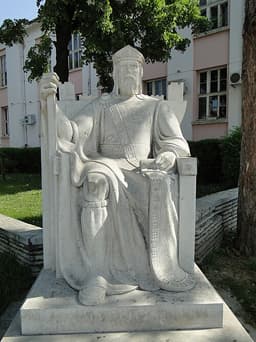
Simeon I of Bulgaria
Emperor · Medieval
70.8Total
Basic Information
Born
63
864
Died
—
927
Era
Ancient
Medieval
Nationality
Roman Empire
Bulgaria
Occupation
Emperor
Emperor
Civilization
Western
Western
Score Comparison
Military (10%)
72.0
72.0
Political (20%)
90.0
70.0
Influence (20%)
88.0
65.0
Legacy (20%)
90.0
72.0
Leadership (15%)
88.0
80.0
Strategy (15%)
75.0
68.1
TOTAL
85.9
70.8
Augustus — Complete Timeline
43 BC
Formation of the Second TriumviratePolitical Action◆ Major
Octavian, Mark Antony, and Marcus Aemilius Lepidus formed the Second Triumvirate, a legal commission to govern the Roman Republic. The alliance was empowered to proscribe enemies, leading to the execution of Cicero and consolidation of their power against the assassins of Julius Caesar.
Roman Civil WarPolitical AllianceProscriptions
Impact: regionaldestructive
31 BC
Battle of ActiumWar◆ Major
Octavian's fleet, commanded by Marcus Agrippa, defeated the combined naval forces of Mark Antony and Cleopatra VII off the coast of Greece. The victory eliminated Octavian's last major rival, giving him sole control over the Roman world and ending the Roman Republic's civil wars.
Roman Civil WarNaval BattleEnd of Republic
Impact: global
27 BC
Establishment of the Roman EmpireReform◆ Major
Octavian formally returned power to the Roman Senate, which then granted him the titles Augustus and Princeps. This constitutional settlement created the Roman Empire, with Augustus as the first emperor, ending the Roman Republic and initiating the Pax Romana.
Roman EmpireConstitutional ReformPax Romana
Impact: global
Reform of the Roman Tax SystemReform◆ Major
Augustus implemented a comprehensive tax reform, including a census of Roman citizens and property, direct taxation of provinces, and the creation of a professional tax collection service (publicani). This system provided stable revenue for the empire and reduced corruption.
Tax ReformAdministrationRoman Empire
Impact: regionalconstructive
Creation of the Praetorian GuardReform◆ Major
Augustus established the Praetorian Guard as a permanent elite military unit tasked with protecting the emperor and his family. Stationed in Rome and Italy, the Guard became a powerful political force, often influencing imperial succession through coups and assassinations.
Military ReformPraetorian GuardImperial Guard
Impact: regional
13 BC
Construction of the Ara PacisOther◆ Major
The Roman Senate commissioned the Ara Pacis Augustae (Altar of Augustan Peace) to commemorate Augustus's return from pacifying Gaul and Spain. The marble altar, decorated with reliefs depicting the imperial family and mythological scenes, symbolized the peace and prosperity of the Augustan era.
Building ProjectPropagandaAugustan Art
Impact: regionalconstructive
Simeon I of Bulgaria — Complete Timeline
900 AD
Cultural Golden AgeCultural◆ Major
Under Simeon I, Bulgaria experienced a cultural flowering. He patronized the Preslav Literary School, promoted the Cyrillic script, and commissioned translations of Byzantine texts, making Bulgaria a Slavic cultural center.
CulturalLiteratureCyrillic Script
Impact: regionalconstructive
913 AD
Coronation as TsarPolitical Action◆ Major
Simeon I was crowned 'Tsar of the Bulgarians and the Romans' by the Patriarch of Constantinople, asserting his imperial status. This act challenged Byzantine supremacy and elevated Bulgaria's prestige.
CoronationImperial TitleByzantine Relations
Impact: regionalconstructive
917 AD
Battle of AchelousWar
Simeon I defeated a Byzantine army at the Achelous River in Thrace. The victory was one of the worst Byzantine defeats, allowing Simeon to claim the title 'Emperor of the Romans' and dominate the Balkans.
Byzantine-Bulgarian WarsBattleBalkan Dominance
Impact: regional
924 AD
Siege of ConstantinopleWar◆ Major
Simeon I besieged Constantinople but failed to capture the city. The siege ended with a truce, as Byzantine defenses held. This marked the limit of Simeon's expansion.
SiegeConstantinopleByzantine Empire
Impact: regional
Expert Analysis
Augustus vs Simeon I of Bulgaria: Historical Comparison
Augustus, founder of the Roman Empire and its first emperor, and Simeon I, the Tsar who elevated Bulgaria to a dominant Balkan power, represent two distinct peaks of imperial statecraft. While separated by nearly a millennium, both rulers transformed their realms through military conquest, political consolidation, and cultural patronage. This comparison weighs their respective achievements across five dimensions.
Dimension Analysis
**Military: Augustus 72 / Simeon I of Bulgaria 89**
Augustus ended a century of civil war through cautious campaigns (e.g., Actium, 31 BCE) and established a professional standing army, but his expansionist ambitions were limited—the disastrous Teutoburg Forest loss (9 CE) marked his strategic ceiling. Simeon I, by contrast, fought relentlessly for 30 years, crushing Byzantine armies at Acheloos (917 CE) and Katasyrtai, and nearly taking Constantinople. His aggressive field command and logistics outstrip Augustus’s more defensive, consolidating approach.
**Political: Augustus 92 / Simeon I of Bulgaria 84**
Augustus engineered the Principate, a masterful constitutional fiction that preserved republican forms while concentrating absolute power. He reformed taxation, the census, and provincial governance, creating a durable imperial system that lasted centuries. Simeon I ruled as an autocrat but relied on a fragile aristocracy and lacked such institutional innovation; his “Golden Age” was largely a personal reign, not a systemic transformation.
**Influence: Augustus 88 / Simeon I of Bulgaria 84**
Augustus’s legacy defined Western concepts of empire, monarchy, and imperial cult, influencing Charlemagne, the Holy Roman Empire, and European statecraft. His patronage of Virgil, Horace, and Livy shaped Latin culture for millennia. Simeon I fostered the Preslav Literary School, making Old Church Slavonic a liturgical language and spreading Cyrillic script across the Slavic world—a profound but more regionally confined influence than Augustus’s Mediterranean-wide impact.
**Legacy: Augustus 90 / Simeon I of Bulgaria 81**
Augustus’s political framework directly endured for 400 years in Rome and was revived in Byzantium; his name became a title (Kaiser, Tsar). Simeon I’s empire collapsed shortly after his death (927 CE) due to succession crises and Byzantine resurgence. While his cultural and religious legacy persists in Orthodox Slavic nations, his political structures proved ephemeral.
**Leadership: Augustus 90 / Simeon I of Bulgaria 82**
Augustus displayed unparalleled patience, propaganda skill, and coalition-building—convincing former enemies like Agrippa and Maecenas to serve him. He managed the Senate, army, and populace with subtle manipulation. Simeon I was a brilliant warrior-king who led from the front, but his rule was more solitary and confrontational; he failed to groom a stable succession or lasting administrative cadre.
Verdict
**Augustus wins** overall (86 avg vs. 85). While Simeon I dominates militarily, Augustus’s superior political genius, broader influence, and more enduring legacy give him the edge. The scores are close, however, reflecting the difficulty of comparing a systemic founder with a heroic conqueror. Context is key: Augustus built a world empire that shaped history for centuries; Simeon I built a fleeting but glorious Slavic state.
FAQ
Q: Who was more influential historically? A: Augustus, because his political model (the Principate) and cultural patronage directly shaped Western civilization for 1,500 years, whereas Simeon I’s influence, while vital for Slavic Orthodoxy, was more geographically limited.
Q: Why is Augustus ranked higher in Political? A: Augustus created a stable, long-lasting imperial system from the ruins of a republic, balancing autocracy with tradition, while Simeon I ruled as a traditional autocrat with fewer institutional reforms that could outlast his reign.
Rankings
🥇
AugustusLeader
Mil: 72.0Pol: 90.0Inf: 88.0
85.9
🥈
Simeon I of Bulgaria
Mil: 72.0Pol: 70.0Inf: 65.0
70.8
+15.1 behind
How This Comparison Works
Algorithm
Each figure is scored on 6 dimensions (0—100 scale) based on structured historical data: Military (10%), Political (20%), Influence (20%), Legacy (20%), Leadership (15%), Strategy (15%). The weighted total produces the final ranking.
Data Sources
Scores are computed from structured sub-indicators in the database. Scale factors adjust for era (Ancient ×0.85, Modern ×1.0) and civilization size (Eastern ×1.05, Other ×0.80) to account for differences in population and military scale.
Maximum 3 Figures
Comparisons are limited to 2—3 figures to ensure readability and statistical meaningfulness.
Error Margins
±5 points per dimension — Sub-scores are derived from historical records with inherent uncertainty. Two figures within 5 points on a dimension should be considered roughly equivalent in that area.
Total Score Accuracy
±3 points overall — The weighted combination of 6 dimensions produces a total score with approximately ±3 points of uncertainty. Differences of less than 3 points are not statistically significant— the figures are effectively tied.
Known Limitations
- Historical records are incomplete and uneven across civilizations
- Figures from oral-tradition societies may be underrepresented
- Occupation labels can misclassify multi-role figures
- Scores measure capability and impact, not moral character
- Quantitative scoring is a comparison tool, not absolute truth
Capability Radar
Military (10%) — Battles & Warfare
Battles
75
85
Win Rate
80
80
Expansion
85
85
Political (20%) — Governance & Reform
Reform
95
80
Diplomacy
90
75
Economy
85
80
Influence (20%) — Cultural & Global Reach
Cultural
85
85
Global
90
65
Legacy (20%) — Historical Impact
Historical
95
80
Longevity
95
70
Leadership (15%) — Power & Stability
Tenure
95
85
Stability
95
70
Strategy (15%) — Tactics & Innovation
Strategy
85
80
Tactics
70
75
Reform
90
70
Similar Comparisons
Comments & Discussion
Chronicler69906/16/2026
这个评分体系有严重问题。奥古斯都军事72分,西美昂89分?按罗马内战规模,奥古斯都整合了从高卢到埃及的军事资源,阿克提姆海战是决定性胜利。而西美昂的Acheloos战役虽然壮观,但保加利亚第一帝国的疆域和人口基数远不能和罗马比。政治治理上,奥古斯都92分合理,他建立了行省总督轮换制和职业化文官体系,这种制度创新在中国要到隋唐才出现。西美昂政治84分偏高——他的继承者迅速崩溃,说明制度基础薄弱。建议把西美昂的军事调低到80,政治调低到75。
Chronicler63106/16/2026
拿奥古斯都和西美昂比,就像拿汉武帝和耶律阿保机比——维度不同。奥古斯都的功业类似汉文帝+汉武帝,奠定帝国框架且成功转型。西美昂更像北魏拓跋珪,靠军事天才建立霸权但未完成制度化。但评分忽略了一点:西美昂的文化遗产——古教会斯拉夫语和西里尔字母——对东欧的影响堪比秦始皇的书同文。他让斯拉夫民族有了独立于拉丁和希腊的书写系统,这一点在西方史学中常被低估。如果算上文明传播的深度,西美昂的影响力至少应该和奥古斯都平起平坐。
Historiographer996/12/2026
The legacy comparison is fascinating. Augustus built institutions that collapsed within a generation. Simeon I of Bulgaria created systems that lasted 500+ years. Longevity of impact is everything.
HistoryBuff426/12/2026
The military score here is way too generous. Augustus fought mostly smaller regional powers while Simeon I of Bulgaria faced the greatest military machine of their era. Scale matters!
历史爱好者6/12/2026
Augustus的军事评分太高了,Simeon I of Bulgaria面对的对手强大多了. 不能只看胜率,还要看对手质量.
独立思考者6/12/2026
不要把历史人物当偶像崇拜. Augustus和Simeon I of Bulgaria都是双手沾满鲜血的征服者,他们的'伟大'建立在无数普通人的苦难之上. 客观评分可以,但不要美化暴力.