Loading...
Ouchi Yoshioki vs Yang Guang
Yang Guang leads by 2.1 pts · 2 figures compared
…

Ouchi Yoshioki
Emperor · Medieval
55.4Total
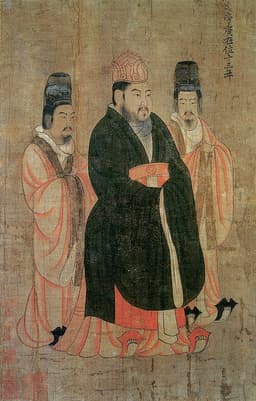
Yang Guang
Emperor · Medieval
57.5Total
Basic Information
Born
1477
569
Died
1528
618
Era
Medieval
Medieval
Nationality
Japan
China
Occupation
Emperor
Emperor
Civilization
Eastern
Eastern
Score Comparison
Military (10%)
52.5
47.5
Political (20%)
53.8
62.7
Influence (20%)
56.4
72.0
Legacy (20%)
48.3
40.0
Leadership (15%)
66.0
62.2
Strategy (15%)
60.0
60.0
TOTAL
55.4
57.5
Ouchi Yoshioki — Complete Timeline
1508 AD
Restoration of Ashikaga YoshitanePolitical Action◆ Major
Ouchi Yoshioki marched his army to Kyoto and restored Ashikaga Yoshitane as shogun, ending the exile of the Ashikaga shogunate. This action reasserted Ouchi influence over central politics and demonstrated his military power.
Ashikaga RestorationKyoto CampaignShogunate Politics
Impact: nationalconstructive
1511 AD
Battle of FunaokayamaWar◆ Major
Ouchi Yoshioki defeated the forces of Hosokawa Takakuni at Funaokayama in Kyoto, securing the position of the restored shogun Ashikaga Yoshitane. The victory solidified Ouchi control over the capital region.
BattleKyotoHosokawa Conflict
Impact: national
1518 AD
Return to YamaguchiPolitical Action
Ouchi Yoshioki returned to his domain in Yamaguchi after a decade in Kyoto, leaving central politics. This withdrawal allowed the Hosokawa clan to regain influence in the capital and marked the end of Ouchi direct involvement in shogunate affairs.
Political WithdrawalYamaguchiPower Shift
Impact: regional
Yang Guang — Complete Timeline
605 AD
Construction of the Grand CanalReform◆ Major
Emperor Yang Guang ordered the construction of the Grand Canal, linking the Yellow River and Yangtze River. The project mobilized millions of laborers and created a vital waterway for grain transport and trade, but the immense human cost led to widespread resentment and rebellion.
InfrastructureGrand CanalCorvée Labor
Impact: national
612 AD
Three Expeditions against GoguryeoWar◆ Major
Yang Guang launched three massive military campaigns against the Korean kingdom of Goguryeo. The first invasion in 612 ended in catastrophic defeat at the Battle of Salsu, with hundreds of thousands of Chinese soldiers killed. The repeated failures drained the treasury and sparked widespread revolts.
Goguryeo-Sui WarMilitary DisasterOverextension
Impact: regionaldestructive
613 AD
Rebellion of Yang XuanganWar◆ Major
While Yang Guang was campaigning against Goguryeo, the noble Yang Xuangan launched a major rebellion in the rear. The revolt was suppressed, but it exposed the fragility of Sui rule and encouraged further uprisings across the empire.
RebellionSui Dynasty Decline
Impact: nationaldestructive
618 AD
Assassination of Yang GuangPolitical Action
As rebellions engulfed the empire, Yang Guang was strangled to death in Jiangdu by his own guards led by Yuwen Huaji. His death marked the effective end of the Sui dynasty, which collapsed shortly after, leading to the rise of the Tang dynasty.
AssassinationSui CollapseDynastic Transition
Impact: nationaltragic
Expert Analysis
Origins
Ouchi Yoshioki (1477–1528) was born into the powerful Ouchi clan, rulers of Yamaguchi in western Japan. His father, Ouchi Masahiro, was a prominent daimyo, and Yoshioki inherited a domain with strong trade links to Korea and China. He received a traditional samurai education, emphasizing martial arts and governance. In contrast, Yang Guang (569–618) was the second son of Emperor Wen of Sui, born into the imperial family. He was groomed for leadership, showing early talent in military campaigns and administration. His father unified China after centuries of division, and Yang Guang played a key role in the conquest of the Chen dynasty in 589.
Rise to Power
Ouchi Yoshioki rose to national prominence by supporting the exiled shogun Ashikaga Yoshitane. In 1508, he marched an army of 30,000 from Yamaguchi to Kyoto, restoring Yoshitane as shogun after defeating the Hosokawa clan. This event, known as the Restoration of Ashikaga Yoshitane, made Yoshioki the de facto power in Kyoto for a decade. Yang Guang's rise was more calculated: he orchestrated the death of his elder brother Yang Yong in 600, becoming crown prince. Upon his father's death in 604, he became emperor. He immediately began ambitious projects, including the construction of the Grand Canal, which linked northern and southern China.
Leadership & Governance
Ouchi Yoshioki governed through a combination of military strength and diplomacy. He maintained control over western Japan by balancing alliances with local clans and leveraging trade wealth. However, his leadership score of 66.0 reflects his ability to command loyalty but his political score of 53.8 shows limited long-term strategic vision. After returning to Yamaguchi in 1518, he withdrew from central politics, allowing the Hosokawa to regain power. Yang Guang's governance was more centralized and ambitious. He reformed the civil service examination system, promoted Confucianism, and built infrastructure. His political score of 62.7 and leadership of 62.2 indicate effective administration, but his military score of 47.5 reflects overreach. The Grand Canal construction mobilized millions, causing widespread suffering and contributing to rebellions.
Triumph & Tragedy
Ouchi Yoshioki's greatest triumph was the restoration of the Ashikaga shogunate, a feat that demonstrated his military capability and political influence. He defeated Hosokawa Takakuni at the Battle of Funaokayama in 1511, securing Yoshitane's position. However, his tragedy was his inability to sustain central power. His withdrawal to Yamaguchi allowed the Hosokawa to reassert control, and his clan's power declined after his death. Yang Guang's triumph was the Grand Canal, a monumental engineering achievement that facilitated trade and cultural exchange for centuries. It remains a symbol of his ambition. His tragedy was his fatal overreach: three disastrous campaigns against Goguryeo (612–614) drained the treasury and led to massive rebellions. He was assassinated by his own guards in 618, ending the Sui dynasty.
Character & Destiny
Ouchi Yoshioki was a capable military leader but lacked the political ruthlessness to maintain dominance. His decision to return to his domain suggests a preference for local stability over national ambition. Historical assessments consider him a competent but not transformative figure. Yang Guang was visionary but arrogant, ignoring the human cost of his projects. His character combined brilliance with tyranny, leading to his downfall. Historians note his intelligence and cultural patronage but condemn his extravagance and cruelty. His total score of 57.5 slightly edges Yoshioki's 55.4, reflecting greater impact but also greater failure.
Legacy
Ouchi Yoshioki's legacy is mixed. He is remembered as a regional power who briefly shaped national politics, but his clan's decline limited long-term influence. The Ouchi were eclipsed by the Mori clan after his death. Yang Guang's legacy is more enduring: the Grand Canal became a vital artery for later dynasties, and his administrative reforms influenced the Tang. However, his reputation as a tyrant persists, and his scores in legacy (40.0) reflect the negative perception of his reign.
Conclusion
While Ouchi Yoshioki achieved a significant political restoration, Yang Guang's projects had a more profound and lasting impact on Chinese history. Despite his catastrophic failures, the Grand Canal and administrative changes outlasted his dynasty. Yang Guang's total score of 57.5 versus Yoshioki's 55.4 reflects his greater influence, but his legacy is deeply flawed. Therefore, Yang Guang had greater impact, albeit with a higher cost.
Rankings
🥇
Yang GuangLeader
Mil: 47.5Pol: 62.7Inf: 72.0
57.5
🥈
Ouchi Yoshioki
Mil: 52.5Pol: 53.8Inf: 56.4
55.4
+2.1 behind
How This Comparison Works
Algorithm
Each figure is scored on 6 dimensions (0—100 scale) based on structured historical data: Military (10%), Political (20%), Influence (20%), Legacy (20%), Leadership (15%), Strategy (15%). The weighted total produces the final ranking.
Data Sources
Scores are computed from structured sub-indicators in the database. Scale factors adjust for era (Ancient ×0.85, Modern ×1.0) and civilization size (Eastern ×1.05, Other ×0.80) to account for differences in population and military scale.
Maximum 3 Figures
Comparisons are limited to 2—3 figures to ensure readability and statistical meaningfulness.
Error Margins
±5 points per dimension — Sub-scores are derived from historical records with inherent uncertainty. Two figures within 5 points on a dimension should be considered roughly equivalent in that area.
Total Score Accuracy
±3 points overall — The weighted combination of 6 dimensions produces a total score with approximately ±3 points of uncertainty. Differences of less than 3 points are not statistically significant— the figures are effectively tied.
Known Limitations
- Historical records are incomplete and uneven across civilizations
- Figures from oral-tradition societies may be underrepresented
- Occupation labels can misclassify multi-role figures
- Scores measure capability and impact, not moral character
- Quantitative scoring is a comparison tool, not absolute truth
Capability Radar
Military (10%) — Battles & Warfare
Battles
55
55
Win Rate
60
40
Expansion
50
60
Political (20%) — Governance & Reform
Reform
45
75
Diplomacy
65
40
Economy
50
70
Influence (20%) — Cultural & Global Reach
Cultural
40
70
Global
30
65
Legacy (20%) — Historical Impact
Historical
50
75
Longevity
40
80
Leadership (15%) — Power & Stability
Tenure
60
60
Stability
55
20
Strategy (15%) — Tactics & Innovation
Strategy
55
50
Tactics
50
45
Reform
40
30
Similar Comparisons
Comments & Discussion
No comments yet. Be the first to share your thoughts!