Loading...
Andrei Bogolyubsky vs Yang Guang
Yang Guang leads by 10.7 pts · 2 figures compared
…
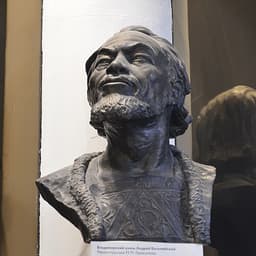
Andrei Bogolyubsky
Emperor · Medieval
46.8Total
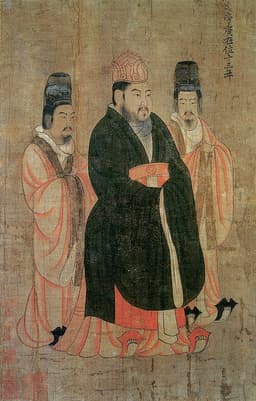
Yang Guang
Emperor · Medieval
57.5Total
Basic Information
Born
1111
569
Died
1174
618
Era
Medieval
Medieval
Nationality
Vladimir-Suzdal
China
Occupation
Emperor
Emperor
Civilization
Western
Eastern
Score Comparison
Military (10%)
10.0
47.5
Political (20%)
43.7
62.7
Influence (20%)
54.9
72.0
Legacy (20%)
46.7
40.0
Leadership (15%)
62.2
62.2
Strategy (15%)
45.0
60.0
TOTAL
46.8
57.5
Andrei Bogolyubsky — Complete Timeline
1157 AD
Transfer of the Capital to VladimirPolitical Action
After becoming Grand Prince, Andrei moved his capital from Kiev to Vladimir, a city in the northeast. He made Vladimir the political and religious center of his realm, building the Assumption Cathedral and Golden Gate.
Capital MoveVladimirPolitical Shift
Impact: regionalconstructive
1165 AD
Construction of the Church of the Intercession on the NerlCultural◆ Major
Andrei commissioned the Church of the Intercession on the Nerl River near Vladimir. This white-stone church is a masterpiece of medieval Russian architecture and a symbol of the Vladimir-Suzdal principality's cultural flourishing.
ArchitectureChurchCultural Symbol
Impact: regionalconstructive
1169 AD
Sack of KievWar
Andrei Bogolyubsky led a coalition of Rus princes in sacking Kiev, the traditional capital. His forces looted and burned the city, marking a decline in Kiev's power and the rise of Vladimir-Suzdal as a new center.
Sack of KievDeclineVladimir-Suzdal
Impact: regionaldestructive
1174 AD
Assassination by BoyarsPolitical Action◆ Major
Andrei was assassinated by a group of boyars in his palace at Bogolyubovo. The conspiracy was driven by his autocratic rule and conflicts with the nobility. His death led to a period of civil strife in Vladimir-Suzdal.
AssassinationBoyar RevoltCivil Strife
Impact: nationaltragic
Yang Guang — Complete Timeline
605 AD
Construction of the Grand CanalReform◆ Major
Emperor Yang Guang ordered the construction of the Grand Canal, linking the Yellow River and Yangtze River. The project mobilized millions of laborers and created a vital waterway for grain transport and trade, but the immense human cost led to widespread resentment and rebellion.
InfrastructureGrand CanalCorvée Labor
Impact: national
612 AD
Three Expeditions against GoguryeoWar◆ Major
Yang Guang launched three massive military campaigns against the Korean kingdom of Goguryeo. The first invasion in 612 ended in catastrophic defeat at the Battle of Salsu, with hundreds of thousands of Chinese soldiers killed. The repeated failures drained the treasury and sparked widespread revolts.
Goguryeo-Sui WarMilitary DisasterOverextension
Impact: regionaldestructive
613 AD
Rebellion of Yang XuanganWar◆ Major
While Yang Guang was campaigning against Goguryeo, the noble Yang Xuangan launched a major rebellion in the rear. The revolt was suppressed, but it exposed the fragility of Sui rule and encouraged further uprisings across the empire.
RebellionSui Dynasty Decline
Impact: nationaldestructive
618 AD
Assassination of Yang GuangPolitical Action
As rebellions engulfed the empire, Yang Guang was strangled to death in Jiangdu by his own guards led by Yuwen Huaji. His death marked the effective end of the Sui dynasty, which collapsed shortly after, leading to the rise of the Tang dynasty.
AssassinationSui CollapseDynastic Transition
Impact: nationaltragic
Expert Analysis
Origins
Andrei Bogolyubsky was born around 1111 in the Rostov-Suzdal principality to Yuri Dolgoruky, a prince of the Rurik dynasty. His early life was shaped by the shifting power centers of Kievan Rus, where princely succession was contested. He received a traditional education in warfare and governance, but his formative years were marked by his father's efforts to seize Kiev. Andrei's upbringing in the northeast, away from Kiev's center, influenced his later decisions.
Yang Guang, born in 569, was the second son of Emperor Wen of Sui, who reunified China after centuries of division. Raised in the imperial court, Yang Guang was educated in Confucian classics and military strategy. His early career included command in the conquest of the Chen dynasty, demonstrating his ambition and capability. Unlike Andrei, Yang Guang was groomed for power from birth, but his path to the throne required political maneuvering against his elder brother.
Rise to Power
Andrei Bogolyubsky rose to prominence by defying his father's legacy. In 1155, he left Vyshgorod (near Kiev) without permission, taking an icon of the Virgin Mary to Vladimir. This act established him as a ruler independent of Kiev. In 1169, he led a coalition of princes that sacked Kiev, an unprecedented act of internecine destruction. He then declared himself Grand Prince but refused to move to Kiev, instead ruling from Vladimir. This shift decentralized Rus power. His rise was more a rejection of tradition than a conquest, relying on alliances and the support of Vladimir's townspeople against the boyars.
Yang Guang's rise was more calculated. He leveraged his role in the conquest of Chen (589) to gain prestige, then orchestrated the deposition of his brother, the crown prince, through palace intrigue. In 604, he became emperor after his father's death, possibly by patricide. He immediately launched ambitious projects to consolidate his rule. Unlike Andrei, Yang Guang's ascent was within a centralized imperial system, not a feudal confederation.
Leadership & Governance
Andrei ruled as an autocrat, seeking to centralize power in Vladimir. He reduced the influence of the boyars by promoting lesser nobles and relying on his personal retinue. He moved the religious center by taking the icon of Vladimir and building the Dormition Cathedral. His governance scored 43.7 in politics, reflecting his limited administrative reach. He alienated the powerful boyar clans, leading to his isolation. In contrast, Yang Guang, scoring 62.7 in politics, implemented massive state projects. He rebuilt the Great Wall, reformed the examination system, and most notably constructed the Grand Canal, linking north and south China. However, his governance was tyrannical, with forced labor and heavy taxation. While Andrei's rule was locally focused, Yang Guang's was imperial in scale but overreaching.
Triumph & Tragedy
Andrei's greatest triumph was relocating the political and religious center of Rus from Kiev to Vladimir, laying the foundation for the rise of Moscow. The Church of the Intercession on the Nerl (1165) is a lasting architectural masterpiece. His tragedy was his assassination in 1174 by his own courtiers, a direct result of his autocratic style. He died without a clear successor, plunging the principality into chaos. His military score of 10.0 reflects his poor strategic judgment and inability to maintain control.
Yang Guang's triumph was the Grand Canal, a feat of engineering that facilitated trade and unity for centuries. His legacy score of 40.0, however, is dragged down by his failures. His three invasions of Goguryeo (612-614) were disastrous, with the first losing over 300,000 men. The massive conscription and taxation sparked widespread rebellions, leading to his assassination in 618. His death ended the Sui dynasty, but the Tang dynasty that followed built on his foundations. Both leaders achieved transformative projects but died in failure.
Character & Destiny
Andrei was pious and ambitious but politically inept. He styled himself as a defender of Orthodoxy but alienated his allies. His character—stubborn, distrustful, and aloof—made him vulnerable to conspiracy. He scored 62.2 in leadership, but his lack of personal military skill (10.0) and strategic vision (45.0) doomed him. Yang Guang was intelligent, cultured, and extremely ambitious. He wrote poetry and patronized the arts, but his megalomania and impatience led to overextension. His leadership score of 62.2 matches Andrei's, but his strategy (60.0) was higher. Yet his inability to listen to advice and his cruelty (he executed critics) created a regime of fear. Both men's character flaws—Andrei's isolation and Yang Guang's hubris—directly caused their downfalls.
Legacy
Andrei's legacy is mixed. He weakened Kiev and centralized power in the northeast, which later became the core of Russia. The Vladimir-Suzdal principality became the precursor to Muscovy. However, his assassination showed the limits of autocratic rule in a feudal system. His architectural contributions remain admired. Yang Guang's legacy is more complex. The Grand Canal endured for over a millennium, and his rebuilding of the Great Wall and expansion of the examination system influenced later dynasties. Yet he is often portrayed as a tyrant, and the Sui dynasty's collapse tarred his reputation. In terms of influence, Yang Guang scores 72.0 vs Andrei's 54.9, reflecting his broader impact on Chinese civilization.
Conclusion
Yang Guang had greater impact than Andrei Bogolyubsky, with a total score of 57.5 to 46.8. While Andrei's shift of power to Vladimir was significant for Russian history, it was a regional change. Yang Guang's Grand Canal fundamentally altered China's economic and political geography, and his administrative reforms shaped imperial governance. However, both failed as rulers: Andrei was assassinated after a brief, contentious reign, while Yang Guang's overreach destroyed his dynasty. In terms of lasting contributions, Yang Guang's projects were more transformative, even if his personal failures were greater. Thus, Yang Guang edges ahead in overall historical significance.
Rankings
🥇
Yang GuangLeader
Mil: 47.5Pol: 62.7Inf: 72.0
57.5
🥈
Andrei Bogolyubsky
Mil: 10.0Pol: 43.7Inf: 54.9
46.8
+10.7 behind
How This Comparison Works
Algorithm
Each figure is scored on 6 dimensions (0—100 scale) based on structured historical data: Military (10%), Political (20%), Influence (20%), Legacy (20%), Leadership (15%), Strategy (15%). The weighted total produces the final ranking.
Data Sources
Scores are computed from structured sub-indicators in the database. Scale factors adjust for era (Ancient ×0.85, Modern ×1.0) and civilization size (Eastern ×1.05, Other ×0.80) to account for differences in population and military scale.
Maximum 3 Figures
Comparisons are limited to 2—3 figures to ensure readability and statistical meaningfulness.
Error Margins
±5 points per dimension — Sub-scores are derived from historical records with inherent uncertainty. Two figures within 5 points on a dimension should be considered roughly equivalent in that area.
Total Score Accuracy
±3 points overall — The weighted combination of 6 dimensions produces a total score with approximately ±3 points of uncertainty. Differences of less than 3 points are not statistically significant— the figures are effectively tied.
Known Limitations
- Historical records are incomplete and uneven across civilizations
- Figures from oral-tradition societies may be underrepresented
- Occupation labels can misclassify multi-role figures
- Scores measure capability and impact, not moral character
- Quantitative scoring is a comparison tool, not absolute truth
Capability Radar
Military (10%) — Battles & Warfare
Battles
35
55
Win Rate
40
40
Expansion
45
60
Political (20%) — Governance & Reform
Reform
45
75
Diplomacy
40
40
Economy
35
70
Influence (20%) — Cultural & Global Reach
Cultural
40
70
Global
30
65
Legacy (20%) — Historical Impact
Historical
45
75
Longevity
35
80
Leadership (15%) — Power & Stability
Tenure
50
60
Stability
30
20
Strategy (15%) — Tactics & Innovation
Strategy
35
50
Tactics
30
45
Reform
20
30
Similar Comparisons
Comments & Discussion
No comments yet. Be the first to share your thoughts!