Loading...
Frederick II of Hohenstaufen vs Yang Guang
Frederick II of Hohenstaufen leads by 1.8 pts · 2 figures compared
…
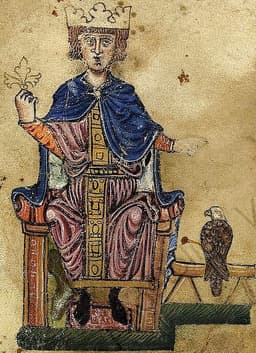
Frederick II of Hohenstaufen
Emperor · Medieval
59.3Total
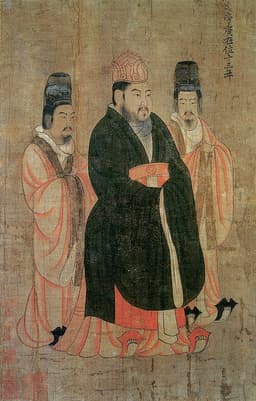
Yang Guang
Emperor · Medieval
57.5Total
Basic Information
Born
1194
569
Died
1250
618
Era
Medieval
Medieval
Nationality
Holy Roman Empire
China
Occupation
Emperor
Emperor
Civilization
Western
Eastern
Score Comparison
Military (10%)
40.0
47.5
Political (20%)
72.0
62.7
Influence (20%)
72.0
72.0
Legacy (20%)
52.0
40.0
Leadership (15%)
53.2
62.2
Strategy (15%)
55.0
60.0
TOTAL
59.3
57.5
Frederick II of Hohenstaufen — Complete Timeline
1220 AD
Coronation as Holy Roman EmperorPolitical Action◆ Major
Frederick II was crowned Holy Roman Emperor by Pope Honorius III in Rome. This coronation confirmed his authority over Germany and Italy, but also set the stage for a long conflict with the papacy over imperial power in Italy.
CoronationHoly Roman EmpirePapacy
Impact: global
1229 AD
Sixth Crusade and Treaty of JaffaWar◆ Major
Frederick II led the Sixth Crusade, negotiating the Treaty of Jaffa with Sultan al-Kamil. Through diplomacy, he regained control of Jerusalem, Bethlehem, and Nazareth without battle, but was excommunicated by the Pope for negotiating with Muslims.
CrusadeDiplomacyJerusalemExcommunication
Impact: globalconstructive
1231 AD
Promulgation of the Constitutions of MelfiReform◆ Major
Frederick II issued the Constitutions of Melfi, a comprehensive legal code for the Kingdom of Sicily. This code centralized royal authority, reformed the administration, and established a modern state based on Roman law.
LawReformSicily
Impact: regionalconstructive
1237 AD
Conflict with the Lombard LeagueWar◆ Major
Frederick II defeated the Lombard League at the Battle of Cortenuova, aiming to assert imperial control over northern Italy. His victory was followed by harsh reprisals, which alienated many Italian cities and strengthened papal opposition.
BattleItalyLombard League
Impact: regionaldestructive
1245 AD
Excommunication by Pope Innocent IV at the Council of LyonPolitical Action◆ Major
Pope Innocent IV declared Frederick II deposed at the First Council of Lyon, accusing him of heresy, sacrilege, and tyranny. This excommunication intensified the conflict between the Empire and the Papacy, leading to a war of propaganda.
ExcommunicationPapacyConflict
Impact: globaldestructive
1250 AD
Death and end of the Hohenstaufen dynastyOther◆ Major
Frederick II died of dysentery at Castel Fiorentino. His death marked the beginning of the end for the Hohenstaufen dynasty, as his sons were unable to maintain control, leading to the Great Interregnum in the Holy Roman Empire.
DeathHohenstaufenInterregnum
Impact: globaltragic
Yang Guang — Complete Timeline
605 AD
Construction of the Grand CanalReform◆ Major
Emperor Yang Guang ordered the construction of the Grand Canal, linking the Yellow River and Yangtze River. The project mobilized millions of laborers and created a vital waterway for grain transport and trade, but the immense human cost led to widespread resentment and rebellion.
InfrastructureGrand CanalCorvée Labor
Impact: national
612 AD
Three Expeditions against GoguryeoWar◆ Major
Yang Guang launched three massive military campaigns against the Korean kingdom of Goguryeo. The first invasion in 612 ended in catastrophic defeat at the Battle of Salsu, with hundreds of thousands of Chinese soldiers killed. The repeated failures drained the treasury and sparked widespread revolts.
Goguryeo-Sui WarMilitary DisasterOverextension
Impact: regionaldestructive
613 AD
Rebellion of Yang XuanganWar◆ Major
While Yang Guang was campaigning against Goguryeo, the noble Yang Xuangan launched a major rebellion in the rear. The revolt was suppressed, but it exposed the fragility of Sui rule and encouraged further uprisings across the empire.
RebellionSui Dynasty Decline
Impact: nationaldestructive
618 AD
Assassination of Yang GuangPolitical Action
As rebellions engulfed the empire, Yang Guang was strangled to death in Jiangdu by his own guards led by Yuwen Huaji. His death marked the effective end of the Sui dynasty, which collapsed shortly after, leading to the rise of the Tang dynasty.
AssassinationSui CollapseDynastic Transition
Impact: nationaltragic
Expert Analysis
Origins
Frederick II of Hohenstaufen was born in 1194 in Jesi, Italy, to Emperor Henry VI and Constance of Sicily. Orphaned by age four, he was raised under papal guardianship in Palermo, exposed to the multicultural Norman court. His upbringing blended Germanic, Latin, Byzantine, and Arabic influences, shaping his cosmopolitan worldview. Yang Guang, born in 569 in Chang'an, was the second son of Emperor Wen of Sui. Raised in a strict Confucian household, he excelled in literature and military arts. His father unified China after centuries of division, instilling in Yang Guang ambitions for grand projects.
Rise to Power
Frederick II was elected King of Germany in 1196 at age two, but his rule was contested. After his father's death, he was crowned King of Sicily in 1198. He spent his youth consolidating power in Sicily, outmaneuvering papal regents. In 1212, he secured German kingship with Pope Innocent III's support, promising to lead a crusade. He was crowned Holy Roman Emperor in 1220. Yang Guang rose by engineering his father's death in 604, allegedly by assassination. He immediately executed his elder brother Yang Yong and other rivals, consolidating power. He moved the capital to Luoyang and began ambitious infrastructure.
Leadership & Governance
Frederick II's governance was innovative. His Constitutions of Melfi (1231) centralized authority, reformed taxation, and established a professional bureaucracy. He promoted religious tolerance, employing Muslims in his army and Jews in his court. His court in Palermo was a hub of learning, translating Greek and Arabic texts. Yang Guang's rule was autocratic and grand-scale. He ordered the Grand Canal's construction (605-609), linking north and south, employing millions. He rebuilt Luoyang with lavish palaces, conscripted laborers, and launched massive military campaigns. His governance relied on coercion and high taxation, leading to widespread resentment.
Triumph & Tragedy
Frederick II's greatest triumph was the Sixth Crusade (1228-1229). Through diplomacy with Sultan al-Kamil, he regained Jerusalem, Bethlehem, and Nazareth without battle, crowned himself King of Jerusalem. His Constitutions of Melfi became a model for later legal systems. His tragedies included his conflict with the papacy: excommunicated twice, he was declared deposed in 1245. His victory over the Lombard League at Cortenuova (1237) was followed by a siege of Parma that failed, leading to defeat. Yang Guang's triumph was the Grand Canal, a 1,800-kilometer engineering feat that boosted trade and cultural exchange for centuries. His tragedies were the disastrous Goguryeo campaigns: the first invasion in 612 saw 300,000 troops annihilated. Subsequent campaigns further drained resources. The canal's construction cost millions of lives, and rebellions erupted across China. He was assassinated in 618.
Character & Destiny
Frederick II was intellectually curious, skeptical of dogma, and pragmatic. His nickname "Stupor Mundi" (Wonder of the World) reflected his erudition. He wrote a book on falconry and corresponded with Islamic scholars. His character, however, made him enemies: the papacy saw him as a heretic. His destiny was a life of conflict with popes, culminating in his deposition. He died in 1250, his dynasty soon collapsing. Yang Guang was ambitious and ruthless, but lacked political acumen. His obsession with glory and legacy drove him to overreach. He ignored warnings, surrounded himself with sycophants, and suppressed dissent. His character led to isolation and betrayal. His assassination by his own guards was a direct result of his failures.
Legacy
Frederick II's legacy is mixed. His legal reforms influenced later European jurisprudence. His promotion of secularism and tolerance was ahead of its time. However, his conflict with the papacy weakened the Holy Roman Empire. He scored 52.0 in legacy. Yang Guang's legacy is dominated by the Grand Canal, which facilitated China's economic integration for over a millennium. Yet his reputation as a tyrant was cemented by Confucian historians. His score of 40.0 reflects the negative view. The Sui dynasty collapsed shortly after his death.
Conclusion
Frederick II had a greater impact on history than Yang Guang, despite a narrow score gap of 1.8 points. Frederick's innovations in governance, law, and diplomacy set precedents that shaped European statecraft. Yang Guang's canal was monumental, but his failures led to China's fragmentation. Frederick's total score of 59.3 vs 57.5 reflects a more balanced assessment. He achieved lasting institutional reforms, while Yang Guang's achievements were overshadowed by his ruinous ambition. Frederick's legacy of tolerance and legal centralization influenced the Renaissance, while Yang Guang's canal, though enduring, came at a cost that destroyed his dynasty. Thus, Frederick II stands as the more significant historical figure.
Rankings
🥇
Frederick II of HohenstaufenLeader
Mil: 40.0Pol: 72.0Inf: 72.0
59.3
🥈
Yang Guang
Mil: 47.5Pol: 62.7Inf: 72.0
57.5
+1.8 behind
How This Comparison Works
Algorithm
Each figure is scored on 6 dimensions (0—100 scale) based on structured historical data: Military (10%), Political (20%), Influence (20%), Legacy (20%), Leadership (15%), Strategy (15%). The weighted total produces the final ranking.
Data Sources
Scores are computed from structured sub-indicators in the database. Scale factors adjust for era (Ancient ×0.85, Modern ×1.0) and civilization size (Eastern ×1.05, Other ×0.80) to account for differences in population and military scale.
Maximum 3 Figures
Comparisons are limited to 2—3 figures to ensure readability and statistical meaningfulness.
Error Margins
±5 points per dimension — Sub-scores are derived from historical records with inherent uncertainty. Two figures within 5 points on a dimension should be considered roughly equivalent in that area.
Total Score Accuracy
±3 points overall — The weighted combination of 6 dimensions produces a total score with approximately ±3 points of uncertainty. Differences of less than 3 points are not statistically significant— the figures are effectively tied.
Known Limitations
- Historical records are incomplete and uneven across civilizations
- Figures from oral-tradition societies may be underrepresented
- Occupation labels can misclassify multi-role figures
- Scores measure capability and impact, not moral character
- Quantitative scoring is a comparison tool, not absolute truth
Capability Radar
Military (10%) — Battles & Warfare
Battles
45
55
Win Rate
40
40
Expansion
50
60
Political (20%) — Governance & Reform
Reform
85
75
Diplomacy
80
40
Economy
75
70
Influence (20%) — Cultural & Global Reach
Cultural
75
70
Global
60
65
Legacy (20%) — Historical Impact
Historical
70
75
Longevity
65
80
Leadership (15%) — Power & Stability
Tenure
65
60
Stability
55
20
Strategy (15%) — Tactics & Innovation
Strategy
55
50
Tactics
60
45
Reform
70
30
Similar Comparisons
Comments & Discussion
No comments yet. Be the first to share your thoughts!