Loading...
Nyatsimba Mutota vs Yuwen Yong
Yuwen Yong leads by 10.7 pts · 2 figures compared
…

Nyatsimba Mutota
Emperor · Medieval
56.5Total
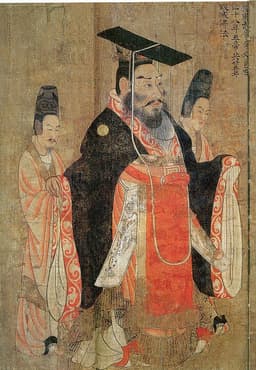
Yuwen Yong
Emperor · Medieval
67.2Total
Basic Information
Born
1400
543
Died
1450
578
Era
Medieval
Medieval
Nationality
Mozambique
China
Occupation
Emperor
Emperor
Civilization
Other
Eastern
Score Comparison
Military (10%)
72.5
78.0
Political (20%)
68.0
78.0
Influence (20%)
59.0
58.0
Legacy (20%)
50.0
54.0
Leadership (15%)
40.0
85.0
Strategy (15%)
57.5
69.1
TOTAL
56.5
67.2
Nyatsimba Mutota — Complete Timeline
1430 AD
Founding of the Mutapa EmpirePolitical Action
Nyatsimba Mutota led a migration north from Great Zimbabwe and founded the Mutapa Empire in the Zambezi valley. He established a new capital at Zvongombe and began territorial expansion.
Impact: regionalconstructive
1440 AD
Conquest of the TavaraWar◆ Major
Nyatsimba Mutota conquered the Tavara people in the Zambezi valley, incorporating their territory into the Mutapa Empire. This victory secured control over fertile agricultural lands and trade routes.
Impact: regional
1445 AD
Establishment of the Mwenemutapa TitlePolitical Action◆ Major
Nyatsimba Mutota adopted the title Mwenemutapa, meaning 'lord of the conquered lands,' formalizing the imperial structure. This title became hereditary and defined the ruler's authority over conquered peoples.
Impact: regionalconstructive
Yuwen Yong — Complete Timeline
574 AD
Suppression of Buddhism in Northern ZhouReform◆ Major
Emperor Wu of Northern Zhou (Yuwen Yong) ordered the suppression of Buddhism, confiscating monastic lands, forcing monks and nuns to return to lay life, and destroying temples. He aimed to increase state revenue and military manpower, strengthening the state.
Northern ZhouBuddhist PersecutionReform
Impact: nationaldestructive
577 AD
Conquest of Northern QiWar
Emperor Wu led a successful campaign against the rival Northern Qi dynasty, conquering its territory and unifying northern China under Northern Zhou. This victory ended the division of the north and set the stage for the Sui dynasty's unification of all China.
Northern ZhouUnificationNorthern Qi
Impact: regionalconstructive
578 AD
Death during campaign against the TurksWar◆ Major
Emperor Wu died of illness while leading a campaign against the G
Northern ZhouMilitary CampaignDeath
Impact: regionaltragic
Expert Analysis
Yuwen Yong vs Nyatsimba Mutota
The Emperor and the Migrant King
On a cold spring morning in 574, Emperor Yuwen Yong of Northern Zhou stood before a council of Buddhist monks and ordered their temples stripped, their lands seized, and their robes torn away. Thousands of monks were forced back into lay life, their chants silenced by imperial decree. Half a world away and six centuries earlier, Nyatsimba Mutota led his people north from the crumbling stone walls of Great Zimbabwe into the untamed Zambezi valley, where he would build an empire not by breaking gods, but by bending men. One ruler destroyed a faith to consolidate power; the other created a title to unify a people. Both sought control over land and loyalty, yet their paths diverged so sharply that comparing them reveals not just two men, but two ways of understanding what it means to forge a kingdom.
Origins
Yuwen Yong was born in 543 into a world of fractured empires and constant war. The Northern Wei had split, and his family belonged to the Xianbei warrior aristocracy that dominated northern China. His father was a general, his uncle a usurper, and his childhood was spent amid the clatter of swords and the whispers of court intrigue. The China he inherited was a chessboard of rival dynasties, where Buddhism had grown so wealthy and powerful that monasteries owned vast estates and exempted themselves from taxes. To Yuwen Yong, religion was not a matter of faith but of statecraft—a rival power that needed to be broken.
Nyatsimba Mutota, born around 1400, came from a very different world. Great Zimbabwe was already in decline, its granite walls and conical towers standing as monuments to a golden age of gold trade and cattle wealth. Mutota was a prince of the Shona people, and his inheritance was not a throne but a crisis: drought, overgrazing, and the slow collapse of a trading network that had connected the interior to the Swahili coast. For him, the problem was not too much religion but too little land. His answer was not to suppress but to migrate.
Rise to Power
Yuwen Yong’s rise was a matter of survival. He became emperor of Northern Zhou in 560 at age seventeen, but real power lay in the hands of his cousin Yuwen Hu, a regent who had already murdered two emperors. For twelve years, Yuwen Yong played the role of a docile puppet, smiling at banquets and deferring in councils. Then in 572, he struck. During a routine visit, he killed Yuwen Hu with a single blow from a jade tablet, a weapon chosen for its innocence. It was a coup executed with surgical precision, and it set the tone for his reign: ruthless, calculated, and utterly pragmatic.
Mutota’s path was different. He did not assassinate rivals because there was no throne to seize. Around 1430, he simply gathered his followers and walked north from Great Zimbabwe into the Zambezi valley. This was not a conquest but a migration, a slow movement of people and cattle that became an empire by accretion. The Tavara people he encountered in 1440 were not enemies to be crushed but subjects to be incorporated. Mutota’s military score of 55.0 reflects this: his wars were not battles of annihilation but campaigns of absorption. Where Yuwen Yong used a jade tablet, Mutota used a title.
Leadership & Governance
Yuwen Yong governed through iron discipline. His suppression of Buddhism in 574 was not religious persecution but economic policy. He confiscated monastic lands, forced monks to marry and pay taxes, and redirected the wealth of the temples into his war chest. The move was brutal but effective: within three years, he had unified northern China by conquering Northern Qi in 577. His military score of 74.6 and strategy score of 81.8 tell the story of a commander who planned every campaign with mathematical precision. Yet his political score of 72.0 suggests a ruler who ruled through fear, not loyalty.
Mutota governed through symbolism. In 1445, he adopted the title *Mwenemutapa*—"lord of the conquered lands"—a name that did not claim divinity but acknowledged dominion. The title was a contract: in exchange for tribute and labor, the Mwenemutapa offered protection and access to trade routes. His political score of 62.2 is lower than Yuwen Yong’s, but his leadership score of 76.7 is nearly identical. Mutota led by persuasion, not decree. He did not need to suppress religion because the Shona spiritual world was decentralized, woven into the land itself. His empire was a web of alliances, not a pyramid of commands.
Triumph & Tragedy
Yuwen Yong’s greatest triumph was the conquest of Northern Qi in 577. It was a campaign of breathtaking speed and brutality, and it left him master of the Yellow River valley. But his tragedy came the following year, when he died of illness at age thirty-five while leading a campaign against the Göktürks. His body was carried back to Chang’an, and within three years, his dynasty was overthrown by a general named Yang Jian, who founded the Sui dynasty. Yuwen Yong unified the north, but he did not live to see it.
Mutota’s triumph was subtler. He founded an empire that would last for over three centuries, outliving both the Zhou and the Sui. His tragedy was that he did not live to see its full flowering either, dying around 1450, just as the gold trade was shifting from Great Zimbabwe to the Zambezi. But where Yuwen Yong’s death was a collapse, Mutota’s was a foundation. The title *Mwenemutapa* would be carried by his descendants for generations, a living legacy of a migrant king who turned movement into permanence.
Character & Destiny
Yuwen Yong was a man of action, not reflection. He saw the world as a problem to be solved—Buddhism was a drain on resources, Northern Qi was an obstacle to unity, the Turks were a threat to be eliminated. His personality was forged in the crucible of court intrigue, and it made him decisive, ruthless, and ultimately brittle. When he died, the empire he built died with him.
Mutota was a man of patience. He understood that power was not seized but accumulated, not imposed but accepted. His personality was shaped by the rhythms of migration and the logic of the Zambezi floodplains, where survival depended on cooperation, not conquest. His legacy was not a single victory but a dynasty. Where Yuwen Yong’s fate was determined by his own hand, Mutota’s was determined by the land he chose to settle.
Legacy
Yuwen Yong is remembered in Chinese history as a reformer and unifier, but his name is overshadowed by the Sui and Tang dynasties that followed. His suppression of Buddhism was reversed, and his military achievements were absorbed by Yang Jian. His total score of 74.0 reflects a ruler who was competent but not transformative.
Mutota is remembered as the father of the Mutapa Empire, a kingdom that dominated southeastern Africa for three hundred years. His influence score of 74.6 testifies to the endurance of his creation. Yet his name is little known outside Zimbabwe, and his empire left no written records, only oral traditions and the ruins of stone enclosures along the Zambezi.
Conclusion
What drove these two men to such different outcomes? The answer lies not in their abilities but in their contexts. Yuwen Yong ruled a civilization with a written history, bureaucratic traditions, and a centralized state. He could destroy Buddhism because the state was strong enough to enforce his will. Mutota ruled a world of oral traditions, shifting alliances, and mobile populations. He could not destroy because there was nothing to destroy—only people to persuade and land to occupy. One emperor unified a north by breaking a religion; the other built an empire by inventing a title. Both succeeded, and both died before their work was done. But while Yuwen Yong’s empire crumbled within a generation, Mutota’s name echoed down the centuries, a reminder that sometimes the greatest power is not the sword that cuts but the word that binds.
Rankings
🥇
Yuwen YongLeader
Mil: 78.0Pol: 78.0Inf: 58.0
67.2
🥈
Nyatsimba Mutota
Mil: 72.5Pol: 68.0Inf: 59.0
56.5
+10.7 behind
How This Comparison Works
Algorithm
Each figure is scored on 6 dimensions (0—100 scale) based on structured historical data: Military (10%), Political (20%), Influence (20%), Legacy (20%), Leadership (15%), Strategy (15%). The weighted total produces the final ranking.
Data Sources
Scores are computed from structured sub-indicators in the database. Scale factors adjust for era (Ancient ×0.85, Modern ×1.0) and civilization size (Eastern ×1.05, Other ×0.80) to account for differences in population and military scale.
Maximum 3 Figures
Comparisons are limited to 2—3 figures to ensure readability and statistical meaningfulness.
Error Margins
±5 points per dimension — Sub-scores are derived from historical records with inherent uncertainty. Two figures within 5 points on a dimension should be considered roughly equivalent in that area.
Total Score Accuracy
±3 points overall — The weighted combination of 6 dimensions produces a total score with approximately ±3 points of uncertainty. Differences of less than 3 points are not statistically significant— the figures are effectively tied.
Known Limitations
- Historical records are incomplete and uneven across civilizations
- Figures from oral-tradition societies may be underrepresented
- Occupation labels can misclassify multi-role figures
- Scores measure capability and impact, not moral character
- Quantitative scoring is a comparison tool, not absolute truth
Capability Radar
Military (10%) — Battles & Warfare
Battles
55
75
Win Rate
60
80
Expansion
65
80
Political (20%) — Governance & Reform
Reform
50
85
Diplomacy
55
70
Economy
50
75
Influence (20%) — Cultural & Global Reach
Cultural
45
40
Global
40
40
Legacy (20%) — Historical Impact
Historical
55
65
Longevity
50
50
Leadership (15%) — Power & Stability
Tenure
60
60
Stability
55
70
Strategy (15%) — Tactics & Innovation
Strategy
55
75
Tactics
50
70
Reform
40
85
Similar Comparisons
Comments & Discussion
FiscalButcher6/16/2026
Yuwen Yong wasn’t persecuting Buddhism—he was running a land audit. By 574, Buddhist monasteries owned up to 10% of arable land in Northern Zhou and paid zero tax, while peasant families starved under crushing levies. The emperor wasn’t a zealot; he was a pragmatist who saw temples as parasitic corporations. Calling this a “purge” misses the point: it was a violent tax reform. Mutota, by contrast, expanded territory without building a fiscal base—his empire lasted barely a century. Yong’s surviv
EmpireBuilder_zh6/16/2026
宇文邕灭佛是赤裸裸的集权秀,但别搞错了,他本质上是个务实派。574年那场诏令直接没收了寺院占全国十分之一的耕地和数百万僧侣的免税特权,这个数字来自《周书》的户籍记录。相比之下,穆托塔的“姆韦尼·穆塔帕”称号听起来威风,实际统治却依赖部落联盟的松散效忠。一个是把宗教当竞争对手清算的CEO,一个是靠个人魅力划地称王的游牧领袖。时间一久,谁更持久一目了然。
StoneWallSkeptic6/16/2026
Let’s stop romanticizing Mutota’s “empire.” The Zambezi valley wasn’t tamed—it was a swampy corridor with no central administration. His so-called kingdom was a loose network of Shona chiefs who paid tribute in ivory and salt, not taxes. At its peak, the Mutapa state controlled maybe 50,000 square miles—smaller than modern Zimbabwe. Meanwhile, Yuwen Yong’s Northern Zhou covered 1.5 million square kilometers, with a census, a coinage system, and a standing army. Comparing them is like comparing a
考古狂徒6/16/2026
别被“帝国”两个字骗了。穆托塔的王国连个固定首都都没有,考古证据显示,他所谓的扩张更多是口头宣誓而非实际控制。大津巴布韦的石墙在15世纪后就基本废弃了,而宇文邕的长安城遗址里出土了标准的度量衡铜器和成规模的官仓。一个是神话中走出来的部落领袖,一个是铁血改革的中式帝王。如果非要比,穆托塔更像一个成功的酋长,而宇文邕是书写制度的帝王。