Loading...
Nyatsimba Mutota vs Pachacuti
Pachacuti leads by 12.9 pts · 2 figures compared
…

Nyatsimba Mutota
Emperor · Medieval
56.5Total
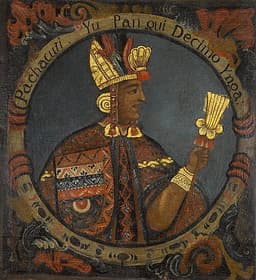
Pachacuti
Emperor · Medieval
69.4Total
Basic Information
Born
1400
1418
Died
1450
1472
Era
Medieval
Medieval
Nationality
Mozambique
Inca Empire
Occupation
Emperor
Emperor
Civilization
Other
Other
Score Comparison
Military (10%)
72.5
78.5
Political (20%)
68.0
58.1
Influence (20%)
59.0
65.0
Legacy (20%)
50.0
72.0
Leadership (15%)
40.0
78.0
Strategy (15%)
57.5
69.2
TOTAL
56.5
69.4
Nyatsimba Mutota — Complete Timeline
1430 AD
Founding of the Mutapa EmpirePolitical Action
Nyatsimba Mutota led a migration north from Great Zimbabwe and founded the Mutapa Empire in the Zambezi valley. He established a new capital at Zvongombe and began territorial expansion.
Impact: regionalconstructive
1440 AD
Conquest of the TavaraWar◆ Major
Nyatsimba Mutota conquered the Tavara people in the Zambezi valley, incorporating their territory into the Mutapa Empire. This victory secured control over fertile agricultural lands and trade routes.
Impact: regional
1445 AD
Establishment of the Mwenemutapa TitlePolitical Action◆ Major
Nyatsimba Mutota adopted the title Mwenemutapa, meaning 'lord of the conquered lands,' formalizing the imperial structure. This title became hereditary and defined the ruler's authority over conquered peoples.
Impact: regionalconstructive
Pachacuti — Complete Timeline
1438 AD
Conquest of the Chanka KingdomWar
Pachacuti led the Inca army to defeat the Chanka, a powerful rival, in a decisive battle near Cusco. This victory secured his position as Sapa Inca and initiated a period of rapid expansion, transforming the Inca from a small kingdom into a vast empire.
ConquestInca ExpansionChanka
Impact: regional
1440 AD
Reconstruction of CuscoCultural◆ Major
Pachacuti rebuilt Cusco as the imperial capital, designing it in the shape of a puma and constructing massive stone structures like Sacsayhuam
Urban PlanningArchitectureInca Empire
Impact: regionalconstructive
1450 AD
Initiation of Machu Picchu's ConstructionCultural◆ Major
Pachacuti ordered the construction of Machu Picchu, a royal estate and ceremonial site high in the Andes. The complex featured sophisticated dry-stone masonry and terraced agriculture, serving as a symbol of Inca engineering and a retreat for the emperor.
ArchitectureRoyal EstateInca Engineering
Impact: regionalconstructive
Expert Analysis
Pachacuti vs Nyatsimba Mutota
### The Stone and the Spear: Two Founders of Empire in the Fifteenth Century
In the high, thin air of the Andes, a prince rallies a broken army and turns a rout into a revolution. In the steamy lowlands of the Zambezi valley, a king packs his belongings, leads his people north, and never looks back. One man will build a city in the shape of a puma; the other will give his name to a title that echoes for centuries. Both lived in the same century, both forged empires from nothing, yet their paths could not have been more different. What made one a builder and the other a wanderer? The answer lies not in their stars, but in the ground beneath their feet.
#### Origins
Pachacuti Inca Yupanqui was born in 1418 into a world that was small, fierce, and precarious. The Incas were then just one of many warring tribes in the Cusco valley, surrounded by enemies who saw them as upstarts. His father, the Sapa Inca Viracocha, was a competent ruler, but the kingdom was a fragile patchwork of alliances. Pachacuti grew up in the shadow of the Chanka, a powerful confederation that dwarfed the Incas. His name, given later, means “earth-shaker” or “cataclysm”—a name earned, not inherited.
Nyatsimba Mutota, born around 1400, came from a world already great but cracking. He was a prince of Great Zimbabwe, the magnificent stone city that had dominated southern African trade for centuries. By the early 1400s, however, its gold fields were thinning, its pastures overgrazed, and its political unity fraying. Mutota saw not a kingdom to defend, but a door closing. His era demanded not a warrior, but a pioneer.
#### Rise to Power
Pachacuti’s rise was forged in fire. In 1438, when the Chanka launched a full-scale assault on Cusco, the Inca army was crushed. His father and the royal court fled the city in panic. According to Inca tradition, only the young prince Pachacuti stayed behind, rallying the remaining defenders. He met the Chanka on the plain of Yawarpampa—the “field of blood”—and, through a combination of desperate courage and tactical brilliance, shattered their army. The victory was absolute. The Chanka were not merely defeated; they were absorbed. Pachacuti returned to Cusco not as a prince, but as the new Sapa Inca.
Mutota’s rise was quieter, but no less decisive. Around 1430, he made a choice that many rulers would have found unthinkable: he abandoned the capital. Leading a migration of perhaps thousands northward into the Zambezi valley, he left behind the stone walls of his ancestors. The journey was not a flight, but a calculated expansion. He found a land rich in ivory, salt, and new trade routes to the Indian Ocean. There, he imposed his rule on the local Tavara people, conquering them in 1440 not with a single dramatic battle, but through sustained campaigns that ground down resistance.
#### Leadership & Governance
Pachacuti governed like a sculptor, reshaping the raw material of conquest into a permanent imperial structure. After 1440, he rebuilt Cusco from a provincial town into a capital that mirrored the cosmos, its streets laid out in the shape of a sacred puma. He imposed Quechua as the official language, created a system of state granaries, and introduced the *mita*—a rotating labor tax that built roads, terraces, and fortresses. His greatest architectural ambition, the initiation of Machu Picchu’s construction around 1450, was a royal estate designed to be both a retreat and a symbol of his divine authority. He was a strategist who understood that an empire is built not just by winning wars, but by making subjects feel they belong.
Mutota governed like a trader, building networks rather than monuments. He adopted the title *Mwenemutapa*—meaning “lord of the conquered lands”—in 1445, formalizing a structure that was more feudal than bureaucratic. Local chiefs were left in place as long as they paid tribute in gold and ivory. He did not rebuild cities; he built relationships with Swahili merchants on the coast, opening a pipeline of goods that bypassed Great Zimbabwe entirely. His empire was not a stone city, but a web of influence.
#### Triumph & Tragedy
Pachacuti’s triumph was the Chanka victory, the moment that turned a tribe into an empire. His tragedy, unrecorded in the data but whispered in the chronicles, was that his success made his successors complacent. The imperial machine he built would, within a century, be destroyed by a handful of Spaniards who exploited its very rigidities.
Mutota’s triumph was the founding itself—the sheer audacity of walking away from Great Zimbabwe and creating something new. His tragedy was that his empire, built on tribute and trade, was fragile. After his death in 1450, the Mutapa Empire would struggle with succession crises and Portuguese encroachment, ultimately fracturing into warring states.
#### Character & Destiny
Pachacuti was a man of stone—unyielding, visionary, and obsessed with order. He believed that the world could be shaped to his will, and he was largely right. His personality drove him to centralize everything: religion, language, architecture, even the calendar. This strength became a weakness, for his system could not bend without breaking.
Mutota was a man of wind—restless, pragmatic, and adaptable. He saw that the old world was dying and had no nostalgia for it. His willingness to move, to change, to let go of the past, was his greatest asset. But it also meant his empire lacked the deep cultural roots that might have sustained it.
#### Legacy
Pachacuti’s legacy is visible today in every stone of Machu Picchu, every terrace of the Sacred Valley. He is remembered as the “Napoleon of the Andes,” the man who transformed a hill tribe into an empire that stretched from Colombia to Chile. His administrative reforms outlived his dynasty, influencing later Spanish colonial governance.
Mutota’s legacy is less tangible but equally profound. The title *Mwenemutapa* became synonymous with power in the region for centuries. The empire he founded controlled the gold trade that fed the Indian Ocean economy, linking Africa to India, Arabia, and China. He is remembered not as a builder, but as a founder—the man who, when the old walls crumbled, had the courage to walk away.
#### Conclusion
Standing at Machu Picchu, one feels the weight of Pachacuti’s ambition—the sheer, stubborn will to carve permanence from stone. Standing in the Zambezi valley, one feels Mutota’s wisdom—the understanding that sometimes, the most powerful act is to let go. Both were founders, but they founded different things: one an empire of stone, the other an empire of movement. In the end, perhaps the question is not which was greater, but which lesson our own age most needs to learn.
Rankings
🥇
PachacutiLeader
Mil: 78.5Pol: 58.1Inf: 65.0
69.4
🥈
Nyatsimba Mutota
Mil: 72.5Pol: 68.0Inf: 59.0
56.5
+12.9 behind
How This Comparison Works
Algorithm
Each figure is scored on 6 dimensions (0—100 scale) based on structured historical data: Military (10%), Political (20%), Influence (20%), Legacy (20%), Leadership (15%), Strategy (15%). The weighted total produces the final ranking.
Data Sources
Scores are computed from structured sub-indicators in the database. Scale factors adjust for era (Ancient ×0.85, Modern ×1.0) and civilization size (Eastern ×1.05, Other ×0.80) to account for differences in population and military scale.
Maximum 3 Figures
Comparisons are limited to 2—3 figures to ensure readability and statistical meaningfulness.
Error Margins
±5 points per dimension — Sub-scores are derived from historical records with inherent uncertainty. Two figures within 5 points on a dimension should be considered roughly equivalent in that area.
Total Score Accuracy
±3 points overall — The weighted combination of 6 dimensions produces a total score with approximately ±3 points of uncertainty. Differences of less than 3 points are not statistically significant— the figures are effectively tied.
Known Limitations
- Historical records are incomplete and uneven across civilizations
- Figures from oral-tradition societies may be underrepresented
- Occupation labels can misclassify multi-role figures
- Scores measure capability and impact, not moral character
- Quantitative scoring is a comparison tool, not absolute truth
Capability Radar
Military (10%) — Battles & Warfare
Battles
55
85
Win Rate
60
90
Expansion
65
90
Political (20%) — Governance & Reform
Reform
50
92
Diplomacy
55
75
Economy
50
80
Influence (20%) — Cultural & Global Reach
Cultural
45
85
Global
40
65
Legacy (20%) — Historical Impact
Historical
55
80
Longevity
50
70
Leadership (15%) — Power & Stability
Tenure
60
85
Stability
55
82
Strategy (15%) — Tactics & Innovation
Strategy
55
88
Tactics
50
80
Reform
40
85
Similar Comparisons
Comments & Discussion
Puma's Architect6/16/2026
Pachacuti wasn't just an emperor; he was an urban planner with a divine ego. Reshaping Cusco into a puma's silhouette wasn't mere aesthetics—it was a theological land grab, merging celestial order with imperial conquest. Mutota walked away from stone walls; Pachacuti built them into a religion. One fled decay, the other manufactured eternity. That's the difference between a founder and a refugee wearing a crown.
数据掘墓人6/16/2026
吹什么"无所不能的起义"?Pachacuti的军事扩张根本经不起经济推敲。印加没有货币、没有轮子,全靠强制劳役和土豆养活大军。他赢的不是战术天才,是运气——Chanka刚好内讧。Mutota呢?黄金贸易线才是真本事,资源控制比会战胜利持久十倍。你们迷恋个人英雄故事,可帝国根基永远是税基和供应链,不是神话。
Hermetic Cartographer6/16/2026
Let's talk about Mutota's real achievement: ethnogenesis. The name "Mwene Mutapa" didn't just label a king—it became a political identity that outlived his empire by centuries. Pachacuti reshaped a capital; Mutota reshaped a people's DNA. When the Portuguese arrived in the 1500s, they dealt with "Monomotapa" as a title, not a person. That's the mark of a founder: your name becomes the state itself, long after your bones are dust.
黄土争辩家6/16/2026
少来什么"石头对长矛",Mutota的迁徙根本是绝望中的豪赌。Great Zimbabwe的生态崩溃不是隐喻,是真实危机——人口过剩、土地盐碱化、黄金枯竭。他带走的是难民,不是先锋。而Pachacuti呢?他在一个只有土豆和羊驼的高原上,依靠米塔制强迫劳动,建起了历史上最脆弱的帝国之一。一个逃跑,一个剥削,都不是什么高尚叙事。
Skeptical Centurion6/16/2026
Both founders conveniently benefitted from timing gaps in historical record. Pachacuti's "earth-shaking" reforms come via Garcilaso de la Vega, written a century later by a mestizo with clear political motives. Mutota's entire narrative is oral tradition filtered through Portuguese traders. We're comparing mythology against mythology. The only certainty: both men exploited a power vacuum using the tools available—terrace farming for one, gold for the other. Let's stop pretending we know their pe