Loading...
Charles de Gaulle vs Nyatsimba Mutota
Charles de Gaulle leads by 11.7 pts · 2 figures compared
…
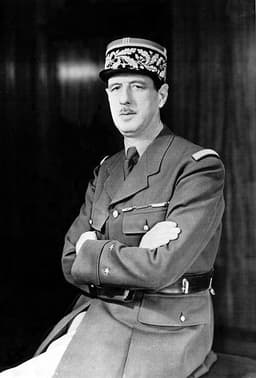
Charles de Gaulle
Politician · Modern
68.2Total

Nyatsimba Mutota
Emperor · Medieval
56.5Total
Basic Information
Born
1890
1400
Died
1970
1450
Era
Modern
Medieval
Nationality
France
Mozambique
Occupation
Politician
Emperor
Civilization
Western
Other
Score Comparison
Military (10%)
55.0
72.5
Political (20%)
75.0
68.0
Influence (20%)
65.0
59.0
Legacy (20%)
68.0
50.0
Leadership (15%)
78.0
40.0
Strategy (15%)
65.0
57.5
TOTAL
68.2
56.5
Charles de Gaulle — Complete Timeline
1940 AD
Appeal of 18 June 1940Political Action
From London, de Gaulle broadcast a radio appeal urging French resistance against Nazi occupation. He called on French soldiers and citizens to continue the fight, founding the Free French Forces and becoming the symbol of French defiance.
World War IIResistanceLeadership
Impact: nationalconstructive
1958 AD
Founding of the Fifth RepublicPolitical Action
De Gaulle returned to power during the Algerian crisis and oversaw the drafting of a new constitution. The Fifth Republic established a strong executive presidency, replacing the unstable parliamentary system of the Fourth Republic.
ConstitutionGovernment ReformPolitical System
Impact: nationalconstructive
1962 AD
End of the Algerian WarPolitical Action◆ Major
De Gaulle negotiated the
DecolonizationPeace TreatyAlgeria
Impact: regionalconstructive
1968 AD
May 1968 CrisisPolitical Action◆ Major
Mass student protests and general strikes paralyzed France, challenging de Gaulle's government. De Gaulle briefly fled to Germany, then returned to dissolve the National Assembly and call elections, which his party won, but his authority was weakened.
ProtestPolitical CrisisSocial Unrest
Impact: nationaldestructive
1969 AD
Resignation as PresidentPolitical Action
De Gaulle resigned after losing a referendum on regional reform and Senate restructuring. The defeat marked the end of his political career, as he withdrew from public life and died the following year.
ResignationPolitical DefeatReferendum
Impact: nationaltragic
Nyatsimba Mutota — Complete Timeline
1430 AD
Founding of the Mutapa EmpirePolitical Action
Nyatsimba Mutota led a migration north from Great Zimbabwe and founded the Mutapa Empire in the Zambezi valley. He established a new capital at Zvongombe and began territorial expansion.
Impact: regionalconstructive
1440 AD
Conquest of the TavaraWar◆ Major
Nyatsimba Mutota conquered the Tavara people in the Zambezi valley, incorporating their territory into the Mutapa Empire. This victory secured control over fertile agricultural lands and trade routes.
Impact: regional
1445 AD
Establishment of the Mwenemutapa TitlePolitical Action◆ Major
Nyatsimba Mutota adopted the title Mwenemutapa, meaning 'lord of the conquered lands,' formalizing the imperial structure. This title became hereditary and defined the ruler's authority over conquered peoples.
Impact: regionalconstructive
Expert Analysis
Charles de Gaulle vs Nyatsimba Mutota
# The Voice and the Spear: Charles de Gaulle and Nyatsimba Mutota
In the summer of 1940, a tall, awkward French general stood before a BBC microphone in London and spoke to a nation that had already fallen. His voice crackled across the English Channel, carrying words that would become legend: “France has lost a battle, but France has not lost the war.” Four centuries earlier and seven thousand kilometers away, another leader stood on the edge of the Zambezi valley, looking south toward the crumbling walls of Great Zimbabwe. Nyatsimba Mutota gathered his people and told them that the old kingdom was dying, but that a new one would rise from the earth. Both men were founders. Both were exiles in spirit before they ever left home. But the worlds they built could not have been more different.
Origins
Charles de Gaulle was born in 1890 into a devoutly Catholic, patriotic family in Lille, northern France. His father taught philosophy and history, and young Charles grew up reading the great French military thinkers while the Franco-Prussian War still haunted the national memory. He was shaped by defeat. The humiliation of 1870, when Prussia crushed France and proclaimed a German Empire in the Hall of Mirrors at Versailles, never left him. De Gaulle entered Saint-Cyr military academy determined not just to serve France, but to restore its grandeur.
Nyatsimba Mutota emerged from a very different tradition. Born around 1400 in what is now modern-day Zimbabwe, he was part of the ruling elite of Great Zimbabwe, the magnificent stone city that had dominated southern African trade for centuries. But by the early 1400s, Great Zimbabwe was in decline—its gold trade routes shifting, its soil exhausted, its central authority fraying. Mutota saw not a nation to restore, but a civilization to leave behind. He was a migrant, a pioneer, a man who understood that survival sometimes meant abandoning the past entirely.
Rise to Power
De Gaulle’s path to power was long, frustrating, and marked by near-constant rejection. In the 1930s, he wrote books arguing for mechanized warfare and tank divisions—ideas that the French high command dismissed as reckless. When the German blitzkrieg proved him tragically right in 1940, de Gaulle was a mere colonel. But as France collapsed, he seized the moment. His Appeal of 18 June 1940 was not an order from a government; it was a challenge from a man who had no authority except his own will. He became the symbol of Free France, a phantom nation that existed only in his voice and the loyalty of a few thousand soldiers.
Mutota’s rise was more direct. Around 1430, he led a migration north from Great Zimbabwe into the Zambezi valley, a fertile region controlled by the Tavara people. He did not ask permission. He did not negotiate. He moved his people, fought, and conquered. By 1440, he had subjugated the Tavara, incorporating their lands into a new empire. By 1445, he had adopted the title Mwenemutapa—“lord of the conquered lands.” There was no long exile, no years of waiting. Mutota built his power with his own hands, spear in hand, on the march.
Leadership & Governance
De Gaulle’s leadership was defined by vision and distance. He believed that a leader must stand above the crowd, aloof, almost priestly. His Fifth Republic, founded in 1958, concentrated power in the presidency, creating a system where one man could guide the nation through crisis. He ended the Algerian War in 1962 with the Évian Accords, a decision that horrified his own military supporters but saved France from endless colonial bloodshed. He was a reformer who understood that sometimes the most patriotic act is to let go.
Mutota governed differently. His empire was built on personal conquest and tribute. The Mwenemutapa was not a distant figure but a warrior-king who led campaigns personally, distributed land to loyal followers, and controlled the gold trade that made his kingdom wealthy. He did not write constitutions or hold referendums. He ruled through presence, through the visible power of a man who had taken what he wanted and could defend it.
Triumph & Tragedy
De Gaulle’s greatest moment was also his most paradoxical. In May 1968, student protests and general strikes paralyzed France. The government seemed helpless. De Gaulle briefly fled to Baden-Baden, Germany, to consult with French military commanders. Then he returned, dissolved the National Assembly, and called new elections. The crisis passed. But the cost was clear: the old France he embodied was dying. He resigned in 1969 after losing a referendum on regional reform—a small issue that became a final verdict on his era.
Mutota’s triumph was the Mutapa Empire itself, which would endure for centuries after his death in 1450. But his tragedy is that we know so little of it. No speeches survive. No memoirs. Only the archaeological traces of a state that controlled the gold that flowed to the Swahili coast and across the Indian Ocean. He built something vast, but the silence of history has swallowed his voice.
Character & Destiny
De Gaulle was stubborn, proud, and convinced of his own historical role. He once wrote, “Great men are those who know how to impose their will on events.” He believed that France could not be France without greatness, and he spent his life trying to force history to agree. His personality was his destiny: the aloofness that saved him in 1940 also isolated him in 1968.
Mutota was a pragmatist. He saw that Great Zimbabwe was dying and chose movement over nostalgia. He did not try to restore a lost golden age; he created a new one. His personality was suited to a world where power was personal, where a king’s authority depended on his ability to lead, fight, and reward loyalty.
Legacy
De Gaulle’s France still lives under the Fifth Republic he designed. His vision of a strong, independent nation—skeptical of American dominance, proud of its own path—remains central to French identity. He is remembered in statues, airports, and the name of France’s nuclear aircraft carrier.
Mutota’s legacy is the Mutapa Empire, which dominated the Zambezi valley for two centuries and shaped the political map of southern Africa. He is remembered in oral traditions, in the title Mwenemutapa that outlasted his dynasty, and in the enduring memory of a people who followed him into the unknown.
Conclusion
One man stood before a microphone and spoke to a nation he could not see. The other stood at the head of a migration and led his people into a valley he would conquer. De Gaulle and Mutota both understood that leadership is the art of seeing what others cannot—and having the courage to act on that vision. The voice and the spear: two ways of making history, two ways of building a world. Both succeeded. Both left marks that time has not erased. And both remind us that the greatest leaders are those who, when the old world crumbles, are willing to build a new one with whatever tools they have.
Rankings
🥇
Charles de GaulleLeader
Mil: 55.0Pol: 75.0Inf: 65.0
68.2
🥈
Nyatsimba Mutota
Mil: 72.5Pol: 68.0Inf: 59.0
56.5
+11.7 behind
How This Comparison Works
Algorithm
Each figure is scored on 6 dimensions (0—100 scale) based on structured historical data: Military (10%), Political (20%), Influence (20%), Legacy (20%), Leadership (15%), Strategy (15%). The weighted total produces the final ranking.
Data Sources
Scores are computed from structured sub-indicators in the database. Scale factors adjust for era (Ancient ×0.85, Modern ×1.0) and civilization size (Eastern ×1.05, Other ×0.80) to account for differences in population and military scale.
Maximum 3 Figures
Comparisons are limited to 2—3 figures to ensure readability and statistical meaningfulness.
Error Margins
±5 points per dimension — Sub-scores are derived from historical records with inherent uncertainty. Two figures within 5 points on a dimension should be considered roughly equivalent in that area.
Total Score Accuracy
±3 points overall — The weighted combination of 6 dimensions produces a total score with approximately ±3 points of uncertainty. Differences of less than 3 points are not statistically significant— the figures are effectively tied.
Known Limitations
- Historical records are incomplete and uneven across civilizations
- Figures from oral-tradition societies may be underrepresented
- Occupation labels can misclassify multi-role figures
- Scores measure capability and impact, not moral character
- Quantitative scoring is a comparison tool, not absolute truth
Capability Radar
Military (10%) — Battles & Warfare
Battles
60
55
Win Rate
55
60
Expansion
20
65
Political (20%) — Governance & Reform
Reform
95
50
Diplomacy
90
55
Economy
70
50
Influence (20%) — Cultural & Global Reach
Cultural
70
45
Global
80
40
Legacy (20%) — Historical Impact
Historical
85
55
Longevity
75
50
Leadership (15%) — Power & Stability
Tenure
85
60
Stability
75
55
Strategy (15%) — Tactics & Innovation
Strategy
85
55
Tactics
70
50
Reform
80
40
Similar Comparisons
Comments & Discussion
Tankie's Ghost6/16/2026
The real irony here? De Gaulle spent years in exile barking orders nobody could follow, then demanded France pretend it won the war. Mutota? He actually founded a functioning state that lasted centuries. The Free French were a radio show with delusions of grandeur; the Mutapa Empire was bronze, gold, and blood in the ground. Gaulle's legacy is a constitution and bad tempers; Mutota's is an actual dynasty that reshaped southern Africa. I know who I'd rather be descended from.