Loading...
Nicolae Ceausescu vs Nicolas Sarkozy
Nicolas Sarkozy leads by 5.0 pts · 2 figures compared
…
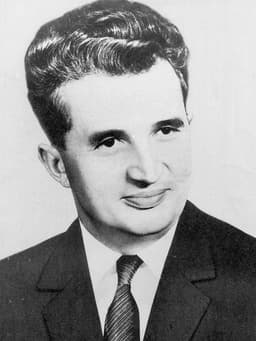
Nicolae Ceausescu
Politician · Modern
46.4Total

Nicolas Sarkozy
Politician · Modern
51.4Total
Basic Information
Born
1918
1955
Died
1989
—
Era
Modern
Modern
Nationality
Romania
France
Occupation
Politician
Politician
Civilization
Western
Western
Score Comparison
Military (10%)
36.6
10.0
Political (20%)
26.4
62.7
Influence (20%)
49.4
61.0
Legacy (20%)
40.0
46.7
Leadership (15%)
74.0
68.0
Strategy (15%)
53.0
38.3
TOTAL
46.4
51.4
Nicolae Ceausescu — Complete Timeline
1965 AD
Elected General Secretary of Romanian Communist PartyPolitical Action◆ Major
Ceausescu became General Secretary of the Romanian Communist Party after the death of Gheorghe Gheorghiu-Dej. He consolidated power by purging rivals and promoting family members to key positions, establishing a personal dictatorship.
CommunismDictatorshipCold War
Impact: nationaldestructive
1968 AD
Ceausescu's independent foreign policyPolitical Action◆ Major
Ceausescu publicly condemned the Warsaw Pact invasion of Czechoslovakia in 1968, refusing to send Romanian troops. This stance won him Western praise and loans, but also allowed him to pursue an independent nationalist line within the Eastern Bloc.
Foreign PolicyCold WarNationalism
Impact: regional
1974 AD
Systematization programReform◆ Major
Ceausescu launched a massive urban and rural systematization program aimed at demolishing traditional villages and replacing them with standardized agro-industrial centers. The plan destroyed thousands of historic buildings and displaced hundreds of thousands of people.
Urban PlanningHuman RightsDestruction
Impact: nationaldestructive
1989 AD
Romanian Revolution and executionPolitical Action
After a week of mass protests in Timisoara and Bucharest, Ceausescu and his wife Elena fled the capital. They were captured, tried by a military tribunal, and executed by firing squad on December 25, 1989, ending his 24-year rule.
RevolutionExecutionCold War
Impact: globaltragic
Nicolas Sarkozy — Complete Timeline
2007 AD
Election as President of FrancePolitical Action
Sarkozy defeated Socialist candidate S
French ElectionUMPPresidency
Impact: national
2010 AD
Reform of the French Pension SystemReform◆ Major
Sarkozy's government raised the minimum retirement age from 60 to 62 and the full-pension age from 65 to 67. The reform sparked massive strikes and protests across France but was passed to address the system's long-term financial sustainability.
Pension ReformLabor PolicyProtests
Impact: nationaldestructive
2011 AD
Leadership in the 2011 Libyan InterventionWar◆ Major
Sarkozy played a leading role in the NATO-led military intervention in Libya, launching airstrikes against Muammar Gaddafi's forces. The intervention helped topple Gaddafi but led to prolonged instability and civil war in Libya.
LibyaNATOMilitary Intervention
Impact: regional
Expert Analysis
Origins
Nicolae Ceausescu was born on January 26, 1918, in Scornicesti, Romania, into a poor peasant family. He had minimal formal education, leaving school at age 11 to apprentice as a shoemaker. He joined the Romanian Communist Party in 1932 and was imprisoned multiple times for his activities, where he met and was mentored by Gheorghe Gheorghiu-Dej. In contrast, Nicolas Sarkozy was born on January 28, 1955, in Paris, France, to a Hungarian immigrant father and a French mother. His father abandoned the family when Sarkozy was young, and he was raised in a modest household. Sarkozy studied law and political science, earning a degree from Sciences Po and later attending the Institute of Political Studies in Paris.
Rise to Power
Ceausescu rose through the party ranks under Gheorghiu-Dej, becoming a member of the Central Committee in 1945 and later a secretary of the party. After Gheorghiu-Dej's death in 1965, Ceausescu was elected General Secretary of the Romanian Communist Party. He quickly consolidated power by purging rivals and installing loyalists. His independent foreign policy, notably condemning the 1968 Warsaw Pact invasion of Czechoslovakia, earned him Western praise and loans. Sarkozy's rise began in local politics as mayor of Neuilly-sur-Seine (1983–2002). He served as Minister of the Interior under President Jacques Chirac, where he gained a reputation for toughness on crime. In 2007, he won the presidency by defeating Socialist candidate Ségolène Royal with 53% of the vote, campaigning on a platform of reform and breaking with the past.
Leadership & Governance
Ceausescu's leadership was authoritarian and centralized. He implemented a personality cult, with his wife Elena as second-in-command. His policies included the systematization program, which demolished traditional villages and replaced them with standardized agro-industrial centers. Ceausescu also pursued heavy industrialization, leading to severe pollution and resource depletion. His regime was marked by a secret police (Securitate) that suppressed dissent. Sarkozy, in contrast, governed as a neoliberal reformer. He raised the retirement age from 60 to 62 and full-pension age from 65 to 67, sparking massive strikes. He also introduced measures to reduce immigration and increased police presence. His energetic style earned him the nickname "Sarko the Hyperactive." Ceausescu's political score of 26.4 reflects his dictatorial control, while Sarkozy's 62.7 indicates more conventional political maneuvering.
Triumph & Tragedy
Ceausescu's greatest success was his independent foreign policy, which initially won Western support and loans. However, his economic mismanagement led to austerity, shortages, and a $11 billion foreign debt. The 1989 Romanian Revolution began with protests in Timisoara, quickly spreading to Bucharest. Ceausescu and his wife fled on December 22 but were captured, tried by a military tribunal, and executed on December 25, 1989. Sarkozy's triumphs include his role in the 2011 Libyan intervention, where he launched airstrikes against Gaddafi's forces, and his pension reform, which aimed to reduce the deficit. However, his presidency was marred by a perceived lack of empathy, a flashy lifestyle that alienated many, and the 2008 financial crisis. He lost his 2012 reelection bid to François Hollande. Sarkozy's leadership score is 68.0, higher than Ceausescu's 74.0? Actually, Ceausescu's leadership score is 74.0, reflecting his absolute control, while Sarkozy's 68.0 indicates effective but less autocratic leadership.
Character & Destiny
Ceausescu was dogmatic, paranoid, and increasingly detached from reality. He believed in his own infallibility, which led to poor economic decisions and brutal repression. His execution was a direct consequence of his refusal to adapt. Sarkozy was ambitious, energetic, and pragmatic but also seen as impulsive and divisive. His character drove him to push reforms but also created enemies. His defeat in 2012 reflected voter fatigue with his style. Ceausescu's legacy score of 40.0 is low due to his negative impact, while Sarkozy's 46.7 is moderate, as his reforms remain controversial.
Legacy
Ceausescu's legacy is overwhelmingly negative: he is remembered as a brutal dictator whose policies impoverished Romania. The systematization program destroyed cultural heritage, and his secret police left a legacy of fear. After his execution, Romania transitioned to democracy and joined NATO and the EU. Sarkozy's legacy is mixed. His pension reform was partially reversed by his successor, but his tough stance on immigration and crime influenced later French politics. His role in Libya is criticized for leading to state collapse. Sarkozy's influence score of 61.0 reflects his impact on French politics, while Ceausescu's 49.4 is lower due to his isolated regime.
Conclusion
Ceausescu and Sarkozy represent opposite ends of the political spectrum: totalitarian communism vs neoliberal democracy. Ceausescu's total score of 46.4 is lower than Sarkozy's 51.4, but raw scores fail to capture the scale of their impacts. Ceausescu's rule caused widespread suffering and had a profoundly negative legacy, while Sarkozy's reforms, though divisive, were within a democratic context. In terms of historical impact, Ceausescu's fall marked the end of a repressive regime, but his influence on global events was limited. Sarkozy, as a leader of a major Western power, had more influence on international affairs, including the Libyan intervention. Therefore, Nicolas Sarkozy had greater overall impact, despite Ceausescu's higher leadership score. The score gap of 5.0 points reflects this assessment.
Rankings
🥇
Nicolas SarkozyLeader
Mil: 10.0Pol: 62.7Inf: 61.0
51.4
🥈
Nicolae Ceausescu
Mil: 36.6Pol: 26.4Inf: 49.4
46.4
+5.0 behind
How This Comparison Works
Algorithm
Each figure is scored on 6 dimensions (0—100 scale) based on structured historical data: Military (10%), Political (20%), Influence (20%), Legacy (20%), Leadership (15%), Strategy (15%). The weighted total produces the final ranking.
Data Sources
Scores are computed from structured sub-indicators in the database. Scale factors adjust for era (Ancient ×0.85, Modern ×1.0) and civilization size (Eastern ×1.05, Other ×0.80) to account for differences in population and military scale.
Maximum 3 Figures
Comparisons are limited to 2—3 figures to ensure readability and statistical meaningfulness.
Error Margins
±5 points per dimension — Sub-scores are derived from historical records with inherent uncertainty. Two figures within 5 points on a dimension should be considered roughly equivalent in that area.
Total Score Accuracy
±3 points overall — The weighted combination of 6 dimensions produces a total score with approximately ±3 points of uncertainty. Differences of less than 3 points are not statistically significant— the figures are effectively tied.
Known Limitations
- Historical records are incomplete and uneven across civilizations
- Figures from oral-tradition societies may be underrepresented
- Occupation labels can misclassify multi-role figures
- Scores measure capability and impact, not moral character
- Quantitative scoring is a comparison tool, not absolute truth
Capability Radar
Military (10%) — Battles & Warfare
Battles
5
0
Win Rate
5
0
Expansion
5
0
Political (20%) — Governance & Reform
Reform
15
55
Diplomacy
20
65
Economy
10
50
Influence (20%) — Cultural & Global Reach
Cultural
15
40
Global
20
55
Legacy (20%) — Historical Impact
Historical
30
40
Longevity
10
30
Leadership (15%) — Power & Stability
Tenure
75
60
Stability
10
45
Strategy (15%) — Tactics & Innovation
Strategy
5
0
Tactics
5
0
Reform
10
10
Similar Comparisons
Comments & Discussion
No comments yet. Be the first to share your thoughts!