Loading...
Nicolae Ceausescu vs Patrice Trovoada
Patrice Trovoada leads by 0.5 pts · 2 figures compared
…
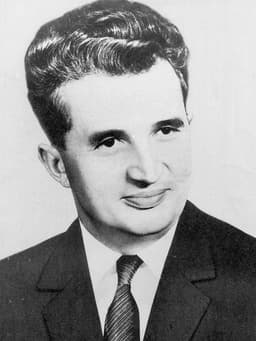
Nicolae Ceausescu
Politician · Modern
46.4Total
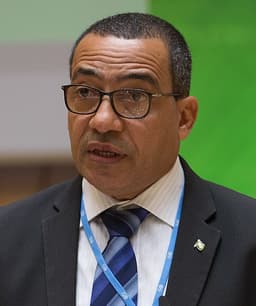
Patrice Trovoada
Politician · Modern
46.9Total
Basic Information
Born
1918
1962
Died
1989
—
Era
Modern
Modern
Nationality
Romania
Sao Tome
Occupation
Politician
Politician
Civilization
Western
Other
Score Comparison
Military (10%)
36.6
46.1
Political (20%)
26.4
68.0
Influence (20%)
49.4
47.9
Legacy (20%)
40.0
39.2
Leadership (15%)
74.0
40.0
Strategy (15%)
53.0
43.0
TOTAL
46.4
46.9
Nicolae Ceausescu — Complete Timeline
1965 AD
Elected General Secretary of Romanian Communist PartyPolitical Action◆ Major
Ceausescu became General Secretary of the Romanian Communist Party after the death of Gheorghe Gheorghiu-Dej. He consolidated power by purging rivals and promoting family members to key positions, establishing a personal dictatorship.
CommunismDictatorshipCold War
Impact: nationaldestructive
1968 AD
Ceausescu's independent foreign policyPolitical Action◆ Major
Ceausescu publicly condemned the Warsaw Pact invasion of Czechoslovakia in 1968, refusing to send Romanian troops. This stance won him Western praise and loans, but also allowed him to pursue an independent nationalist line within the Eastern Bloc.
Foreign PolicyCold WarNationalism
Impact: regional
1974 AD
Systematization programReform◆ Major
Ceausescu launched a massive urban and rural systematization program aimed at demolishing traditional villages and replacing them with standardized agro-industrial centers. The plan destroyed thousands of historic buildings and displaced hundreds of thousands of people.
Urban PlanningHuman RightsDestruction
Impact: nationaldestructive
1989 AD
Romanian Revolution and executionPolitical Action
After a week of mass protests in Timisoara and Bucharest, Ceausescu and his wife Elena fled the capital. They were captured, tried by a military tribunal, and executed by firing squad on December 25, 1989, ending his 24-year rule.
RevolutionExecutionCold War
Impact: globaltragic
Patrice Trovoada — Complete Timeline
2008 AD
Appointed Prime Minister of São Tomé and PríncipePolitical Action
Patrice Trovoada, son of former president Miguel Trovoada, was appointed Prime Minister by President Fradique de Menezes. His first term was short-lived due to a no-confidence vote.
AppointmentGovernmentSão Tomé and Príncipe
Impact: national
2010 AD
Returned as Prime MinisterPolitical Action◆ Major
Trovoada's party won the parliamentary elections, and he became Prime Minister again. He served until 2012, implementing economic reforms and facing political instability.
ElectionGovernmentSão Tomé and Príncipe
Impact: nationalconstructive
2014 AD
Third Term as Prime MinisterPolitical Action
Trovoada won a third term as Prime Minister after his party secured a majority in parliament. His government focused on infrastructure and attracting foreign investment.
ElectionGovernmentSão Tomé and Príncipe
Impact: nationalconstructive
Expert Analysis
Origins
Nicolae Ceausescu was born on January 26, 1918, in Scornicești, Romania, into a poor peasant family. He had little formal education, leaving school at age 11 to become an apprentice shoemaker. He joined the Romanian Communist Party in 1933 and was imprisoned multiple times for his activities, meeting future leader Gheorghe Gheorghiu-Dej in prison. His early life was shaped by poverty and communist ideology.
Patrice Trovoada was born on March 18, 1962, in Libreville, Gabon, while his father, Miguel Trovoada, was in exile. He studied at the University of Coimbra in Portugal and later at the University of Lisbon. His father served as the first Prime Minister of São Tomé and Príncipe and later as President. Patrice Trovoada entered politics as a diplomat, serving as ambassador to Portugal and later as Minister of Foreign Affairs.
Rise to Power
Ceausescu rose through the ranks of the Romanian Communist Party under Gheorghiu-Dej, becoming a member of the Politburo in 1955 and Secretary of the Central Committee in 1965. After Gheorghiu-Dej's death in March 1965, Ceausescu maneuvered to become General Secretary, consolidating power by purging rivals like Alexandru Drăghici. By 1967, he also became President of the State Council, effectively head of state. His independent foreign policy, notably condemning the 1968 Warsaw Pact invasion of Czechoslovakia, won him Western praise and aid.
Trovoada's rise began when President Fradique de Menezes appointed him Prime Minister in 2008 after his party, the Independent Democratic Action (ADI), won a plurality in parliament. However, his first term lasted only months due to a no-confidence vote. He returned as Prime Minister in 2010 after ADI won the elections, serving until 2012. His third term began in 2014 after ADI secured a majority, and he remained in office until 2018. His career is marked by frequent changes in coalition politics.
Leadership & Governance
Ceausescu ruled Romania with an iron fist, creating a pervasive cult of personality. He centralized all power, with his wife Elena as second-in-command. His governance was characterized by extreme austerity to pay off foreign debt, leading to widespread poverty. He initiated the systematization program in 1974, demolishing villages and building standardized blocks, displacing millions. His secret police, the Securitate, maintained control through surveillance and repression. He scored 74.0 in leadership but only 26.4 in political skill, reflecting his authoritarian style.
Trovoada led a democratic government in a small island nation. His governance focused on economic reforms, infrastructure development, and attracting foreign investment, particularly in oil exploration. He faced political instability due to frequent no-confidence votes and coalition shifts. His leadership score of 40.0 reflects his moderate approach, while his political score of 68.0 shows his ability to navigate multiparty politics. He implemented policies to improve education and health, but corruption remained a challenge.
Triumph & Tragedy
Ceausescu's greatest triumph was his independent foreign policy, which earned Romania a unique position in the Eastern Bloc. He secured loans from the West and maintained relations with China and North Korea. However, his greatest tragedy was the 1989 revolution: after mass protests, he and Elena were captured, tried by a military tribunal, and executed on December 25, 1989. His policies left Romania impoverished and isolated, with a legacy of distrust.
Trovoada's triumphs include stabilizing São Tomé's economy during his terms and securing oil exploration deals. He also improved infrastructure, such as road construction and airport upgrades. His tragedies include frequent political crises: his first government fell within months, and his party lost power after 2018. He also faced allegations of corruption, though he was acquitted in some cases. His legacy is mixed, with modest achievements in a volatile political environment.
Character & Destiny
Ceausescu was dogmatic, paranoid, and increasingly detached from reality. He believed in his own infallibility, surrounding himself with sycophants. His obsession with debt repayment and systematization led to widespread suffering. His character—rigid, secretive, and authoritarian—directly caused his downfall, as he refused to negotiate with protesters. Historical assessments label him as one of the most repressive communist leaders, with a total score of 46.4.
Trovoada is pragmatic, diplomatic, and resilient. He adapted to political shifts, forming coalitions and returning to power multiple times. His character—conciliatory but persistent—allowed him to survive in a fractious political system. However, his lack of a clear ideological vision led to incremental rather than transformative change. He scored 46.9 total, slightly higher than Ceausescu, but his impact is limited to a small nation.
Legacy
Ceausescu's legacy is overwhelmingly negative in Romania, where he is remembered as a brutal dictator. His systematization program destroyed cultural heritage, and his economic policies caused hardship. Internationally, he is a symbol of communist excess. His influence score of 49.4 reflects his global notoriety, but his legacy score is 40.0 due to the rejection of his ideology.
Trovoada's legacy is modest: he is seen as a competent manager in São Tomé's democratic framework. His economic reforms had limited success, and he failed to significantly reduce poverty or corruption. His influence score of 47.9 and legacy score of 39.2 reflect his minor role in global history. He is one of many African leaders in a small state.
Conclusion
While Ceausescu and Trovoada have similar total scores (46.4 vs 46.9), their impacts are vastly different in scale. Ceausescu's actions affected 23 million people and reshaped a European nation, albeit destructively. Trovoada governed a country of 200,000 with limited global relevance. In terms of historical impact, Ceausescu's influence was greater, despite his negative legacy. The score gap of 0.5 points does not capture the magnitude of their respective roles. Ceausescu's dictatorship and execution left a deeper mark on history than Trovoada's democratic stints.
Rankings
🥇
Patrice TrovoadaLeader
Mil: 46.1Pol: 68.0Inf: 47.9
46.9
🥈
Nicolae Ceausescu
Mil: 36.6Pol: 26.4Inf: 49.4
46.4
+0.5 behind
How This Comparison Works
Algorithm
Each figure is scored on 6 dimensions (0—100 scale) based on structured historical data: Military (10%), Political (20%), Influence (20%), Legacy (20%), Leadership (15%), Strategy (15%). The weighted total produces the final ranking.
Data Sources
Scores are computed from structured sub-indicators in the database. Scale factors adjust for era (Ancient ×0.85, Modern ×1.0) and civilization size (Eastern ×1.05, Other ×0.80) to account for differences in population and military scale.
Maximum 3 Figures
Comparisons are limited to 2—3 figures to ensure readability and statistical meaningfulness.
Error Margins
±5 points per dimension — Sub-scores are derived from historical records with inherent uncertainty. Two figures within 5 points on a dimension should be considered roughly equivalent in that area.
Total Score Accuracy
±3 points overall — The weighted combination of 6 dimensions produces a total score with approximately ±3 points of uncertainty. Differences of less than 3 points are not statistically significant— the figures are effectively tied.
Known Limitations
- Historical records are incomplete and uneven across civilizations
- Figures from oral-tradition societies may be underrepresented
- Occupation labels can misclassify multi-role figures
- Scores measure capability and impact, not moral character
- Quantitative scoring is a comparison tool, not absolute truth
Capability Radar
Military (10%) — Battles & Warfare
Battles
5
23
Win Rate
5
26
Expansion
5
26
Political (20%) — Governance & Reform
Reform
15
45
Diplomacy
20
55
Economy
10
40
Influence (20%) — Cultural & Global Reach
Cultural
15
10
Global
20
15
Legacy (20%) — Historical Impact
Historical
30
20
Longevity
10
15
Leadership (15%) — Power & Stability
Tenure
75
60
Stability
10
35
Strategy (15%) — Tactics & Innovation
Strategy
5
31
Tactics
5
32
Reform
10
34
Similar Comparisons
Comments & Discussion
No comments yet. Be the first to share your thoughts!