Loading...
Nguyen Cao Ky vs Shi Dakai
Shi Dakai leads by 10.6 pts · 2 figures compared
…
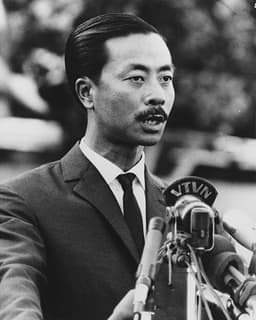
Nguyen Cao Ky
General · Modern
49.0Total
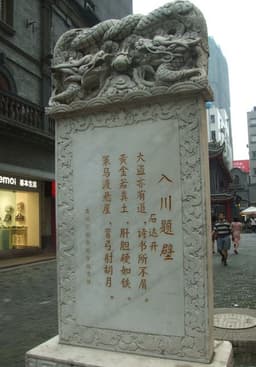
Shi Dakai
General · Modern
59.6Total
Basic Information
Born
1930
1831
Died
—
1863
Era
Modern
Modern
Nationality
Vietnam
China
Occupation
General
General
Civilization
Eastern
Eastern
Score Comparison
Military (10%)
45.0
76.0
Political (20%)
39.4
45.0
Influence (20%)
50.2
56.7
Legacy (20%)
40.0
54.0
Leadership (15%)
67.0
72.0
Strategy (15%)
60.0
68.1
TOTAL
49.0
59.6
Nguyen Cao Ky — Complete Timeline
1963 AD
Commander of South Vietnamese Air ForcePolitical Action◆ Major
Nguyen Cao Ky was appointed commander of the Republic of Vietnam Air Force. He led the air force during the Buddhist crisis and participated in the coup that overthrew President Ngo Dinh Diem.
Air ForceCoupDiem
Impact: national
1965 AD
Appointed Prime MinisterPolitical Action◆ Major
Nguyen Cao Ky became Prime Minister of South Vietnam, leading a military junta. His government intensified the war against the Viet Cong and North Vietnam, with strong US support.
Prime MinisterMilitary juntaVietnam War
Impact: national
1967 AD
Conflict with President ThieuPolitical Action
Nguyen Cao Ky ran for president but lost to Nguyen Van Thieu, becoming vice president. The two leaders had a tense relationship, with Ky later accusing Thieu of corruption and mismanagement of the war.
ElectionThieuRivalry
Impact: nationaldestructive
1975 AD
Exile after fall of SaigonPolitical Action◆ Major
Nguyen Cao Ky fled South Vietnam as Saigon fell to North Vietnamese forces. He settled in the United States, where he became a critic of the communist government and later returned to Vietnam for visits.
ExileFall of SaigonVietnam War
Impact: nationaltragic
Shi Dakai — Complete Timeline
1851 AD
Jintian UprisingWar◆ Major
Shi Dakai joined the Taiping Rebellion at its inception in Jintian, Guangxi. As a core leader, he helped organize the rebel forces and was appointed Wing King, becoming one of the key military commanders of the Taiping Heavenly Kingdom.
Taiping RebellionUprisingMilitary Command
Impact: national
1854 AD
Battle of XiangtanWar◆ Major
Shi Dakai led Taiping forces to a major victory at Xiangtan, Hunan, defeating Qing imperial troops. This battle secured Taiping control over key territories in the Yangtze River valley and demonstrated his military skill.
Taiping RebellionBattleVictory
Impact: regional
1856 AD
Tianjing IncidentPolitical Action
Shi Dakai returned to Tianjing (Nanjing) after the internal purge of the Eastern King Yang Xiuqing and the murder of the Northern King Wei Changhui. He condemned the violence and was forced to flee, leading to a split in Taiping leadership.
Taiping RebellionInternal ConflictPurge
Impact: nationaltragic
1858 AD
Campaign in Zhejiang and FujianWar
Shi Dakai led a separate Taiping army into Zhejiang and Fujian provinces, capturing several cities. This campaign expanded Taiping influence into southeastern China but also isolated his forces from the main Taiping base.
Taiping RebellionCampaignExpansion
Impact: regional
1863 AD
Battle of Baishui RiverWar◆ Major
Shi Dakai's army was trapped and defeated by Qing forces at the Baishui River in Sichuan. He was captured and executed shortly after, marking the end of his military career and a significant loss for the Taiping cause.
Taiping RebellionBattleDefeatDeath
Impact: nationaltragic
Expert Analysis
Shi Dakai vs Nguyen Cao Ky
# The General Who Couldn't Win the Peace
On a sweltering June morning in 1965, Nguyen Cao Ky stepped before the world's cameras in Saigon, a silk scarf knotted at his throat and a pearl-handled revolver on his hip. He was thirty-four years old, the youngest prime minister in South Vietnam's turbulent history, and he looked every bit the fighter pilot he had been. Half a world away and a century earlier, another young commander found himself in a different kind of struggle. Shi Dakai, the Wing King of the Taiping Heavenly Kingdom, was then leading his armies through the gorges of Sichuan, his reputation for military brilliance already legendary. Both men rose from the chaos of civil war, both commanded loyalty and fear, and both saw their dreams end in exile or execution. But why did one become a footnote and the other a symbol of tragic nobility?
Origins
Nguyen Cao Ky was born in 1930 into a wealthy landowning family in northern Vietnam, a world of French colonial privilege where ambition was expected and rebellion was unthinkable. He trained as a pilot in France and Morocco, mastering the art of aerial combat in an era when air power was reshaping warfare. His Vietnam was a country fractured by colonialism, communism, and a Cold War that would consume his generation. He was a product of the elite—confident, flamboyant, and utterly convinced that modern technology and American support could defeat any enemy.
Shi Dakai came from a different soil. Born in 1831 in Guangxi, a mountainous region of southern China, he grew up in a world of peasant poverty, Confucian hierarchy, and simmering resentment against the corrupt Qing dynasty. He was educated in the classics but found his calling in the Taiping Rebellion, a millenarian movement that promised to overthrow the Manchus and establish a Heavenly Kingdom of peace and equality. Where Ky was shaped by Western military academies and jet fighters, Shi was forged in the crucible of peasant armies, guerrilla tactics, and a faith that God was on his side.
Rise to Power
Ky’s ascent was vertical and violent. In 1963, at just thirty-three, he was appointed commander of the South Vietnamese Air Force, a position that gave him the power to bomb his enemies—and his rivals. He led the bombing of Buddhist dissidents in Hue, a decision that deepened the country’s wounds. Two years later, he became prime minister, the face of a military junta that promised order but delivered only more war. His path was paved with American dollars and a conviction that force could solve everything.
Shi Dakai’s rise was slower, more organic, and earned through blood. He joined the Taiping Rebellion at its inception in 1851, the Jintian Uprising, and quickly distinguished himself as a commander of rare skill. At the Battle of Xiangtan in 1854, he crushed Qing forces and secured Hunan for the Heavenly Kingdom. He was not just a general; he was a king, one of the five original princes of the Taiping court, a man whose name inspired both terror and devotion. His power came from loyalty earned on the battlefield, not from a coup in a capital.
Leadership & Governance
Here the two men diverge most sharply. Ky governed by fear and charisma. He was a man of style—the black flight suit, the defiant swagger—but his substance was thin. His government intensified the war, relied on American bombing, and alienated the Buddhist majority. He had no vision beyond victory, and when he ran for president in 1967, he lost to Nguyen Van Thieu, a more cautious rival. As vice president, he fumed in the shadows, a pilot without a plane.
Shi Dakai governed by principle and competence. As a military leader, he was a master of maneuver—his campaign in Zhejiang and Fujian in 1858 showed a strategic mind that could outthink any Qing general. But he was also a voice for moderation within the Taiping court, warning against the fanaticism that would destroy his kingdom. After the Tianjing Incident of 1856, when the Eastern King Yang Xiuqing was purged and the Western King Wei Changhui was murdered, Shi returned to find his movement in ruins. He tried to restore unity, but the bloodletting had already poisoned everything.
Triumph & Tragedy
Ky’s greatest moment was probably his survival. He fled Saigon in 1975, just hours before the city fell, and settled in the United States, where he opened a liquor store in California and wrote a memoir. His tragedy was not his exile but his irrelevance—a man who had once commanded air forces ended his days selling wine to strangers, a ghost of a lost war.
Shi Dakai’s tragedy was far more epic. In 1863, after years of wandering with his own army, he was trapped by Qing forces at the Baishui River in Sichuan. He could have fought to the death, but instead he surrendered, hoping to spare his men. The Qing executed him slowly, by the thousand cuts, a death that became legend. His final act was not one of weakness but of terrible mercy—a leader who chose to die so that his soldiers might live.
Character & Destiny
Ky was a man of action, not reflection. He lived by the code of the fighter pilot: speed, aggression, and a refusal to look back. This made him effective in the air but disastrous on the ground, where politics required patience and compromise. His flamboyance was a mask for insecurity—he needed to be seen as strong because he feared being seen as weak.
Shi Dakai was a man of conscience in a movement of fanatics. He believed in the Heavenly Kingdom’s ideals—land reform, equality, the overthrow of tyranny—but he also saw the corruption and cruelty that came with power. His tragedy was that he was too good for his cause. He could win battles, but he could not win the peace, because the peace he wanted was impossible in a world of war.
Legacy
Today, Nguyen Cao Ky is remembered, if at all, as a footnote to the Vietnam War—a colorful, tragic figure who represented the failure of American-backed leadership. His score of 56.0 in legacy reflects a life that ended not with a bang but a whimper.
Shi Dakai lives on in Chinese memory as a hero of tragic nobility. His military brilliance—scored at 84.6—is still studied, and his death is remembered as a symbol of loyalty and sacrifice. He is the Wing King who could not save his kingdom but who never betrayed his honor.
Conclusion
The difference between these two generals is not just in their scores or their fates. It lies in the nature of their struggles. Ky fought for a country that was already lost, a puppet state in a proxy war. Shi fought for a dream—a Heavenly Kingdom that might have been, if only the dreamers had been as pure as their faith. One man was destroyed by history; the other was ennobled by it. In the end, the general who could not win the peace may have been the greater soul, because he knew that some victories are not worth the price, and some defeats are the truest victories of all.
Rankings
🥇
Shi DakaiLeader
Mil: 76.0Pol: 45.0Inf: 56.7
59.6
🥈
Nguyen Cao Ky
Mil: 45.0Pol: 39.4Inf: 50.2
49.0
+10.6 behind
How This Comparison Works
Algorithm
Each figure is scored on 6 dimensions (0—100 scale) based on structured historical data: Military (10%), Political (20%), Influence (20%), Legacy (20%), Leadership (15%), Strategy (15%). The weighted total produces the final ranking.
Data Sources
Scores are computed from structured sub-indicators in the database. Scale factors adjust for era (Ancient ×0.85, Modern ×1.0) and civilization size (Eastern ×1.05, Other ×0.80) to account for differences in population and military scale.
Maximum 3 Figures
Comparisons are limited to 2—3 figures to ensure readability and statistical meaningfulness.
Error Margins
±5 points per dimension — Sub-scores are derived from historical records with inherent uncertainty. Two figures within 5 points on a dimension should be considered roughly equivalent in that area.
Total Score Accuracy
±3 points overall — The weighted combination of 6 dimensions produces a total score with approximately ±3 points of uncertainty. Differences of less than 3 points are not statistically significant— the figures are effectively tied.
Known Limitations
- Historical records are incomplete and uneven across civilizations
- Figures from oral-tradition societies may be underrepresented
- Occupation labels can misclassify multi-role figures
- Scores measure capability and impact, not moral character
- Quantitative scoring is a comparison tool, not absolute truth
Capability Radar
Military (10%) — Battles & Warfare
Battles
30
75
Win Rate
35
70
Expansion
10
75
Political (20%) — Governance & Reform
Reform
20
50
Diplomacy
25
45
Economy
15
40
Influence (20%) — Cultural & Global Reach
Cultural
15
55
Global
15
40
Legacy (20%) — Historical Impact
Historical
20
60
Longevity
10
45
Leadership (15%) — Power & Stability
Tenure
40
55
Stability
10
35
Strategy (15%) — Tactics & Innovation
Strategy
30
80
Tactics
40
85
Reform
25
60
Similar Comparisons
Comments & Discussion
WingedBrokenSword6/16/2026
Shi Dakai was the real military genius, not some American puppet in silk pajamas. When Ky fled Saigon in 1975, he left with his tail between his legs—meanwhile, Shi sacrificed himself at Dadu River to save his men from annihilation. That's honor, not headlines. Ky couldn't even hold the Mekong Delta. Shi held the Yangtze. One fought for Heaven, the other for a U.S. embassy passport. Who's the real warlord here?
丝绸神话6/16/2026
阮高其就是个穿飞行员夹克的戏精。他在西贡搞政变的时候,石达开已经在四川打出了"万人敌"的名号。Ky靠美国飞机炸弹撑腰,石达开用大刀长矛打出太平军最辉煌的战绩。大渡河一战,石达开为三千将士甘愿就戮;Ky呢?1975年坐美国直升机跑得比兔子还快。历史从来公平:英雄死于战场,小丑逃上直升机。
AceOfCaudillo6/16/2026
Let's be real—Ky’s pearl-handled revolver and silk scarf were pure performative machismo, a poor man's Latin American dictator cosplay. He had the air force, U.S. backing, and still lost to the Viet Cong. Shi Dakai didn't have a single aircraft or Western ally, but he bloodied the Qing for a decade. Ky's wild-card coup culture ruined South Vietnam's stability. Shi's "no retreat" stand at Dadu earned him martyrs' legends. One died a footnote, the other a poem.
红翼黑星6/16/2026
表面看都是年轻将领,骨子里差个太平洋。石达开十六岁就带兵,天京事变后单枪匹马撑住太平天国半壁江山;阮高其不过是法国殖民教育和美式装备堆出来的空中少爷。Ky在岘港搞政变时,石达开早就在湖南练出了令清军胆寒的"翼军"。更讽刺的是:石达开最终败于洪水,Ky则败于自己人。一个被命运捉弄,一个被野心吞噬。
DataDriftSkeptic6/16/2026
Forget the poetry—let’s compare kill ratios. Shi Dakai’s Taiping forces often faced 10:1 odds and still won Xiangtan, Baoning. Ky’s ARVN air support had 500% superiority over Viet Cong, yet he couldn't pacify a single province. One man’s legacy is built on genuine tactical overperformance; the other’s career was propped up by CIA paychecks and propaganda. Put Ky in Shi’s shoes—no jets, no napalm—he’d surrender in a week. Facts don’t weep.