Loading...
Mswati III vs Oscar II
Oscar II leads by 8.5 pts · 2 figures compared
…
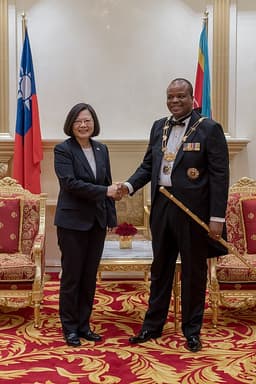
Mswati III
Emperor · Modern
39.0Total

Oscar II
Emperor · Modern
47.5Total
Basic Information
Born
1968
1829
Died
—
1907
Era
Modern
Modern
Nationality
Eswatini
Sweden
Occupation
Emperor
Emperor
Civilization
Other
Western
Score Comparison
Military (10%)
14.6
25.9
Political (20%)
26.4
46.6
Influence (20%)
48.6
49.4
Legacy (20%)
35.8
39.2
Leadership (15%)
64.3
65.0
Strategy (15%)
28.0
60.0
TOTAL
39.0
47.5
Mswati III — Complete Timeline
1986 AD
Coronation as King of SwazilandPolitical Action◆ Major
Mswati III was crowned king of Swaziland at age 18, ending a four-year regency. His coronation continued the absolute monarchy established by his father Sobhuza II.
CoronationSuccessionMonarchy
Impact: national
2000 AD
HIV/AIDS Crisis ResponsePolitical Action◆ Major
Mswati III faced criticism for his response to the HIV/AIDS epidemic, which infected over 25% of Eswatini's population. He declared a national emergency but was accused of insufficient action and spending on royal luxuries.
Public HealthHIV/AIDSCriticism
Impact: nationaltragic
2018 AD
Renaming of Swaziland to EswatiniPolitical Action◆ Major
Mswati III officially renamed the Kingdom of Swaziland to the Kingdom of Eswatini, meaning 'land of the Swazis,' to mark 50 years of independence and shed colonial-era names.
RenamingNational IdentityDecolonization
Impact: nationalconstructive
2021 AD
Constitutional Crisis and Pro-Democracy ProtestsPolitical Action◆ Major
Mswati III faced widespread pro-democracy protests demanding political reforms and an end to absolute monarchy. Security forces cracked down, resulting in dozens of deaths and arrests. The protests were the largest in Eswatini's history.
ProtestsDemocracy MovementRepression
Impact: nationaldestructive
2022 AD
Polygamy and Royal Expenditure ControversyCultural
Mswati III's multiple marriages and lavish spending on royal palaces and cars drew criticism amid poverty in Eswatini. He defended polygamy as a cultural tradition but faced accusations of misusing public funds.
PolygamyRoyal SpendingControversy
Impact: national
Oscar II — Complete Timeline
1880 AD
Patronage of the arts and sciencesCultural
Oscar II was a noted patron of the arts and sciences. He supported the Swedish Academy, the Royal Swedish Academy of Sciences, and various cultural institutions. He also personally funded expeditions, such as the Vega Expedition, which completed the first navigation of the Northeast Passage.
SwedenCultureSciencePatronage
Impact: nationalconstructive
1901 AD
Defense reform and military modernizationReform◆ Major
Oscar II oversaw a major reform of the Swedish military, introducing universal conscription and modernizing the army and navy. This was in response to the changing geopolitical situation in Europe and aimed at maintaining Sweden's neutrality and defense capabilities.
SwedenMilitaryConscriptionReform
Impact: nationalconstructive
1905 AD
Dissolution of the union with NorwayPolitical Action
Oscar II was the last king of the united kingdoms of Sweden and Norway. After a political crisis, the Norwegian parliament unilaterally declared the dissolution of the union. Oscar II accepted the separation peacefully, abdicating his claim to the Norwegian throne and recognizing Norway's independence.
SwedenNorwayUnionIndependence
Impact: regional
Expert Analysis
Origins
Mswati III was born on April 19, 1968, in Manzini, Swaziland (now Eswatini), the son of King Sobhuza II and one of his many wives, Ntfombi Tfwala. He was chosen as crown prince in 1982 after his father's death, but a regency ruled until he turned 18. His education included secondary school in Swaziland and military training in the United Kingdom. Oscar II, born Oscar Fredrik on January 21, 1829, in Stockholm, was the third son of King Oscar I of Sweden and Josephine of Leuchtenberg. He studied at Uppsala University and had a military education, serving as a naval officer. His older brothers' early deaths placed him in line for the throne.
Rise to Power
Mswati III was crowned King of Swaziland on April 25, 1986, at age 18, ending a four-year regency led by his mother and a council. He inherited an absolute monarchy established by his father, who had ruled for 61 years. His rise was uncontested due to the traditional Swazi system. Oscar II became king on September 18, 1872, upon the death of his brother King Charles XV. He had previously served as crown prince and was involved in politics. His accession occurred during a period of constitutional development and rising tensions with Norway, which was in a personal union with Sweden.
Leadership & Governance
Mswati III rules as an absolute monarch, wielding executive, legislative, and judicial powers. He appoints the prime minister and cabinet, controls the military, and can veto legislation. His governance is traditional, relying on the Swazi National Council and customary law. He faced criticism for his response to the HIV/AIDS epidemic, which infected over 25% of Eswatini's population, and for lavish spending on palaces and cars while poverty persists. Oscar II ruled as a constitutional monarch, with power limited by parliament. He oversaw defense reforms, introducing universal conscription and modernizing the military, scoring 65.0 in leadership. His political score of 46.6 reflects his role in navigating the Norwegian crisis, though he ultimately accepted the dissolution of the union in 1905.
Triumph & Tragedy
Mswati III's triumphs include maintaining the absolute monarchy and cultural traditions, such as the Umhlanga Reed Dance, and renaming the country to Eswatini in 2018. However, his reign has been marred by the HIV/AIDS crisis, with life expectancy dropping to 49 years, and pro-democracy protests in 2021 that were met with a security crackdown resulting in deaths. His military score is low at 14.6, reflecting no significant military achievements. Oscar II's triumphs include modernizing Sweden's military and fostering cultural patronage, supporting the Swedish Academy and Nobel Prize ceremonies. His tragedy was the dissolution of the union with Norway in 1905, which he opposed but could not prevent. He scored 60.0 in strategy, showing diplomatic acumen in avoiding war.
Character & Destiny
Mswati III is characterized by a commitment to absolute power and tradition, often dismissing calls for democracy as foreign influences. His multiple marriages (over 15 wives) and expenditures have drawn criticism, but he remains popular in rural areas. His destiny is tied to the survival of absolute monarchy in a democratizing world. Oscar II was known for his intelligence, literary interests, and diplomatic skills. He authored books on history and military topics. His destiny was to preside over a peaceful transition to constitutional monarchy and the end of the Swedish-Norwegian union, scoring 49.4 in influence for his role in cultural and political life.
Legacy
Mswati III's legacy is mixed: he is one of the last absolute monarchs in Africa, but his rule has been associated with human rights abuses and economic stagnation. Eswatini remains a low-income country with high inequality. Oscar II is remembered as the last king of the united Sweden and Norway, and for his patronage of the arts and sciences. His legacy includes the modern Swedish military and the peaceful dissolution of the union. He scored 39.2 in legacy, reflecting his historical role in Scandinavian unity and cultural advancement.
Conclusion
Oscar II had greater impact than Mswati III, with a total score of 47.5 to 39.0. While Mswati III maintains a traditional monarchy, Oscar II navigated constitutional change and modernization, leaving a legacy of peace and cultural enrichment. Oscar II's political and strategic scores (46.6 and 60.0) outweigh Mswati III's political score of 26.4 and strategy of 28.0. Oscar II's leadership (65.0) is comparable to Mswati III's (64.3), but his broader influence and lasting contributions to Swedish society and Scandinavian relations give him the edge.
Rankings
🥇
Oscar IILeader
Mil: 25.9Pol: 46.6Inf: 49.4
47.5
🥈
Mswati III
Mil: 14.6Pol: 26.4Inf: 48.6
39.0
+8.5 behind
How This Comparison Works
Algorithm
Each figure is scored on 6 dimensions (0—100 scale) based on structured historical data: Military (10%), Political (20%), Influence (20%), Legacy (20%), Leadership (15%), Strategy (15%). The weighted total produces the final ranking.
Data Sources
Scores are computed from structured sub-indicators in the database. Scale factors adjust for era (Ancient ×0.85, Modern ×1.0) and civilization size (Eastern ×1.05, Other ×0.80) to account for differences in population and military scale.
Maximum 3 Figures
Comparisons are limited to 2—3 figures to ensure readability and statistical meaningfulness.
Error Margins
±5 points per dimension — Sub-scores are derived from historical records with inherent uncertainty. Two figures within 5 points on a dimension should be considered roughly equivalent in that area.
Total Score Accuracy
±3 points overall — The weighted combination of 6 dimensions produces a total score with approximately ±3 points of uncertainty. Differences of less than 3 points are not statistically significant— the figures are effectively tied.
Known Limitations
- Historical records are incomplete and uneven across civilizations
- Figures from oral-tradition societies may be underrepresented
- Occupation labels can misclassify multi-role figures
- Scores measure capability and impact, not moral character
- Quantitative scoring is a comparison tool, not absolute truth
Capability Radar
Military (10%) — Battles & Warfare
Battles
7
34
Win Rate
11
37
Expansion
10
44
Political (20%) — Governance & Reform
Reform
10
30
Diplomacy
20
40
Economy
15
30
Influence (20%) — Cultural & Global Reach
Cultural
20
20
Global
10
15
Legacy (20%) — Historical Impact
Historical
10
25
Longevity
15
20
Leadership (15%) — Power & Stability
Tenure
38
35
Stability
25
45
Strategy (15%) — Tactics & Innovation
Strategy
14
46
Tactics
19
50
Reform
20
51
Similar Comparisons
Comments & Discussion
No comments yet. Be the first to share your thoughts!