Loading...
Mswati III vs Napoleon Bonaparte
Napoleon Bonaparte leads by 31.9 pts · 2 figures compared
…
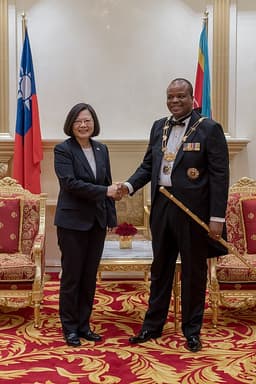
Mswati III
Emperor · Modern
39.0Total

Napoleon Bonaparte
General · Modern
70.9Total
Basic Information
Born
1968
1769
Died
—
1821
Era
Modern
Modern
Nationality
Eswatini
France
Occupation
Emperor
General
Civilization
Other
Western
Score Comparison
Military (10%)
14.6
94.0
Political (20%)
26.4
72.0
Influence (20%)
48.6
40.0
Legacy (20%)
35.8
80.0
Leadership (15%)
64.3
78.0
Strategy (15%)
28.0
90.0
TOTAL
39.0
70.9
Mswati III — Complete Timeline
1986 AD
Coronation as King of SwazilandPolitical Action◆ Major
Mswati III was crowned king of Swaziland at age 18, ending a four-year regency. His coronation continued the absolute monarchy established by his father Sobhuza II.
CoronationSuccessionMonarchy
Impact: national
2000 AD
HIV/AIDS Crisis ResponsePolitical Action◆ Major
Mswati III faced criticism for his response to the HIV/AIDS epidemic, which infected over 25% of Eswatini's population. He declared a national emergency but was accused of insufficient action and spending on royal luxuries.
Public HealthHIV/AIDSCriticism
Impact: nationaltragic
2018 AD
Renaming of Swaziland to EswatiniPolitical Action◆ Major
Mswati III officially renamed the Kingdom of Swaziland to the Kingdom of Eswatini, meaning 'land of the Swazis,' to mark 50 years of independence and shed colonial-era names.
RenamingNational IdentityDecolonization
Impact: nationalconstructive
2021 AD
Constitutional Crisis and Pro-Democracy ProtestsPolitical Action◆ Major
Mswati III faced widespread pro-democracy protests demanding political reforms and an end to absolute monarchy. Security forces cracked down, resulting in dozens of deaths and arrests. The protests were the largest in Eswatini's history.
ProtestsDemocracy MovementRepression
Impact: nationaldestructive
2022 AD
Polygamy and Royal Expenditure ControversyCultural
Mswati III's multiple marriages and lavish spending on royal palaces and cars drew criticism amid poverty in Eswatini. He defended polygamy as a cultural tradition but faced accusations of misusing public funds.
PolygamyRoyal SpendingControversy
Impact: national
Napoleon Bonaparte — Complete Timeline
1799 AD
Coup of 18 BrumaireOther◆ Major
Napoleon Bonaparte, with support from his brother Lucien and key political figures, overthrew the Directory in a bloodless coup. He established the Consulate with himself as First Consul, effectively becoming the ruler of France. This event ended the French Revolution's most unstable period.
French RevolutionCoupRise to Power
Impact: regional
1804 AD
Promulgation of the Napoleonic CodeOther◆ Major
Napoleon enacted the Civil Code of the French, known as the Napoleonic Code, a comprehensive set of laws that replaced the fragmented feudal legal systems. The code established legal equality, protected property rights, and secularized law. It became the basis for legal systems in many European and world countries.
Legal ReformNapoleonic CodeCivil Law
Impact: globalconstructive
1805 AD
Battle of AusterlitzWar◆ Major
Napoleon's Grande Arm
Napoleonic WarsBattleDecisive Victory
Impact: global
1812 AD
Invasion of RussiaWar◆ Major
Napoleon led the Grande Arm
Napoleonic WarsInvasionDisaster
Impact: globaldestructive
1815 AD
Battle of WaterlooWar◆ Major
Napoleon's French army was defeated by the combined forces of the Duke of Wellington's Anglo-Allied army and Gebhard Leberecht von Bl
Napoleonic WarsBattleFinal Defeat
Impact: globaldestructive
Expert Analysis
mswati-iii-vs-napoleon-bonaparte
# The Emperor and the King: Two Faces of Absolute Power
On a June morning in 1815, Napoleon Bonaparte stood on a muddy field near Waterloo, watching his Imperial Guard march into cannon fire for the last time. Nearly two centuries later, in a small kingdom in southern Africa, another absolute ruler faced a different kind of battlefield—not of muskets and cavalry, but of protesters demanding democracy and a global health crisis that would kill a quarter of his people. One man conquered Europe; the other struggles to hold together a nation of 1.2 million. What separates these two figures, both born to rule with unchallenged authority, is not just time or geography, but the very nature of power itself.
Origins
Napoleon Bonaparte was born in 1769 on the island of Corsica, a place that had only recently become French. His family was minor nobility, but they were poor, and young Napoleon grew up with a chip on his shoulder—a sense that he had to prove himself to a continent that looked down on him. He entered a military academy at age nine, where his classmates mocked his Corsican accent. That humiliation forged something in him: a burning ambition to rise so high that no one could ever look down on him again.
Mswati III was born in 1968 into a very different world. His father, King Sobhuza II, had ruled Swaziland for over sixty years, and the throne was never in doubt. Young Mswati grew up in the royal palace, surrounded by tradition and ceremony. He was educated in England, but when his father died in 1982, a regency ruled for four years until he turned eighteen. In 1986, he was crowned king of Swaziland, inheriting absolute power without ever having to fight for it.
Rise to Power
Napoleon’s ascent was a masterpiece of opportunism. He rose through the ranks during the chaos of the French Revolution, a time when old hierarchies crumbled and a young artillery officer could become a general at twenty-four. In 1796, he took command of the French army in Italy and stunned Europe with a series of lightning campaigns. By 1799, he had seized control of France itself in a coup d'état, declaring himself First Consul. Five years later, he crowned himself Emperor in Notre Dame Cathedral, taking the crown from the Pope’s hands and placing it on his own head.
Mswati III’s path was the opposite. He did not seize power; it was handed to him. When he was crowned in 1986, the ceremonies followed ancient rituals—dancing warriors, sacred cattle, the blessing of ancestral spirits. He became not just a political ruler but a living symbol of Swazi nationhood, a position that carried immense traditional authority but also immense constraints. He could not reinvent himself; he had to embody continuity.
Leadership & Governance
Napoleon governed with the energy of a man who believed he could reshape the world through sheer will. He reformed French law with the Napoleonic Code, standardizing justice across a fractured nation. He built roads, established the Bank of France, and created a system of lycées—state-run schools—to train a new elite. His military genius was undeniable: he won sixty battles, from Austerlitz in 1805 to Jena in 1806, and at his peak, he ruled an empire that stretched from Spain to Poland. His political score of 75 reflects real administrative achievement, but his leadership score of 80 shows a man who demanded absolute loyalty and punished dissent.
Mswati III governs in a smaller, more fragile context. He rules Eswatini—renamed from Swaziland in 2018—as an absolute monarch in a constitutional age. His military score of 14.6 is negligible; he has never led an army in battle. His political score of 46.8 reflects a ruler caught between tradition and modernity. He has faced criticism for his response to the HIV/AIDS crisis, which by 2000 infected over 25% of his people. His multiple marriages and lavish spending on palaces and cars have drawn sharp criticism in a country where poverty is widespread. In 2021, pro-democracy protests erupted, demanding an end to absolute monarchy. His leadership score of 72.2 suggests he maintains authority, but it is the authority of survival, not conquest.
Triumph & Tragedy
Napoleon’s greatest triumph was Austerlitz, where he destroyed a combined Russian and Austrian army in a single day. His most devastating failure was the invasion of Russia in 1812. He marched with 600,000 men; he returned with fewer than 100,000. The Russian winter, the scorched-earth tactics, and his own overreach destroyed the Grand Army. He was exiled to Elba in 1814, escaped in 1815, and was finally defeated at Waterloo. He died in 1821 on the remote island of Saint Helena, a prisoner of the British.
Mswati III’s triumphs are quieter. He has maintained the monarchy in an era when absolute rulers have been swept aside across Africa. His legacy score of 46.7 is still being written, but his greatest tragedy may be the HIV/AIDS crisis—a catastrophe that, by some measures, cut life expectancy in Eswatini to under 50 years. He has also faced the tragedy of irrelevance: a king who commands no armies, conquers no lands, and whose power rests on tradition in a world that increasingly questions tradition.
Character & Destiny
Napoleon was driven by an insatiable hunger for glory. “I am not a man,” he once said, “but a thing.” He saw himself as an instrument of destiny, and his personality—brilliant, ruthless, arrogant—shaped every decision. His strategy score of 93 reflects a mind that could calculate odds faster than any opponent, but his total score of 82.4 is tempered by his inability to stop. He could conquer but could not consolidate.
Mswati III’s character is harder to read. He has not written memoirs or fought epic battles. His strategy score of 65.8 suggests a cautious ruler, one who navigates between the demands of his people and the expectations of the international community. He is not a conqueror; he is a survivor. His destiny is not to reshape the world but to hold his small kingdom together.
Legacy
Napoleon’s legacy is immense. The Napoleonic Code influenced legal systems across Europe and the Americas. His military campaigns are still studied in war colleges. His influence score of 82 reflects a man who changed the course of history. But his legacy is also contested: he restored slavery in French colonies, suppressed women’s rights, and left Europe scarred by war.
Mswati III’s legacy is uncertain. He may be remembered as the king who kept tradition alive in a modern world, or as a ruler who failed his people in a time of crisis. His influence score of 64 suggests he matters, but how much remains to be seen.
Conclusion
In the end, these two rulers illuminate a profound truth about power. Napoleon’s power was built on conquest, ambition, and the force of his own genius. He rose from nothing and almost conquered everything. Mswati III’s power is inherited, traditional, and fragile—a crown passed down through centuries, now tested by democracy, disease, and poverty. One shaped an era; the other is shaped by it. Both remind us that absolute power, whether won by the sword or born in the blood, is never truly absolute. It depends on the world around it—and that world is always changing.
Rankings
🥇
Napoleon BonaparteLeader
Mil: 94.0Pol: 72.0Inf: 40.0
70.9
🥈
Mswati III
Mil: 14.6Pol: 26.4Inf: 48.6
39.0
+31.9 behind
How This Comparison Works
Algorithm
Each figure is scored on 6 dimensions (0—100 scale) based on structured historical data: Military (10%), Political (20%), Influence (20%), Legacy (20%), Leadership (15%), Strategy (15%). The weighted total produces the final ranking.
Data Sources
Scores are computed from structured sub-indicators in the database. Scale factors adjust for era (Ancient ×0.85, Modern ×1.0) and civilization size (Eastern ×1.05, Other ×0.80) to account for differences in population and military scale.
Maximum 3 Figures
Comparisons are limited to 2—3 figures to ensure readability and statistical meaningfulness.
Error Margins
±5 points per dimension — Sub-scores are derived from historical records with inherent uncertainty. Two figures within 5 points on a dimension should be considered roughly equivalent in that area.
Total Score Accuracy
±3 points overall — The weighted combination of 6 dimensions produces a total score with approximately ±3 points of uncertainty. Differences of less than 3 points are not statistically significant— the figures are effectively tied.
Known Limitations
- Historical records are incomplete and uneven across civilizations
- Figures from oral-tradition societies may be underrepresented
- Occupation labels can misclassify multi-role figures
- Scores measure capability and impact, not moral character
- Quantitative scoring is a comparison tool, not absolute truth
Capability Radar
Military (10%) — Battles & Warfare
Battles
7
95
Win Rate
11
90
Expansion
10
95
Political (20%) — Governance & Reform
Reform
10
95
Diplomacy
20
80
Economy
15
85
Influence (20%) — Cultural & Global Reach
Cultural
20
85
Global
10
90
Legacy (20%) — Historical Impact
Historical
10
95
Longevity
15
90
Leadership (15%) — Power & Stability
Tenure
38
85
Stability
25
70
Strategy (15%) — Tactics & Innovation
Strategy
14
95
Tactics
19
98
Reform
20
92
Similar Comparisons
Comments & Discussion
King's Gambit6/17/2026
Comparing Mswati III to Napoleon is like comparing a game of Risk to actual war. Napoleon built an empire through extraordinary military skill—he won 60 battles and created the Napoleonic Code that still influences law today. Mswati inherited a throne and spends $100 million on palaces while his people face a 56% HIV rate. One earned his power through genius and sacrifice; the other just had the right father.
帝国计算器6/17/2026
数据不会撒谎。拿破仑在1807年控制7千万欧洲人时,斯威士兰现在只有120万人口。拿破仑每年军费占GDP的15%,打赢50多场战役;姆斯瓦蒂三世2023年个人预算占国家收入10%,却连抗疫都搞砸了。这不是比较历史地位,是在比谁是更称职的统治者——答案明显到不需要讨论。
Classics Pedant6/17/2026
Both claimed divine right, but Napoleon’s legitimacy came from the people via plebiscite (99.9% approval in 1804), not birth. He secularized government and spread meritocracy. Mswati III operates under a 1968 constitution that still bans political parties—an anachronism in the 21st century. Napoleon at least modernized Europe; Mswati III preserves feudalism. There’s a moral difference between building a new order and obstructing progress.
废墟考古者6/17/2026
拿破仑的失败叫滑铁卢,姆斯瓦蒂的失败叫"没有继承人问题"。拿破仑死后有人在圣赫勒拿岛发现他的《圣赫勒拿回忆录》,写了上千页反思;姆斯瓦蒂三世的"反思"可能只有他第15任妻子的嫁妆清单。一个在流放中思考历史,一个在豪华轿车里思考选妃——权力的重量完全不同。