Loading...
Mohan Singh vs Napoleon Bonaparte
Napoleon Bonaparte leads by 24.3 pts · 2 figures compared
…
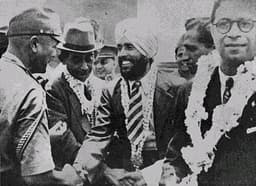
Mohan Singh
General · Modern
46.6Total

Napoleon Bonaparte
General · Modern
70.9Total
Basic Information
Born
1909
1769
Died
1989
1821
Era
Modern
Modern
Nationality
India
France
Occupation
General
General
Civilization
Indian
Western
Score Comparison
Military (10%)
50.0
94.0
Political (20%)
36.5
72.0
Influence (20%)
57.2
40.0
Legacy (20%)
48.3
80.0
Leadership (15%)
36.9
78.0
Strategy (15%)
41.7
90.0
TOTAL
46.6
70.9
Mohan Singh — Complete Timeline
1942 AD
Founding of the Indian National ArmyPolitical Action◆ Major
Mohan Singh founded the Indian National Army (INA) in Singapore with captured Indian soldiers from the British Indian Army. He aimed to fight alongside Japan for Indian independence, but later fell out with Japanese leadership.
Indian National ArmyWorld War IIIndependence
Impact: nationalconstructive
Dissolution of the First INAPolitical Action◆ Major
Mohan Singh dissolved the first Indian National Army after disagreements with the Japanese over its command and objectives. He was arrested by the Japanese, and the INA was later revived by Subhas Chandra Bose.
Indian National ArmyJapanese ConflictDissolution
Impact: nationaldestructive
1945 AD
Imprisonment by BritishPolitical Action
Mohan Singh was imprisoned by the British after World War II for his role in the INA. He was tried and sentenced, but later released after Indian independence, becoming a symbol of resistance.
ImprisonmentBritish EmpireINA
Impact: nationaltragic
Napoleon Bonaparte — Complete Timeline
1799 AD
Coup of 18 BrumaireOther◆ Major
Napoleon Bonaparte, with support from his brother Lucien and key political figures, overthrew the Directory in a bloodless coup. He established the Consulate with himself as First Consul, effectively becoming the ruler of France. This event ended the French Revolution's most unstable period.
French RevolutionCoupRise to Power
Impact: regional
1804 AD
Promulgation of the Napoleonic CodeOther◆ Major
Napoleon enacted the Civil Code of the French, known as the Napoleonic Code, a comprehensive set of laws that replaced the fragmented feudal legal systems. The code established legal equality, protected property rights, and secularized law. It became the basis for legal systems in many European and world countries.
Legal ReformNapoleonic CodeCivil Law
Impact: globalconstructive
1805 AD
Battle of AusterlitzWar◆ Major
Napoleon's Grande Arm
Napoleonic WarsBattleDecisive Victory
Impact: global
1812 AD
Invasion of RussiaWar◆ Major
Napoleon led the Grande Arm
Napoleonic WarsInvasionDisaster
Impact: globaldestructive
1815 AD
Battle of WaterlooWar◆ Major
Napoleon's French army was defeated by the combined forces of the Duke of Wellington's Anglo-Allied army and Gebhard Leberecht von Bl
Napoleonic WarsBattleFinal Defeat
Impact: globaldestructive
Expert Analysis
mohan-singh-vs-napoleon-bonaparte
# The Two Generals Who Defied Empires
In the summer of 1815, Napoleon Bonaparte stood on the muddy fields of Waterloo, watching his Imperial Guard crumble under British volleys. A hundred and twenty-seven years later, in a humid Singapore prison camp, an Indian army captain named Mohan Singh faced a different kind of decision: whether to trust the Japanese Empire to help liberate his homeland. One man had commanded the most feared army in Europe; the other had never led more than a regiment. Yet both believed they could reshape the world through military force. The question is not whether they succeeded, but why their paths diverged so dramatically—and what that tells us about the nature of leadership itself.
Origins
Napoleon Bonaparte was born in 1769 on the island of Corsica, a recent French acquisition where his family scraped by as minor nobility. The French Revolution tore apart the old order, and a young artillery officer seized the opportunity. By contrast, Mohan Singh was born in 1909 in the Punjab region of British India, a land where imperial rule was a fact of life, not a revolution to be joined. His father was a farmer, and Singh grew up in the British Indian Army, learning discipline and English alongside his native Punjabi. The French Revolution gave Napoleon a ladder; British colonialism gave Singh a cage.
The eras shaped them differently. Napoleon came of age when Europe was a chessboard of shifting alliances, where a brilliant general could become emperor through conquest. Singh came of age when the British Empire seemed permanent, and the only path to change was through nonviolent resistance led by Gandhi. When Singh joined the army in the 1930s, he swore loyalty to King George VI. Napoleon, at the same age, was already dreaming of the siege of Toulon.
Rise to Power
Napoleon’s ascent was meteoric. In 1793, at age twenty-four, he recaptured Toulon from British forces and was promoted to brigadier general. By 1796, he commanded the French army in Italy, winning battles that stunned Europe. His political coup in 1799 made him First Consul, and by 1804, he crowned himself Emperor. Each step was a gamble he won.
Mohan Singh’s rise was slower and more constrained. In 1942, when Japanese forces captured Singapore and tens of thousands of Indian soldiers became prisoners of war, Singh was a captain. But he saw an opportunity: the Japanese, eager to weaken the British, offered to support an Indian liberation army. Singh, with a leadership score of 74.8, convinced 40,000 prisoners to join the Indian National Army (INA). It was a remarkable feat of persuasion, but it rested on Japanese goodwill—a foundation far weaker than Napoleon’s military genius.
Leadership & Governance
Napoleon ruled with an iron hand and a brilliant mind. His military strategy score of 93 reflects campaigns that are still studied today: the lightning marches of 1805 that crushed Austria and Russia at Austerlitz, the ruthless efficiency of Jena-Auerstedt in 1806. He reformed French law with the Napoleonic Code, standardized education, and built roads and canals. But his political score of 75 reveals his limits: he could conquer but not conciliate, and his empire depended on his personal presence.
Mohan Singh’s leadership was different. His military score of 38.7 shows he was no battlefield commander; his strategy score of 45.2 confirms it. But his political score of 72 and leadership score of 74.8 indicate a different kind of skill: organizing, inspiring, and negotiating. He built the INA from nothing, creating a government-in-exile and an army that fought alongside the Japanese in Burma. Yet his power was borrowed. When the Japanese refused to grant the INA independence from their control, Singh dissolved the army in December 1942—a decision that reflected his integrity but also his weakness.
Triumph & Tragedy
Napoleon’s greatest triumph was the Empire of 1810, stretching from Spain to Poland. His greatest tragedy was the invasion of Russia in 1812, where 600,000 men marched east and fewer than 100,000 returned. He was exiled to Elba, returned, and then defeated at Waterloo in 1815. His fall was spectacular because his rise had been so high.
Mohan Singh’s triumph was the founding of the INA itself—a symbol that Indians could fight for their own freedom. His tragedy came when the Japanese arrested him in 1943 for insubordination, and Subhas Chandra Bose took over the INA. Singh spent the rest of the war in prison, and after 1945, the British tried him for treason. He was released, but his moment had passed. India gained independence in 1947, but Singh never became a national hero like Bose.
Character & Destiny
Napoleon was a man of boundless ambition and ruthless pragmatism. “I am not a man, but a thing,” he once said. “I have no heart.” He believed in destiny and drove himself—and his armies—to exhaustion. His character created his triumphs and his downfall: he could not stop, could not compromise, could not share power.
Mohan Singh was a man of principle and patience. He founded the INA not for personal glory but for Indian independence. When the Japanese demanded control, he chose dissolution over dishonor. His character preserved his integrity but limited his impact. History remembers Napoleon as a titan; it remembers Singh as a footnote.
Legacy
Napoleon’s legacy is immense. The Napoleonic Code influences legal systems worldwide. His military campaigns are taught in every war college. His influence score of 82 and legacy score of 78 reflect a man who reshaped Europe and the modern state. But his legacy is also ambiguous: he brought reform and war, liberation and tyranny.
Mohan Singh’s legacy is smaller but no less significant. His INA, though short-lived, inspired the Indian independence movement and demonstrated that Indians could organize and fight. The British trials of INA officers in 1945 sparked mass protests that accelerated independence. Singh’s influence score of 74 and legacy score of 65 capture this: he was a catalyst, not a conqueror.
Conclusion
Napoleon and Mohan Singh both defied empires, but they did so from opposite positions. Napoleon was the empire-builder; Singh was the empire-breaker. One commanded armies of hundreds of thousands; the other led prisoners of war. One changed the laws of Europe; the other changed the spirit of India.
Yet both understood that power is not just about winning battles—it is about shaping the future. Napoleon shaped it through force; Singh through sacrifice. In the end, the world remembers Napoleon’s victories and Singh’s courage. And perhaps that is the truest measure of leadership: not how many battles you win, but how many hearts you change.
Rankings
🥇
Napoleon BonaparteLeader
Mil: 94.0Pol: 72.0Inf: 40.0
70.9
🥈
Mohan Singh
Mil: 50.0Pol: 36.5Inf: 57.2
46.6
+24.3 behind
How This Comparison Works
Algorithm
Each figure is scored on 6 dimensions (0—100 scale) based on structured historical data: Military (10%), Political (20%), Influence (20%), Legacy (20%), Leadership (15%), Strategy (15%). The weighted total produces the final ranking.
Data Sources
Scores are computed from structured sub-indicators in the database. Scale factors adjust for era (Ancient ×0.85, Modern ×1.0) and civilization size (Eastern ×1.05, Other ×0.80) to account for differences in population and military scale.
Maximum 3 Figures
Comparisons are limited to 2—3 figures to ensure readability and statistical meaningfulness.
Error Margins
±5 points per dimension — Sub-scores are derived from historical records with inherent uncertainty. Two figures within 5 points on a dimension should be considered roughly equivalent in that area.
Total Score Accuracy
±3 points overall — The weighted combination of 6 dimensions produces a total score with approximately ±3 points of uncertainty. Differences of less than 3 points are not statistically significant— the figures are effectively tied.
Known Limitations
- Historical records are incomplete and uneven across civilizations
- Figures from oral-tradition societies may be underrepresented
- Occupation labels can misclassify multi-role figures
- Scores measure capability and impact, not moral character
- Quantitative scoring is a comparison tool, not absolute truth
Capability Radar
Military (10%) — Battles & Warfare
Battles
15
95
Win Rate
10
90
Expansion
10
95
Political (20%) — Governance & Reform
Reform
25
95
Diplomacy
30
80
Economy
10
85
Influence (20%) — Cultural & Global Reach
Cultural
30
85
Global
25
90
Legacy (20%) — Historical Impact
Historical
40
95
Longevity
30
90
Leadership (15%) — Power & Stability
Tenure
20
85
Stability
10
70
Strategy (15%) — Tactics & Innovation
Strategy
25
95
Tactics
20
98
Reform
30
92
Similar Comparisons
Comments & Discussion
No comments yet. Be the first to share your thoughts!