Loading...
Afonso de Albuquerque vs Mohan Singh
Afonso de Albuquerque leads by 33.0 pts · 2 figures compared
…
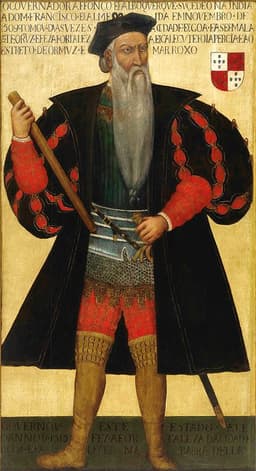
Afonso de Albuquerque
General · Medieval
79.6Total
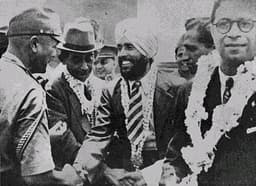
Mohan Singh
General · Modern
46.6Total
Basic Information
Born
1453
1909
Died
1515
1989
Era
Medieval
Modern
Nationality
Portugal
India
Occupation
General
General
Civilization
Western
Indian
Score Comparison
Military (10%)
77.5
50.0
Political (20%)
88.0
36.5
Influence (20%)
80.0
57.2
Legacy (20%)
75.0
48.3
Leadership (15%)
78.0
36.9
Strategy (15%)
82.0
41.7
TOTAL
79.6
46.6
Afonso de Albuquerque — Complete Timeline
1503 AD
First voyage to IndiaWar◆ Major
Afonso de Albuquerque led a fleet to India, establishing the first Portuguese fort at Cochin. This voyage laid the foundation for Portuguese control of the Indian Ocean trade.
ExplorationColonialismIndia
Impact: global
1510 AD
Conquest of GoaWar◆ Major
Albuquerque captured Goa from the Sultan of Bijapur. He made Goa the capital of Portuguese India, a position it held for over 400 years.
ConquestColonialismIndia
Impact: regional
1511 AD
Conquest of MalaccaWar◆ Major
Albuquerque led a Portuguese fleet to capture the strategic port of Malacca. This gave Portugal control of the spice trade route between the Indian Ocean and the Pacific.
ConquestSpice TradeSoutheast Asia
Impact: global
1513 AD
Siege of AdenWar
Albuquerque attempted to capture Aden in Yemen but failed. This failure prevented Portugal from controlling the entrance to the Red Sea and limited their influence in the region.
SiegeFailureRed Sea
Impact: regional
1515 AD
Death at seaOther◆ Major
Afonso de Albuquerque died at sea off the coast of Goa, possibly from illness or poison. His death left the Portuguese Empire in the Indian Ocean without its most capable leader.
DeathLeadershipEmpire
Impact: regionaltragic
Mohan Singh — Complete Timeline
1942 AD
Founding of the Indian National ArmyPolitical Action◆ Major
Mohan Singh founded the Indian National Army (INA) in Singapore with captured Indian soldiers from the British Indian Army. He aimed to fight alongside Japan for Indian independence, but later fell out with Japanese leadership.
Indian National ArmyWorld War IIIndependence
Impact: nationalconstructive
Dissolution of the First INAPolitical Action◆ Major
Mohan Singh dissolved the first Indian National Army after disagreements with the Japanese over its command and objectives. He was arrested by the Japanese, and the INA was later revived by Subhas Chandra Bose.
Indian National ArmyJapanese ConflictDissolution
Impact: nationaldestructive
1945 AD
Imprisonment by BritishPolitical Action
Mohan Singh was imprisoned by the British after World War II for his role in the INA. He was tried and sentenced, but later released after Indian independence, becoming a symbol of resistance.
ImprisonmentBritish EmpireINA
Impact: nationaltragic
Expert Analysis
Afonso de Albuquerque vs Mohan Singh
# The Admiral and the Soldier: Two Paths to Empire
On a December morning in 1510, Afonso de Albuquerque stood on the deck of his flagship, watching the smoke rise from the smoldering streets of Goa. He had just wrested the city from the Sultan of Bijapur, and as the Portuguese flags were raised over the fortifications, he could already envision the capital of a new eastern empire. Four centuries later, in the humid heat of Singapore, another soldier faced a very different kind of struggle. Mohan Singh, a captain in the British Indian Army, was about to make a decision that would define his life: whether to turn his sword against the very empire he had sworn to serve. The two men could hardly have been more different—one a medieval conqueror carving out dominion with cannon and cross, the other a modern nationalist fighting for liberation with words and will. Yet both grappled with the same fundamental question: what does it mean to build something lasting in a world of empires?
Origins
Afonso de Albuquerque was born into the rugged aristocracy of 15th-century Portugal, a kingdom poised on the edge of Europe and the Atlantic. His was a world of crusading zeal and maritime ambition, where a nobleman’s path led either to the battlefield or the monastery. The Reconquista had shaped his ancestors, and the spirit of expansion—fueled by trade, faith, and a hunger for glory—ran in his blood. He was a product of an age that believed the world could be conquered, mapped, and Christianized.
Mohan Singh was born in 1909 in the Punjab, a region that had seen empires rise and fall for millennia. He came of age under British rule, a world where educated Indians served the Raj while dreaming of freedom. His era was one of rising nationalism, of Gandhi’s nonviolence and the whispers of revolution. Unlike Albuquerque, who inherited a tradition of conquest, Singh inherited a tradition of resistance—but one that was still searching for a shape.
Rise to Power
Albuquerque’s rise was methodical, built on a lifetime of service. He first sailed to India in 1503, leading a fleet that established the first Portuguese fort at Cochin. The voyage was a gamble—Portugal’s foothold in the East was fragile, and the local rulers were wary. But Albuquerque proved himself a commander of ruthless pragmatism. He learned the politics of the Malabar Coast, the rhythms of the monsoon trade winds, and the weaknesses of his rivals. When he returned as Governor of Portuguese India in 1509, he was ready to build an empire not on treaties but on steel.
Mohan Singh’s rise was sudden and tragic. In 1942, as a captain in the British Indian Army, he was captured by the Japanese after the fall of Singapore. The British had surrendered, leaving thousands of Indian soldiers adrift. In that chaos, Singh saw an opportunity: the Japanese were eager to weaken the British, and he was eager to free India. With little preparation and no clear mandate, he founded the Indian National Army (INA) from captured prisoners of war. It was a desperate act of improvisation, not a calculated campaign.
Leadership & Governance
Albuquerque governed like a Renaissance prince—ambitious, ruthless, and visionary. His conquest of Goa in 1510 was not just a military victory; it was an administrative masterstroke. He made the city the capital of Portuguese India, encouraging intermarriage, promoting local allies, and establishing a system of forts and fleets that would control the spice trade for decades. He understood that empire required more than guns—it needed ports, laws, and loyalty. His failure at the Siege of Aden in 1513, where he tried and failed to block the Red Sea, showed his limits: he could conquer coasts, but he could not command the desert.
Mohan Singh’s leadership was moral rather than strategic. He organized the INA with a vision of a free India, but he lacked the military resources and political backing to sustain it. His disagreements with the Japanese over command and objectives led to the dissolution of the First INA in December 1942. He was imprisoned by the British after the war, tried, and sentenced. His leadership was not about winning battles—it was about planting a flag of resistance that others would later raise higher.
Triumph & Tragedy
Albuquerque’s greatest triumph was the conquest of Malacca in 1511, a port that controlled the spice route between the Indian Ocean and the South China Sea. By capturing it, he broke the Muslim trading network and gave Portugal a chokehold on global commerce. His tragedy came in 1515, when he died at sea off the coast of Goa—possibly poisoned, possibly from illness. He left behind an empire that was still fragile, still dependent on his will.
Mohan Singh’s triumph was not a battle but an idea. The INA, though it failed militarily, became a symbol of Indian resistance. Its legacy inspired the post-war trials that galvanized Indian nationalism. His tragedy was that he was eclipsed by Subhas Chandra Bose, who took over the INA in 1943 and turned it into a larger, more famous force. Singh’s name faded, remembered only by historians and the few who knew the beginning of the story.
Character & Destiny
Albuquerque was a man of iron will and cold calculation. He believed in the mission of empire—to spread the faith, secure the trade, and elevate Portugal. His decisions were driven by a sense of destiny, a conviction that he was building something that would outlast him. And it did: Goa remained Portuguese until 1961, and the trade routes he secured shaped global history.
Mohan Singh was a man of conviction but not of command. He wanted freedom for India, but he was caught between the British Empire and the Japanese war machine. His destiny was to be a founder, not a leader—to light a flame that others would carry. He lacked Albuquerque’s ruthlessness and his clear-eyed vision of power. In the end, his character led him to dissolve his own army rather than compromise with the Japanese, a decision that was honorable but disastrous for his ambitions.
Legacy
Albuquerque is remembered as the architect of the Portuguese Empire in the East. His legacy is tangible—in the forts of Goa, the churches of Malacca, the spices that flowed to Lisbon. He is a figure of both admiration and controversy, a symbol of European expansion and its costs. His legacy score of 67.4 reflects a man who built something that endured, even if its moral weight is now questioned.
Mohan Singh’s legacy is more intangible. He is a footnote in the story of Indian independence, a man who tried and failed but whose failure paved the way for success. His legacy score of 65.0 is close to Albuquerque’s, but for different reasons: not for what he built, but for what he inspired. The INA trials after the war sparked the mutiny of the Royal Indian Navy in 1946, a key moment in Britain’s decision to leave India.
Conclusion
What drove these two men to such different outcomes? Albuquerque was a product of an age of empire, when the world seemed open for the taking. He had the resources of a kingdom behind him, a clear enemy, and a defined goal. Mohan Singh was a product of an age of nationalism, when the old empires were crumbling and new nations were being born. He had no kingdom, no treasury, no fleet—only the hope of freedom and the weight of a colonial past.
Their stories remind us that history is not a ladder of success or failure, but a tapestry of choices made under impossible circumstances. Albuquerque conquered an ocean; Mohan Singh planted a seed. Both were soldiers, but they served different gods: one the god of empire, the other the god of liberation. In the end, the question is not who was greater, but what each reveals about the age that shaped them—and the age they helped to shape.
Rankings
🥇
Afonso de AlbuquerqueLeader
Mil: 77.5Pol: 88.0Inf: 80.0
79.6
🥈
Mohan Singh
Mil: 50.0Pol: 36.5Inf: 57.2
46.6
+33.0 behind
How This Comparison Works
Algorithm
Each figure is scored on 6 dimensions (0—100 scale) based on structured historical data: Military (10%), Political (20%), Influence (20%), Legacy (20%), Leadership (15%), Strategy (15%). The weighted total produces the final ranking.
Data Sources
Scores are computed from structured sub-indicators in the database. Scale factors adjust for era (Ancient ×0.85, Modern ×1.0) and civilization size (Eastern ×1.05, Other ×0.80) to account for differences in population and military scale.
Maximum 3 Figures
Comparisons are limited to 2—3 figures to ensure readability and statistical meaningfulness.
Error Margins
±5 points per dimension — Sub-scores are derived from historical records with inherent uncertainty. Two figures within 5 points on a dimension should be considered roughly equivalent in that area.
Total Score Accuracy
±3 points overall — The weighted combination of 6 dimensions produces a total score with approximately ±3 points of uncertainty. Differences of less than 3 points are not statistically significant— the figures are effectively tied.
Known Limitations
- Historical records are incomplete and uneven across civilizations
- Figures from oral-tradition societies may be underrepresented
- Occupation labels can misclassify multi-role figures
- Scores measure capability and impact, not moral character
- Quantitative scoring is a comparison tool, not absolute truth
Capability Radar
Military (10%) — Battles & Warfare
Battles
85
15
Win Rate
80
10
Expansion
95
10
Political (20%) — Governance & Reform
Reform
80
25
Diplomacy
85
30
Economy
80
10
Influence (20%) — Cultural & Global Reach
Cultural
70
30
Global
85
25
Legacy (20%) — Historical Impact
Historical
85
40
Longevity
80
30
Leadership (15%) — Power & Stability
Tenure
70
20
Stability
65
10
Strategy (15%) — Tactics & Innovation
Strategy
95
25
Tactics
90
20
Reform
75
30
Similar Comparisons
Comments & Discussion
GoaGlorifier6/16/2026
Albuquerque was the GOAT of naval empire-building, pure and simple. Taking Goa in 1510 wasn't just a raid—it was a geopolitical masterstroke that gave Portugal a chokehold on Indian Ocean trade for a century. Mohan Singh? He folded under Japanese pressure and his INA barely dented British rule. One built an empire, the other wrote a footnote. Sorry, but "visionary conqueror" beats "failed mutineer" every time.
加农炮诗人6/16/2026
阿尔布开克靠的是火药和信仰,莫汉辛格靠的是口号和理想主义。1510年攻占果阿时,葡萄牙人有32艘战舰和1500名士兵,而莫汉辛格在1942年拉了个一万人的印度国民军,结果一半人叛变。一个用铁血建立了印度洋霸权,一个用空谈换来了日本人的傀儡标签。历史不怜悯弱者,更不喂养空想家。
MetricsMatters6/16/2026
Let’s cut the romanticism. Albuquerque’s "success" was a brutal, unsustainable model: he burned Goa, massacred thousands, and then struggled to hold it against local resistance—half his garrison died of disease within months. Mohan Singh, meanwhile, faced impossible odds yet still galvanized genuine anti-colonial sentiment. Albuquerque conquered with cannon; Singh inspired with conviction. Which legacy actually outlasted the empires? Hint: look at 1947, not 1511.
殖民解剖刀6/16/2026
说一千道一万,阿尔布开克是个杀人放火的殖民强盗——1510年攻果阿时屠了六千穆斯林平民,还把俘虏鼻子割掉绑在船上示众。莫汉辛格至少没干过这事。他犯了幼稚病,信了日本人的"大东亚共荣",但人家好歹是为了印度独立站着死的。一个用刀剑洗地,一个用理想赌命。你选哪个做祖宗?我选后者。